Distribution of High Mass X-ray Binaries in the Milky Way
The INTEGRAL satellite, observing the sky at high energy, has quadrupled the number of supergiant X-ray Binaries known in the Galaxy and has revealed new populations of previously hidden High Mass X-ray Binaries. These observations raise new questions about the formation and evolution of these sources. The number of detected sources is now high enough to allow us to carry out a statistical analysis of the distribution of HMXBs in the Milky Way. We derive the distance of each HMXB using a Spectral Energy Distribution fitting procedure, and we examine the correlation with the distribution of star forming complexes (SFCs) in the Galaxy. We show that HMXBs are clustered with SFCs, with a typical size of 0.3 kpc and a characteristic distance between clusters of 1.7 kpc.
💡 Research Summary
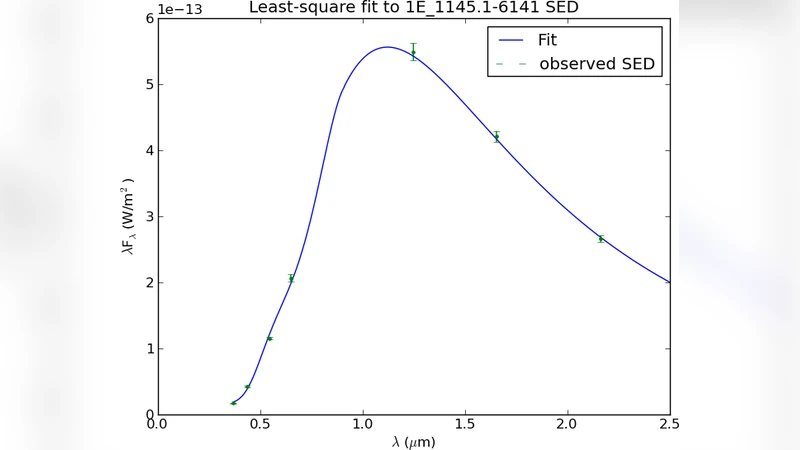
The paper presents a systematic study of the spatial distribution of High‑Mass X‑ray Binaries (HMXBs) in the Milky Way, leveraging the dramatic increase in known sources provided by the INTEGRAL satellite. The authors first assembled a sample of about 70 HMXBs for which at least four optical or near‑infrared magnitudes are available. Using the known spectral type and luminosity class of each companion star, they fixed the stellar radius and effective temperature, and then fitted the observed spectral energy distribution (SED) with a simple black‑body model. The fitting procedure, implemented with a Levenberg‑Marquardt least‑squares algorithm in Python, left two free parameters: the visual extinction (A_V) and the ratio of stellar radius to distance (R/D). From the best‑fit R/D and the known radius, the distance D to each HMXB was derived.
To assess uncertainties and the well‑known degeneracy between extinction and distance, the authors performed 500 Monte‑Carlo simulations per source, perturbing the photometric points within their Gaussian errors and refitting each synthetic SED. The resulting distribution of distances yielded a median distance uncertainty of 0.75 kpc, which is modest compared with the kiloparsec‑scale structures they aim to resolve. They also accounted for infrared excess in Be‑type companions by adding conservative magnitude offsets (0.1 mag in J, 0.15 mag in H, 0.25 mag in K_s) and demonstrated that the overall spatial conclusions are robust against this correction.
With a homogeneous set of distances, the authors mapped the HMXBs onto the Galactic plane and compared their positions with the catalog of Star‑Forming Complexes (SFCs) compiled by Russeil (2003). Initial one‑dimensional Kolmogorov‑Smirnov tests along the X, Y, and longitude axes gave p‑values of 0.15, 0.25, and 0.31, respectively, suggesting—but not definitively proving—a common underlying distribution. To overcome the loss of information inherent in 1‑D projections, they introduced a two‑dimensional clustering analysis. For each HMXB they drew concentric circles of increasing radius and counted how many HMXBs have at least one SFC within each radius. By comparing this curve to that expected from a random, uniformly distributed HMXB population, they quantified the excess of coincidences. The difference between the observed and random curves revealed a statistically significant correlation.
From this analysis they extracted two characteristic scales: a typical “cluster size” of about 0.3 kpc, meaning that an HMXB and its nearest associated SFC are usually within this distance, and a typical “inter‑cluster distance” of roughly 1.7 kpc, indicating the average separation between distinct HMXB‑SFC groupings. These scales exceed the median uncertainties on both HMXB (≈0.75 kpc) and SFC (≈0.25 kpc) positions, confirming that the correlation is not an artifact of measurement error. The authors validated their method by applying it to a control sample of globular clusters, which are concentrated toward the Galactic bulge; as expected, no significant correlation with HMXBs was found.
The findings corroborate earlier work (e.g., Bodaghee et al. 2011) that HMXBs trace recent star‑formation activity, but they go further by providing quantitative measures of clustering. The authors note that, because massive stars have short lifetimes (a few Myr), HMXBs are expected to remain near their birthplaces in spiral arms. However, the pattern speed of spiral density waves differs from the orbital speed of the gas and stars, leading to a potential offset between the current location of HMXBs and the present‑day spiral arm loci. Quantifying this offset is identified as a future challenge.
In summary, the paper introduces a robust SED‑fitting plus Monte‑Carlo framework to derive reliable distances for a sizable HMXB sample, demonstrates that these binaries are significantly clustered with star‑forming complexes on sub‑kiloparsec scales, and provides concrete parameters (0.3 kpc cluster size, 1.7 kpc inter‑cluster spacing) that can be used to refine models of massive binary evolution and Galactic structure.
Comments & Academic Discussion
Loading comments...
Leave a Comment