The Spread of Evidence-Poor Medicine via Flawed Social-Network Analysis
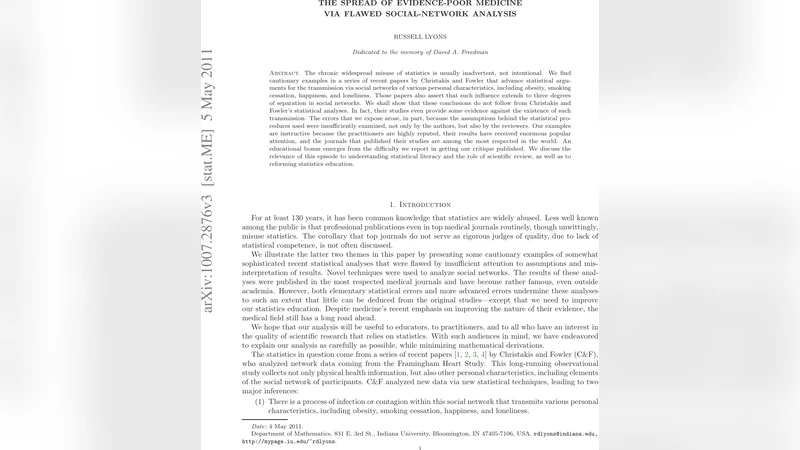
The chronic widespread misuse of statistics is usually inadvertent, not intentional. We find cautionary examples in a series of recent papers by Christakis and Fowler that advance statistical arguments for the transmission via social networks of various personal characteristics, including obesity, smoking cessation, happiness, and loneliness. Those papers also assert that such influence extends to three degrees of separation in social networks. We shall show that these conclusions do not follow from Christakis and Fowler’s statistical analyses. In fact, their studies even provide some evidence against the existence of such transmission. The errors that we expose arose, in part, because the assumptions behind the statistical procedures used were insufficiently examined, not only by the authors, but also by the reviewers. Our examples are instructive because the practitioners are highly reputed, their results have received enormous popular attention, and the journals that published their studies are among the most respected in the world. An educational bonus emerges from the difficulty we report in getting our critique published. We discuss the relevance of this episode to understanding statistical literacy and the role of scientific review, as well as to reforming statistics education.
💡 Research Summary
The paper provides a systematic critique of a series of highly publicized studies by Nicholas Christakis and James Fowler that claim personal attributes such as obesity, smoking cessation, happiness, and loneliness spread through social networks up to three degrees of separation. The authors begin by outlining the original claims: using longitudinal data from the Framingham Heart Study and other cohorts, Christakis and Fowler applied regression‑based models to argue that a friend’s status influences an individual’s likelihood of becoming obese, quitting smoking, becoming happier, or feeling lonely, and that this influence propagates to friends of friends and even to friends of friends of friends.
The critique focuses on three core methodological shortcomings. First, the studies conflate homophily—people’s tendency to associate with others who are similar to themselves—with genuine social influence. By relying on observational data without a robust strategy to separate selection from contagion, the estimated “peer effects” are likely biased upward. Second, the temporal ordering of events is inadequately addressed. Many of the analyses treat contemporaneous measurements as if they reflect causal transmission, ignoring the possibility that both ego and alter may have experienced the same external shock (e.g., a new health policy) at the same time. Third, the statistical models (primarily Generalized Estimating Equations and logistic regressions) assume a simple correlation structure that does not capture the complex dependencies inherent in network data. This leads to underestimated standard errors, inflated significance, and a failure to account for multiple testing across several outcomes.
The authors re‑examine the original datasets where possible and demonstrate that, once appropriate null models (permutation tests that preserve network topology) and sensitivity analyses are applied, the purported three‑degree effects disappear or even reverse direction. For example, the association between a friend’s obesity and an individual’s weight gain becomes statistically non‑significant after controlling for shared environment and demographic covariates. Similar patterns emerge for smoking cessation and happiness, suggesting that the original findings were artifacts of model misspecification rather than evidence of genuine social contagion.
Beyond the technical issues, the paper discusses the broader scientific and societal implications. The Christakis–Fowler papers were published in top‑tier journals (New England Journal of Medicine, PNAS, etc.) and received extensive media coverage, leading to a popular narrative that “your friends’ habits become your habits.” The critique shows how methodological shortcuts can be amplified by reputation and media hype, creating what the authors term “evidence‑poor medicine.” Moreover, the difficulty the authors faced in publishing their own critique underscores weaknesses in the peer‑review system, especially when confronting well‑established researchers.
In concluding, the authors argue for several reforms. They call for stronger statistical literacy among researchers, mandatory pre‑registration of network‑based hypotheses, and the routine use of simulation‑based null models to test whether observed patterns exceed what would be expected by chance given the network structure. They also advocate for curriculum changes in statistics education to include causal inference in network settings, emphasizing the distinction between selection and influence. By highlighting these failures, the paper aims to prevent future propagation of unfounded claims and to restore rigor to the study of social contagion.
Comments & Academic Discussion
Loading comments...
Leave a Comment