Contact-Density Analysis of Lattice Polymer Adsorption Transitions
By means of contact-density chain-growth simulations, we investigate a simple lattice model of a flexible polymer interacting with an attractive substrate. The contact density is a function of the numbers of monomer-substrate and monomer-monomer contacts. These contact numbers represent natural order parameters and allow for a comprising statistical study of the conformational space accessible to the polymer in dependence of external parameters such as the attraction strength of the substrate and the temperature. Since the contact density is independent of the energy scales associated to the interactions, its logarithm is an unbiased measure for the entropy of the conformational space. By setting explicit energy scales, the thus defined, highly general microcontact entropy can easily be related to the microcanonical entropy of the corresponding hybrid polymer-substrate system.
💡 Research Summary
The paper presents a comprehensive microcanonical study of the adsorption transition of a flexible polymer on an attractive planar substrate using a lattice model and a novel contact‑density chain‑growth simulation technique. The polymer is modeled as an interacting self‑avoiding walk (ISAW) on a simple cubic lattice with N = 250 monomers. Two natural order parameters are introduced: the number of non‑bonded nearest‑neighbor monomer‑monomer contacts (n_m) and the number of monomer‑substrate contacts (n_s). The total energy of a conformation is expressed as E = −n_m − ε n_s, where ε controls the relative strength of surface attraction. An additional steric wall at z = L_z = 300 confines the polymer perpendicular to the substrate but does not graft it, allowing free movement between the substrate and the wall.
To obtain a scale‑free description, the authors perform simulations in a generalized ensemble that samples uniformly over the two‑dimensional space of contact numbers (n_m, n_s). This is achieved with the contact‑density chain‑growth algorithm, which combines Rosenbluth‑Rosenbluth chain growth, population control (pruning and enrichment), and multicanonical sampling. The direct output is the absolute contact density g(n_m, n_s), i.e., the exact degeneracy of each (n_m, n_s) macrostate. Taking the logarithm yields the micro‑contact entropy S(n_m, n_s) = k_B ln g, which is independent of any specific energy scale.
By assigning a concrete value to ε, the microcanonical entropy for that model is reconstructed as
S_ε(E) = k_B ln ∑{n_m,n_s} δ{E,−n_m−ε n_s} g(n_m, n_s).
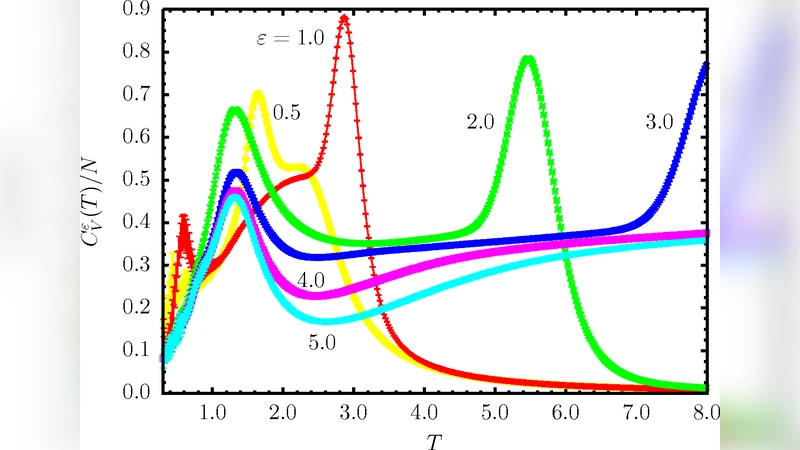
Thus a single simulation provides S_ε(E) for any ε without additional computational effort. The authors display entropy curves for ε ranging from 0.5 to 40.0. For ε < 1.0 the ground‑state entropy is relatively high because the polymer adopts compact three‑dimensional droplet conformations that maximize monomer‑monomer contacts. For ε ≥ 1.0 the ground state becomes a two‑dimensional film lying on the substrate; surface contacts dominate, the entropy plateaus, and the ground‑state energy scales linearly with ε (E_0 ≈ −N ε). The transition from three‑ to two‑dimensional ground states is accompanied by a stepwise increase in entropy as ε decreases, reflecting layering (dewetting) effects.
Microcanonical analysis reveals a convex intruder in S_ε(E) for the finite polymer, indicating a first‑order‑like transition with phase coexistence between adsorbed and desorbed states. The transition temperature can be extracted from the double‑tangent construction on the entropy curve. From the reconstructed density of states g_ε(E) = exp
Comments & Academic Discussion
Loading comments...
Leave a Comment