Unbounded Contention Resolution in Multiple-Access Channels
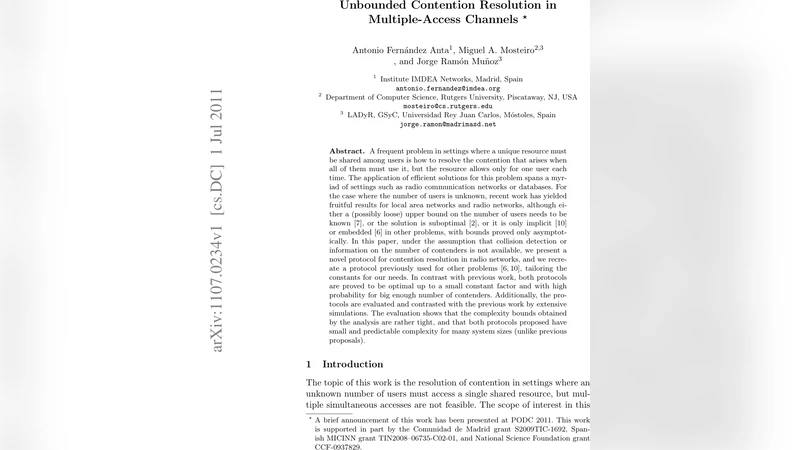
A frequent problem in settings where a unique resource must be shared among users is how to resolve the contention that arises when all of them must use it, but the resource allows only for one user each time. The application of efficient solutions for this problem spans a myriad of settings such as radio communication networks or databases. For the case where the number of users is unknown, recent work has yielded fruitful results for local area networks and radio networks, although either a (possibly loose) upper bound on the number of users needs to be known, or the solution is suboptimal, or it is only implicit or embedded in other problems, with bounds proved only asymptotically. In this paper, under the assumption that collision detection or information on the number of contenders is not available, we present a novel protocol for contention resolution in radio networks, and we recreate a protocol previously used for other problems, tailoring the constants for our needs. In contrast with previous work, both protocols are proved to be optimal up to a small constant factor and with high probability for big enough number of contenders. Additionally, the protocols are evaluated and contrasted with the previous work by extensive simulations. The evaluation shows that the complexity bounds obtained by the analysis are rather tight, and that both protocols proposed have small and predictable complexity for many system sizes (unlike previous proposals).
💡 Research Summary
The paper addresses the classic contention‑resolution problem in a single‑hop radio network where a shared channel can carry at most one transmission per time slot. Unlike most prior work, the authors assume no collision detection and no prior knowledge of either the total number of stations (n) or the number of active stations (k). The focus is on the static k‑selection problem: k nodes each hold a message that arrives simultaneously, and the goal is to have every node successfully transmit at least once.
Two randomized protocols are introduced, both of which achieve optimal Θ(k) time up to constant factors with high probability, while requiring no information about n or k.
-
One‑fail Adaptive
- The protocol interleaves two sub‑algorithms, AT (high‑contention phase) and BT (low‑contention phase).
- AT maintains an estimator e^κ of the remaining number of messages. In each AT slot a node transmits with probability 1/e^κ and then increments κ, thereby gradually decreasing the transmission probability as contention is expected to drop.
- BT is invoked on even‑numbered slots; it uses the count σ of already‑received messages and transmits with probability 1/(1+log(σ+1)).
- Upon any successful reception, the estimator is pulled down by a constant δ (chosen so that e < δ ≤ ∏_{j=1}^5 (5/6)^j). This “pull‑back” step prevents the estimator from growing too large after a burst of collisions.
- The authors prove that One‑fail Adaptive finishes in at most 2(δ+1)·k + O(log²k) slots, and succeeds with probability 1 − 2/(k+1), i.e., high‑probability for any k.
-
Exp Back‑on/Back‑off
- This protocol adopts the “saw‑tooth” technique previously used as a sub‑routine in other works, but the authors give a full analysis without assuming knowledge of n.
- Initially the transmission probability is set relatively high to quickly discover a successful slot. After each failure the probability is exponentially decreased (back‑off). When a success is observed, the protocol backs on by increasing the probability again, creating a non‑monotonic schedule that adapts to the unknown contention level.
- With a suitable choice of the back‑off constant δ (0 < δ < 1/e), the protocol guarantees completion within 4(1 + 1/δ)·k slots and succeeds with probability 1 − 1/k^c for some constant c > 0, again a high‑probability guarantee.
Both protocols improve over earlier solutions that either required an upper bound on n (e.g., Log‑fails Adaptive) or achieved only sub‑optimal asymptotic factors (e.g., Loglog‑iterated Back‑off). The key technical contribution is the explicit constant‑factor analysis that shows the protocols are not just asymptotically optimal but also practically tight.
The paper includes an extensive simulation study covering k ranging from 10³ to 10⁶. Results show:
- Average runtime – One‑fail Adaptive and Exp Back‑on/Back‑off consistently beat Loglog‑iterated Back‑off by 30‑40 % and dominate Log‑fails Adaptive for k > 10⁵, where the latter’s runtime grows dramatically.
- Stability – Both new protocols exhibit a smooth, predictable runtime curve across all tested k, whereas the older protocols display large variance depending on the hidden n.
- Reliability – Empirical failure probabilities stay below 10⁻⁶, matching the theoretical high‑probability guarantees.
The authors conclude that contention resolution without collision detection and without any a‑priori size information is feasible with simple, constant‑factor‑optimal randomized algorithms. They suggest future work on extending the techniques to multi‑channel settings, handling asynchronous arrivals, incorporating energy‑aware back‑off schedules, and defending against adversarial nodes. Overall, the paper provides both a solid theoretical foundation and convincing empirical evidence that the proposed protocols are ready for deployment in real‑world radio networks where hardware constraints preclude collision detection and where network scale cannot be assumed.
Comments & Academic Discussion
Loading comments...
Leave a Comment