How Not to Characterize Planar-emulable Graphs
We investigate the question of which graphs have planar emulators (a locally-surjective homomorphism from some finite planar graph) – a problem raised already in Fellows’ thesis (1985) and conceptually related to the better known planar cover conjecture by Negami (1986). For over two decades, the planar emulator problem lived poorly in a shadow of Negami’s conjecture–which is still open–as the two were considered equivalent. But, in the end of 2008, a surprising construction by Rieck and Yamashita falsified the natural “planar emulator conjecture”, and thus opened a whole new research field. We present further results and constructions which show how far the planar-emulability concept is from planar-coverability, and that the traditional idea of likening it to projective embeddability is actually very out-of-place. We also present several positive partial characterizations of planar-emulable graphs.
💡 Research Summary
The paper investigates the class of graphs that admit planar emulators – finite planar graphs together with a locally‑surjective homomorphism onto the target graph – and contrasts this class with the better‑studied class of planar covers. A planar cover requires a locally‑bijective homomorphism, which automatically yields a planar emulator, but the converse was long believed to hold. This belief stemmed from the similarity to Negami’s planar‑cover conjecture (Conjecture 1.1), which asserts that a graph has a finite planar cover if and only if it embeds in the projective plane. Fellows (1985) proposed the analogous “planar‑emulator conjecture” (Conjecture 1.2) stating that a graph has a planar emulator exactly when it embeds in the projective plane.
The authors recount the historical context: for two decades the two problems were treated as essentially equivalent, until Rieck and Yamashita (2008) produced a striking counterexample – the graphs K₁,₂,₂,₂ and K₄,₅−4K₂ have planar emulators but no planar covers, disproving Conjecture 1.2. This breakthrough opened a new research direction, prompting the authors to explore how far the class of planar‑emulable graphs extends beyond the class of planar‑coverable graphs.
Section 2 formalizes the definitions, reviews known results on planar covers, and restates the list of 32 connected projective‑forbidden minors (the minimal non‑projective graphs). The authors recall that every planar‑coverable graph must avoid these minors, and that proving Conjecture 1.1 reduces to showing that none of the 32 minors have planar covers. They note that the same approach fails for emulators: many of the forbidden minors actually possess planar emulators.
The core contribution appears in Theorem 2.5: except possibly for K₄,₄−e, all of the remaining projective‑forbidden minors (including K₁,₂,₂,₂, K₄,₅−4K₂, B₇, C₃, C₄, D₂, E₂, K₇−C₄, D₃, E₅, and F₁) admit planar emulators. This dramatically enlarges the known emulator class and demonstrates that the projective‑plane embedding criterion is not relevant for emulators.
Section 3 collects basic structural properties of planar emulators, many of which were already sketched by Fellows (unpublished). The authors prove that planar‑emulability is closed under taking minors (vertex/edge deletions and edge contractions) and under Y‑Δ transformations (replacing a degree‑3 vertex by a triangle on its three neighbours). Lemma 3.3 shows that for any independent set of degree‑3 vertices one can find an emulator where every copy of those vertices has degree 3, a technical tool used later to simplify constructions. Lemma 3.5 establishes that in any planar emulator of a non‑planar connected graph, each original vertex must be represented by at least two vertices in the emulator – a key ingredient for the forbidden‑minor arguments.
Using these tools, Theorem 3.4 proves that a planar‑emulable graph cannot contain two disjoint “k‑graphs” (subdivisions of K₄ or K₂,₃ satisfying certain connectivity conditions). This yields a quick exclusion of 19 of the 32 forbidden minors (the first three rows of Fig. 3), confirming that they have no planar emulators.
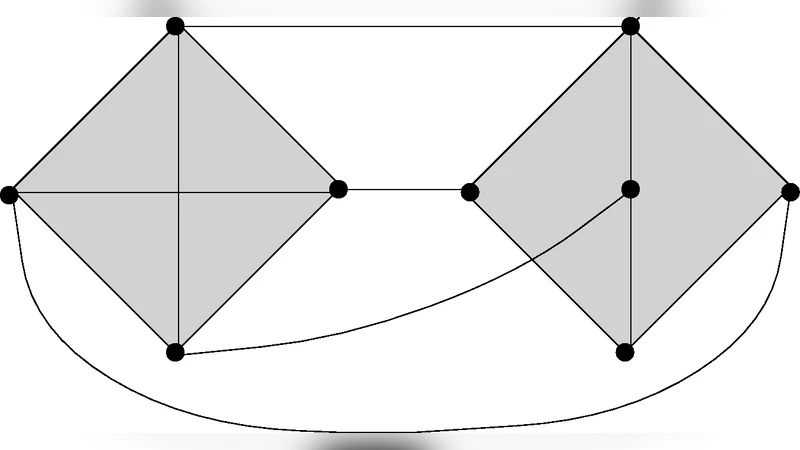
Section 4 presents explicit constructions for the remaining minors. The authors describe how to build small planar emulators for K₁,₂,₂,₂ (a classic hard case) and for K₄,₅−4K₂, and then extend the technique to the other listed minors. The constructions typically involve replicating each vertex a few times, arranging the copies in a planar fashion, and carefully adding edges so that the local neighbourhoods map surjectively onto the original graph’s neighbourhoods. The paper includes illustrative figures (e.g., Fig. 4, Fig. 11) showing the resulting planar embeddings.
Section 5 discusses the limits of current techniques. While many forbidden minors are now known to be emulable, K₄,₄−e remains unresolved; the authors conjecture it may also admit an emulator but note that existing methods (discharging, structural decomposition) have not succeeded. They argue that new structural tools, perhaps based on different minor‑closed families or on algebraic graph theory, will be needed to achieve a full characterization of planar‑emulable graphs. Moreover, they highlight potential algorithmic implications: problems that are polynomial on planar graphs might retain tractability on the broader class of planar‑emulable graphs, suggesting a new avenue for complexity research.
In conclusion, the paper establishes that planar‑emulability is a substantially larger property than planar‑coverability, refutes the long‑standing planar‑emulator conjecture, and provides a suite of constructions and structural results that map out much of the new landscape. It opens several promising directions, including the search for a complete forbidden‑minor characterization, the development of new construction techniques, and the exploration of algorithmic consequences for this expanded graph class.
Comments & Academic Discussion
Loading comments...
Leave a Comment