A Gelfand-type spectral radius formula and stability of linear constrained switching systems
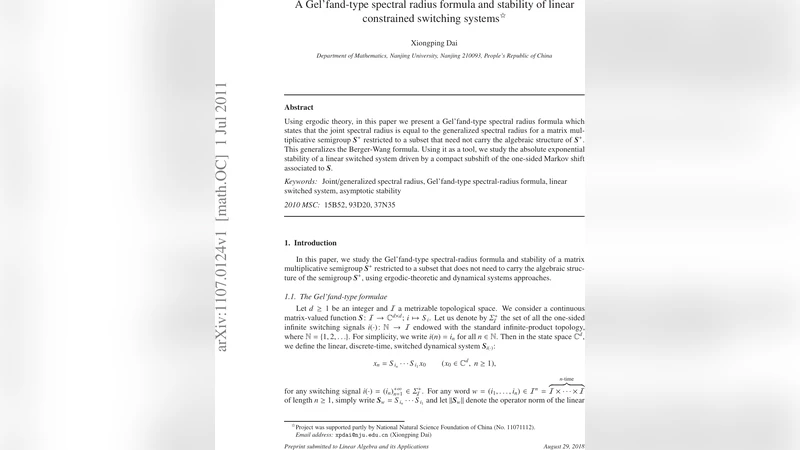
Using ergodic theory, in this paper we present a Gel’fand-type spectral radius formula which states that the joint spectral radius is equal to the generalized spectral radius for a matrix multiplicative semigroup $\bS^+$ restricted to a subset that need not carry the algebraic structure of $\bS^+$. This generalizes the Berger-Wang formula. Using it as a tool, we study the absolute exponential stability of a linear switched system driven by a compact subshift of the one-sided Markov shift associated to $\bS$.
💡 Research Summary
The paper investigates the relationship between the joint spectral radius and the generalized spectral radius for matrix families when the admissible switching signals are restricted by constraints. Classical results such as the Berger‑Wang formula assert that for an unconstrained bounded set of matrices S, the joint spectral radius ĥρ(S) equals the generalized spectral radius ρ(S). However, in many practical control problems the switching sequence must satisfy additional rules (e.g., those induced by a directed graph or a Markov transition matrix). The authors formalize this situation by introducing a non‑empty subset Λ of the one‑sided infinite product space Σ⁺_I, which represents the admissible switching signals. They require Λ to be invariant under the shift map θ⁺ and compact, but they do not assume any algebraic semigroup structure on the set of products S⁺↾Λ.
The main theoretical contribution, Theorem A, proves that under the above hypotheses the equality ρ(S↾Λ)=ĥρ(S↾Λ) still holds. The proof relies on ergodic theory rather than combinatorial arguments. First, the shift θ⁺ restricted to Λ is a continuous transformation on a compact metric space, so the set of invariant probability measures M_inv(Λ,θ⁺) is non‑empty and compact. By considering the sub‑additive sequence f_n(ω)=log‖S_{i_n}…S_{i_1}‖, the authors apply Kingman’s sub‑additive ergodic theorem to any ergodic invariant measure μ, obtaining almost‑sure convergence of (1/n)f_n(ω) to a constant χ(μ). A semi‑uniform sub‑additive theorem (due to Schreiber and to Sturman‑Stark) then shows that the supremum of (1/n)f_n over all ω coincides with the maximum of χ(μ) over all ergodic μ. Lemma 2.5 guarantees the existence of an ergodic measure μ* attaining this maximum, which yields the desired equality of the two spectral radii. The argument works even though the set of product matrices S⁺↾Λ does not form a semigroup, thereby extending the Berger‑Wang formula to constrained settings.
The second major result, Theorem B, provides a complete stability criterion for linear switched systems under the same constraints. Assuming the underlying matrix family S is bounded and ρ(S)=1, the theorem states that the following three statements are equivalent: (a) Λ‑absolute asymptotic stability (i.e., for every admissible switching signal the product matrices converge to the zero matrix); (b) the constrained generalized spectral radius satisfies ρ(S↾Λ)<1; (c) there exist constants γ∈(0,1) and N∈ℕ such that for all n≥N and all admissible signals the spectral radius of the product of length n is bounded by γ. The proof combines Theorem A with Fenichel’s uniformity theorem to handle the implication (a)⇒(b) without the extra assumption ρ(S)=1, and uses standard compactness arguments to obtain (c)⇒(b). The authors also present a counter‑example where Λ is non‑compact; in that case (a) holds but ρ(S↾Λ)=1, illustrating the necessity of compactness.
Several remarks clarify the relationship with existing literature. Remark 1.4 discusses the existence of a pre‑extremal norm when ĥρ(S)<1 in the unconstrained case, and explains why such a norm may fail to exist under constraints because the sub‑multiplicative property cannot be guaranteed for all admissible products. Remark 1.5 points out that in the unconstrained setting the identity ρ(S)=sup_n sup_{w∈I^n} ρ(S_w)^{1/n} holds, which ensures continuity of the spectral radius with respect to the matrix family; this identity generally breaks down for constrained systems.
The paper concludes with open questions, including extensions to non‑compact constraint sets, continuous‑time analogues, and deeper connections between the combinatorial structure of the constraint graph (e.g., cycle lengths, entropy) and the constrained spectral radius. Overall, the work offers a rigorous ergodic‑theoretic framework that broadens the applicability of spectral radius formulas and provides practical stability tests for switched systems subject to realistic switching constraints.
Comments & Academic Discussion
Loading comments...
Leave a Comment