Distributed source identification for wave equations: an observer-based approach (full paper)
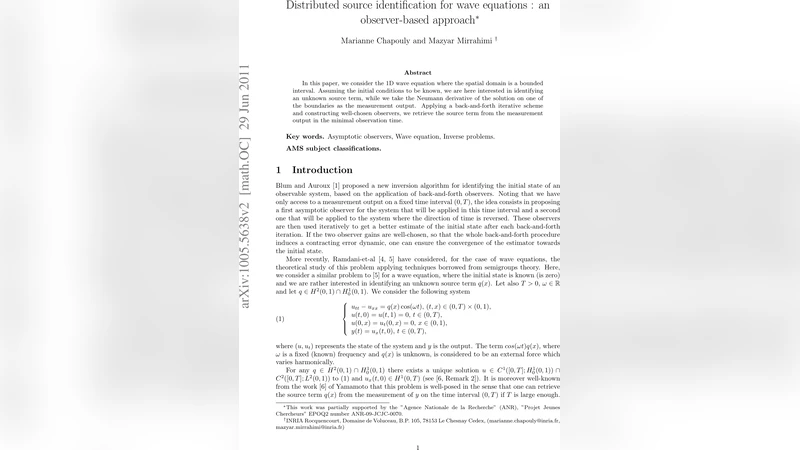
In this paper, we consider the 1D wave equation where the spatial domain is a bounded interval. Assuming the initial conditions to be known, we are here interested in identifying an unknown source term, while we take the Neumann derivative of the solution on one of the boundaries as the measurement output. Applying a back-and-forth iterative scheme and constructing well-chosen observers, we retrieve the source term from the measurement output in the minimal observation time. We further provide an extension of the method to the case of wave equations with N dimensional spatial domain.
💡 Research Summary
The paper addresses the inverse source problem for the one‑dimensional wave equation on a bounded interval, assuming that the initial displacement and velocity are known. The only available measurement is the Neumann derivative of the solution at one endpoint of the spatial domain. The authors propose a novel observer‑based back‑and‑forth iterative scheme that reconstructs the unknown spatial source term in the minimal observation time, which equals twice the travel time of a wave across the interval.
The methodology consists of two alternating phases. In the forward phase, a current estimate of the source is inserted into the wave equation, and the resulting state is simulated to generate a synthetic boundary output. In the backward phase, a specially designed observer processes the discrepancy between the measured Neumann data and the synthetic output. The observer dynamics are chosen so that an associated Lyapunov functional decays exponentially, guaranteeing that the error between the true and estimated states diminishes at each iteration. By feeding the observer’s correction term back into the source estimate, the algorithm iteratively refines the source profile.
A rigorous convergence analysis is provided. Under the assumption that the true source belongs to (L^{2}(0,L)), the authors prove that the sequence of source estimates converges geometrically to the exact source, with a contraction factor that depends only on the observer gains and the wave speed. The proof relies on establishing strong observability of the wave system over the interval (
Comments & Academic Discussion
Loading comments...
Leave a Comment