An informal introduction to topos theory
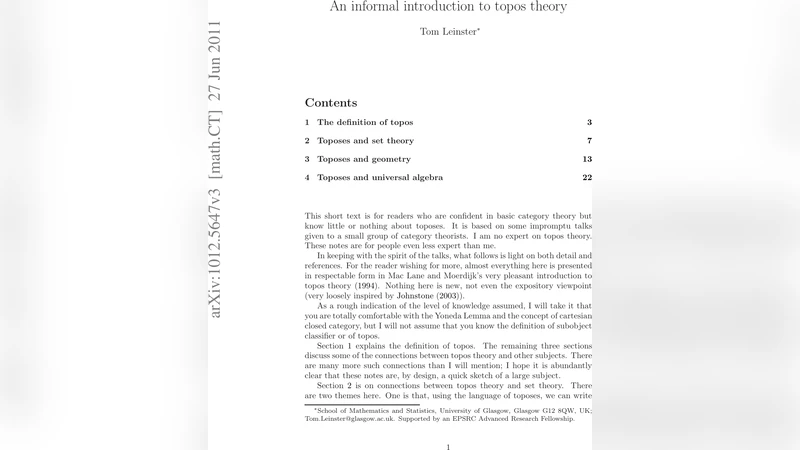
This short expository text is for readers who are confident in basic category theory but know little or nothing about toposes. It is based on some impromptu talks given to a small group of category theorists.
💡 Research Summary
The paper serves as a concise, informal introduction to topos theory aimed at readers who are comfortable with basic category theory but have little or no exposure to toposes. Structured as a series of impromptu talks, the exposition proceeds in a logical sequence that builds intuition before formal definitions. It begins by presenting two equivalent perspectives on a topos: the elementary viewpoint, where a topos is a category equipped with all finite limits, exponentials, and a subobject classifier Ω; and the Grothendieck viewpoint, where a topos arises as the category of sheaves on a site. By juxtaposing these viewpoints, the author highlights that the same abstract structure can be encountered both in pure categorical settings (e.g., Set) and in geometric contexts (e.g., sheaves on a topological space).
Concrete examples are used throughout. The category of sets, Set, is shown to be the prototypical elementary topos: Ω is the two‑element truth‑value set {0,1}, subobjects correspond to characteristic functions, and exponentials B^A are ordinary function sets. The sheaf topos Sh(X) on a topological space X illustrates the Grothendieck side: Ω now encodes open subsets, subobjects are sheaf‑subsheaves, and exponentials capture internal hom‑sheaves of continuous maps. These examples make the abstract definitions tangible and demonstrate how the same machinery works in different mathematical worlds.
A central theme is the role of the subobject classifier. The paper explains that for any object A, the set of subobjects of A is naturally isomorphic to Hom(A,Ω). This identification turns propositions about A into morphisms into Ω, thereby internalising logic. The author emphasizes that Ω carries the truth‑values of a Boolean or intuitionistic logic depending on the topos, and that logical connectives ∧, ∨, → are realized as internal operations on Ω (pullbacks, coproducts, exponentials).
Exponentials are treated next. The existence of B^A provides an internal function space, allowing one to speak of “maps” inside the topos without leaving the categorical framework. The construction of exponentials via limits and equalizers is sketched, and the author points out that this mirrors the familiar set‑theoretic construction of function sets, while in sheaf toposes it yields sheaves of continuous maps.
The internal logic section formalizes quantifiers. For a morphism f : A → B, the left adjoint ∃_f and right adjoint ∀_f to the pullback functor f^* give rise to existential and universal quantification on subobjects. The paper shows how these adjoints arise from the universal properties of pullbacks and pushforwards, and how they satisfy the usual logical rules (e.g., ∀_f distributes over ∧). This demonstrates that every topos carries an intrinsic higher‑order logic, often intuitionistic, which can be used to reason about objects and morphisms internally.
Finally, the relationship between elementary and Grothendieck toposes is addressed through geometric morphisms. A geometric morphism consists of an adjoint pair (f^, f_) where f^* preserves finite limits; this mirrors the familiar inverse‑image/direct‑image pair for sheaves. The paper gives the example of the global‑section functor Γ : Sh(X) → Set as a geometric morphism, illustrating how topos theory unifies logical and geometric ideas.
Overall, the article succeeds in demystifying topos theory by focusing on concrete examples, clear diagrams, and a step‑by‑step buildup from familiar categorical notions to the richer internal logic of a topos. It equips the reader with a solid conceptual framework that can serve as a springboard for deeper study of sheaf theory, categorical logic, and applications in algebraic geometry and computer science.
Comments & Academic Discussion
Loading comments...
Leave a Comment