Introduction to Graphical Modelling
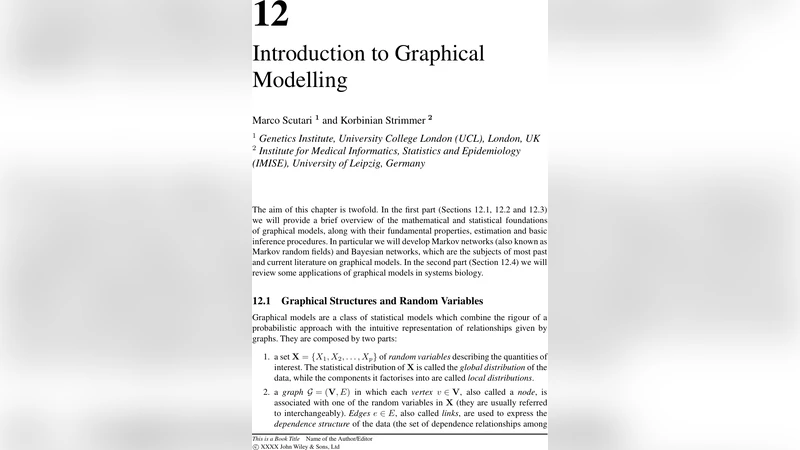
The aim of this chapter is twofold. In the first part we will provide a brief overview of the mathematical and statistical foundations of graphical models, along with their fundamental properties, estimation and basic inference procedures. In particular we will develop Markov networks (also known as Markov random fields) and Bayesian networks, which comprise most past and current literature on graphical models. In the second part we will review some applications of graphical models in systems biology.
💡 Research Summary
The chapter titled “Introduction to Graphical Modelling” is organized into two complementary parts that together give the reader a solid grounding in both the theory and practical use of graphical models. The first part lays out the mathematical and statistical foundations. It begins by defining the correspondence between random variables and graph structures, distinguishing between undirected graphs (Markov random fields, MRFs) and directed acyclic graphs (Bayesian networks, BNs). For MRFs, the authors present the Hammersley‑Clifford theorem, explain how the joint distribution factorises over cliques using potential functions, and discuss the notorious difficulty of computing the normalising constant. To circumvent this, they describe pseudo‑likelihood, variational approximations, contrastive divergence, and other tractable alternatives. Spectral methods based on the graph Laplacian are also introduced as tools for structure learning. The BN section focuses on conditional independence expressed through d‑separation, the construction of conditional probability tables, and the two main families of structure‑learning algorithms: score‑based (BIC, AIC, Bayesian Dirichlet scores) and constraint‑based (PC, FCI). The authors compare these approaches, highlighting trade‑offs in sample efficiency and computational cost. Inference techniques are then surveyed. Exact inference is covered through variable elimination, junction‑tree transformation, and belief propagation on trees. Approximate inference is addressed with loopy belief propagation, Gibbs sampling, Metropolis‑Hastings, and other Markov‑chain Monte‑Carlo (MCMC) schemes, together with discussion of convergence diagnostics and scalability.
The second part shifts focus to applications in systems biology, illustrating how the abstract machinery can be deployed on real‑world high‑dimensional data. Three case studies are presented. The first demonstrates causal network reconstruction from gene‑expression profiles using Bayesian networks. The workflow includes preprocessing, feature selection, structure learning, cross‑validation, and biological validation of inferred regulator‑target relationships. The second case study applies MRFs to metabolic network modelling, incorporating spatial expression patterns to define clique potentials that capture tissue‑specific fluxes. Approximate inference yields probabilistic maps of metabolic activity, offering insights into organ‑level physiology. The third example combines BNs and MRFs in a hybrid framework to predict protein‑protein interactions (PPIs). By integrating noisy experimental interaction data with literature‑derived priors, the hybrid model improves predictive performance (AUC, precision‑recall) and uncovers novel interaction candidates for experimental follow‑up.
Throughout the chapter, the authors emphasise practical considerations: algorithmic complexity, handling of missing or noisy data, and validation strategies. They conclude with a critical appraisal of current limitations—scalability to genome‑wide data, robustness to measurement error, and the difficulty of establishing true causal directionality. Future research directions are outlined, including the fusion of graphical models with deep learning (graph neural networks), development of richer Bayesian priors, and online learning algorithms capable of processing streaming biological data. By weaving together rigorous theory, algorithmic detail, and concrete biological examples, the chapter serves as a comprehensive guide for researchers who wish to employ graphical modelling as a quantitative lens on complex biological systems.
Comments & Academic Discussion
Loading comments...
Leave a Comment