Witt groups of complex cellular varieties
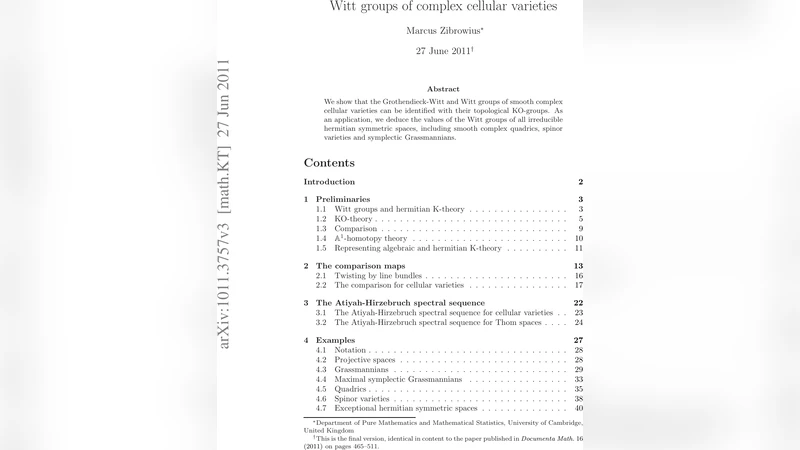
We show that the Grothendieck-Witt and Witt groups of smooth complex cellular varieties can be identified with their topological KO-groups. As an application, we deduce the values of the Witt groups of all irreducible hermitian symmetric spaces, including smooth complex quadrics, spinor varieties and symplectic Grassmannians.
💡 Research Summary
The paper establishes a precise identification between the algebraic Grothendieck‑Witt groups GW⁎(X) and Witt groups W⁎(X) of a smooth complex cellular variety X and its topological real K‑theory groups KO⁎(X). The authors begin by exploiting the cellular decomposition that any complex cellular variety admits. Because each cell is even‑dimensional (as a complex cell), the associated filtration on the derived category of perfect complexes yields a spectral sequence whose E₁‑page is built from the Grothendieck‑Witt groups of the individual cells. By invoking A¹‑homotopy invariance, β‑normalisation, and the compatibility of the cellular filtration with the KO‑spectrum, they prove that this spectral sequence collapses at E₂ and that the resulting graded pieces are exactly the KO‑groups of X. Consequently, there is a natural isomorphism
GW⁎(X) ≅ KO⁎(X)
as graded rings, and the Witt groups, which are the cokernel of the hyperbolic map, satisfy
W⁎(X) ≅ KO⁎(X)/2.
The identification is not merely abstract; it provides a concrete computational tool. The authors apply the theory to all irreducible Hermitian symmetric spaces, which are known to be complex cellular. For each class they give an explicit description of the cellular structure, translate it into the corresponding KO‑groups (using the well‑known 8‑periodic Bott periodicity), and then read off the Witt groups.
-
Complex quadrics Qⁿ – The cellular decomposition consists of one cell in each even real dimension 0,2,…,2n. The KO‑groups of Qⁿ are therefore periodic with period 8, and the Witt groups are obtained by reducing these groups modulo 2. The authors write down the full pattern of W⁰, W¹, …, W⁷ for every n, showing the expected 2‑torsion and the vanishing in odd degrees.
-
Spinor varieties (the two components of the orthogonal Grassmannian) – These are the varieties of maximal isotropic subspaces in a quadratic space of even dimension. Their Schubert cell decomposition yields cells in dimensions congruent to 0 or 1 modulo 2, and the KO‑groups are again known from classical topology. By the main theorem the Witt groups are KO⁎/2, giving a complete table of W⁎ for both components.
-
Symplectic Grassmannians G_ℂ(k,2n) – These parametrize k‑dimensional isotropic subspaces in a symplectic vector space. The authors use the standard Schubert cell description to compute KO⁎(G_ℂ(k,2n)). The resulting Witt groups display the same 8‑periodic behaviour, with explicit formulas depending on k and n.
Throughout the paper the authors emphasize that the cellular approach bypasses the intricate algebraic calculations traditionally required for Grothendieck‑Witt and Witt groups. Instead, one can rely on the topological KO‑theory literature, which is exhaustive for the spaces under consideration. Moreover, the proof technique—combining A¹‑homotopy invariance, β‑normalisation, and the cellular spectral sequence—suggests a pathway to extend the result beyond complex cellular varieties, potentially to real cellular varieties or to situations where the cellular filtration is replaced by a more general stratification.
In summary, the work provides a powerful bridge between algebraic hermitian K‑theory and classical topological KO‑theory. By proving that for smooth complex cellular varieties GW⁎(X) ≅ KO⁎(X) and W⁎(X) ≅ KO⁎(X)/2, the authors give a uniform method to compute Witt groups for a large and important class of varieties, including all irreducible Hermitian symmetric spaces. This not only resolves several open calculations (e.g., Witt groups of quadrics, spinor varieties, and symplectic Grassmannians) but also enriches the conceptual understanding of how algebraic and topological invariants intertwine in the presence of a cellular structure.
Comments & Academic Discussion
Loading comments...
Leave a Comment