Synchronization and Transient Stability in Power Networks and Non-Uniform Kuramoto Oscillators
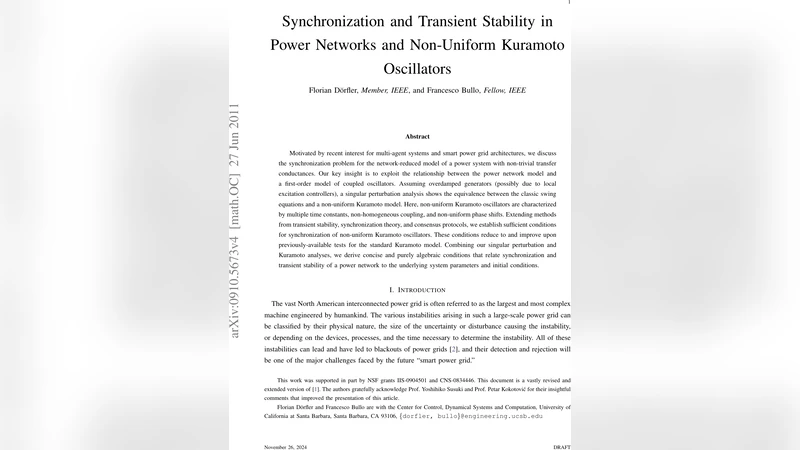
Motivated by recent interest for multi-agent systems and smart power grid architectures, we discuss the synchronization problem for the network-reduced model of a power system with non-trivial transfer conductances. Our key insight is to exploit the relationship between the power network model and a first-order model of coupled oscillators. Assuming overdamped generators (possibly due to local excitation controllers), a singular perturbation analysis shows the equivalence between the classic swing equations and a non-uniform Kuramoto model. Here, non-uniform Kuramoto oscillators are characterized by multiple time constants, non-homogeneous coupling, and non-uniform phase shifts. Extending methods from transient stability, synchronization theory, and consensus protocols, we establish sufficient conditions for synchronization of non-uniform Kuramoto oscillators. These conditions reduce to and improve upon previously-available tests for the standard Kuramoto model. Combining our singular perturbation and Kuramoto analyses, we derive concise and purely algebraic conditions that relate synchronization and transient stability of a power network to the underlying system parameters and initial conditions.
💡 Research Summary
The paper tackles the long‑standing problem of synchronization and transient stability in electric power networks by establishing a rigorous link between the classical second‑order swing‑equation model and a first‑order non‑uniform Kuramoto oscillator model. The authors begin by considering a network‑reduced representation of a power system that retains non‑trivial line conductances. In this setting each transmission line is described by a complex admittance (Y_{ij}=G_{ij}+jB_{ij}), which introduces a phase shift (\phi_{ij}=\arctan(G_{ij}/B_{ij})) into the power‑flow equations.
Assuming that generators are heavily damped—an assumption justified for machines equipped with local excitation controllers—the paper applies singular‑perturbation theory. The small parameter (\epsilon_i=M_i/D_i) (ratio of inertia to damping) multiplies the second‑order term in the swing equation. As (\epsilon_i\to0) the fast inertial dynamics collapse, leaving a reduced first‑order dynamics:
\
Comments & Academic Discussion
Loading comments...
Leave a Comment