On normality of the Wijsman topology
Let $(X,\rho)$ be a metric space and $(CL(X),W_\rho)$ be the hyperspace of all nonempty closed subsets of $X$ equipped with the Wijsman topology. The Wijsman topology is one of the most important classical hyperspace topologies. We give a partial ans…
Authors: Lubica Hola, Branislav Novotny
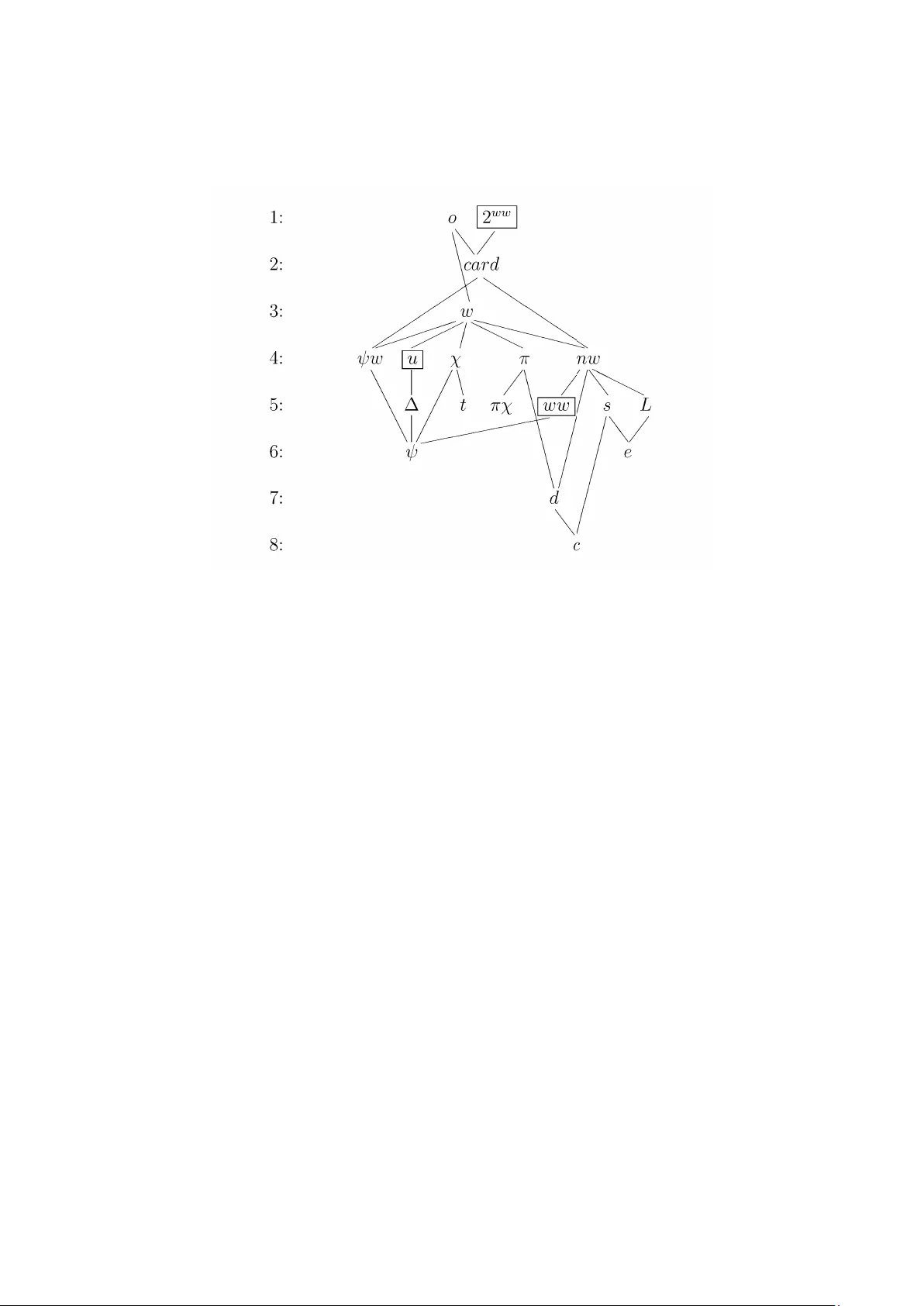
ON NORMALITY OF THE WIJSMAN TOPOLOGY L ’UBICA HOL ´ A AND BRANISLA V NO V OTN ´ Y Mathematic al Institute, Slovak A c ademy of Scienc es, ˇ Stef´ anikova 49, SK-814 73 Br atislava, Slovakia Abstract. Let ( X , ρ ) be a metric space and ( C L ( X ) , W ρ ) be the hyperspace of all nonempt y closed subsets of X equipp ed with the Wijsman topology . The Wijsman topology is one of the most imp ortant classical h yperspace top ologies. W e give a partial answer to a question p osed in [15] whether the normalit y of ( C L ( X ) , W ρ ) is equiv alent to its metrizability . If ( X , ρ ) is a linear metric space, then ( C L ( X ) , W ρ ) is normal if and only if ( C L ( X ) , W ρ ) is metrizable. Some further results concerning normalit y of the Wijsman topology on C L ( X ) are also pro ved. 1. Introduction Let ( X, ρ ) b e a metric space and ( C L ( X ) , W ρ ) be the hyperspace of all nonempt y closed subsets of X equipp ed with the Wijsman top ology . The Wijsman topology is now considered as a classical one. It is one of the most imp ortant hyperspace top ologies. The Wijsman top ology is finer than the F ell top ology and weak er than the Vietoris top ology and the Husdorff metric top ology . The Wijsman topology W ρ is the w eak top ology (initial topology) determined b y all distance functionals ρ ( x, · ) : C L ( X ) → [0 , ∞ ), where ρ ( x, A ) = inf { ρ ( x, a ); a ∈ A } [3]; i.e. A λ → A iff ρ ( x, A λ ) → ρ ( x, A ) for all x ∈ X . This topology , or more precisely con v ergence, w as introduced in 1966 by R. Wijsman for closed conv ex sets in R n [19]. Since then the Wijsman top ology was studied b y many authors and found man y applications; see e.g. [2], [6], [11], [15], [20]. In [4] there is prov ed that for a metrizable space ( X , τ ), the Vietoris top ology is the smallest top ology con taining all Wijsman topologies determined b y metrics compatible with τ and for a metric space ( X , ρ ), the proximal top ology is the smallest top ology con taining all Wijsman top ologies determined by metrics whic h are uniformly equiv alen t to ρ . As a basic reference for the Wijsman top ology we recommend [3]. In this pap er w e study the normalit y and cardinal in v ariants of the Wijsman top ology . Notice that the normality of the Vietoris topology on C L ( X ) w as studied b y Keesling in [13], [14], but it was solv ed by V elichk o in [18]; he prov ed that it is equiv alent to the compactness of X . Hol´ a, Levi and P elan t pro v ed in [10] that the normality of the F ell top ology on C L ( X ) is equiv alen t to the lo cal compactness and Lindel¨ ofness of X . In our pap er we giv e a partial answ er to a question posed in [15]: It is known that if ( X , ρ ) is a sep ar able metric sp ac e, then ( C L ( X ) , W ρ ) is metrizable and so E-mail addr ess : lubica.hola@mat.savba.sk, branislav.novotny@mat.savba.sk . 2010 Mathematics Subje ct Classific ation. Primary 54A25, 54B20, 54D15; Secondary 54E35. Key wor ds and phr ases. Wijsman topology , cardinal inv ariant, normality . Both authors w ere supp orted b y VEGA 2/0047/10. 1 2 WIJSMAN TOPOLOGY p ar ac omp act and normal. Is the opp osite true? Is ( C L ( X ) , W ρ ) normal if and only if ( C L ( X ) , W ρ ) is metrizable? 2. Preliminaries Let s, e, c, d, nw, w , ψ w, π , χ, ψ , π χ, t, L b e cardinal inv ariants of a top ological space: spread, extent, cellularity , densit y , net w eigh t, w eigh t, pseudo weigh t, π − weigh t, c haracter, pseudo character, π − character, tigh tness, and Lindel¨ of n um ber resp ec- tiv ely , as defined in [12] and [8]. All are greater or equal to ℵ 0 . Consider a top ological space ( X, τ ) and x ∈ X . Argumen ts in cardinal functions will b e denoted as f ( x, X , τ ). W e will omit sp ecification of the topology τ when it will not b e confusing. Poin ts will b e sp ecified only for a p oint specific cardinal functions ( ψ , χ, t, ... ) and in this case we hav e f ( X ) = sup { f ( x, X ); x ∈ X } . Ev ery cardinal function has also a hereditary version hf ( X ) = sup { f ( Y ); Y is a subspace of X } . No w define some other cardinal functions. | X | denotes the cardinality of X , car d ( X ) = ℵ 0 + | X | , o ( X ) = ℵ 0 + | τ | , the diagonal degree b y ∆( X ) = ℵ 0 + min {|G | ; G is a family of op en sets in X × X with ∩G equal to the diagonal in X × X } [9]. F or a Tyc honoff space define the uniform w eigh t b y u ( X ) = ℵ 0 + min {|W | ; W is a base for compatible uniformity } [8] and the weak w eight by w w ( X ) = min { w ( Y ); there is a con tin uous bijection from X on to a Tyc honoff space Y } [16]. A metric space ( X, ρ ) is − discrete iff for any distinct x, y ∈ X holds ρ ( x, y ) ≥ ; and it is uniformly discrete iff it is − discrete for some > 0. In a metric space denote b y S ( x, ) ( B ( x, )) an op en (closed) ball with the radius and the cen ter x . S ( M , ) = S x ∈ M S ( x, ) and B ( M , ) = S x ∈ M B ( x, ). If w e need to sp ecify the metric ρ , w e will write S ρ ( x, α ) , B ρ ( x, α ) , S ρ ( M , ) and B ρ ( M , ). Note 2.1 ([12, 2.1.], [9, Fig. 1.], [8, 8.5.17.], [16, IV.9.16.]) . The diagr am in the Figure 1 shows r elations among c ar dinal invariants on a T ychonoff sp ac e. (Without sp e cifying a p oint i.e. only f(X).) F unctions c onne cte d by a line ar e c omp ar able and the upp er one is gr e ater than or e qual to the lower one. This is true also for a T 1 sp ac e, but one should omit those in b oxes. Note 2.2. F or a metric sp ac e X is w ( X ) = nw ( X ) = π ( X ) = L ( X ) = s ( X ) = e ( X ) = d ( X ) = c ( X ) = sup { card ( D ); D is a uniformly discr ete subsp ac e of X } . 3. Cardinal Inv ariants of the Wijsman Topology W e will work on a metric space ( X , ρ ) and its hyperspace ( C L ( X ) , W ρ ). If X is only a top ological space we can consider the Vietoris top ology V on C L ( X ). F or U ⊂ X denote U − = { A ∈ C L ( X ); A ∩ U 6 = ∅} and U + = { A ∈ C L ( X ); A ⊂ U } . The family { U − ; U is op en } ( { U + ; U is op en } ) is a subbase of V − , the lo w er part of the Vietoris top ology ( V + , the upper part of the Vietoris top ology V + ). T ogether they form a subbase of V . Analogically we hav e the low er and upp er parts of the Wijsman top ology W − ρ , W + ρ with the follo wing subbases { S − ( x, α ); x ∈ E , α ∈ Q + } { S + ( x, α ); x ∈ E , α ∈ Q + } resp ectiv ely; where S − ( x, α ) = { A ∈ C L ( X ); ρ ( x, A ) < α } = S ( x, α ) − , S + ( x, α ) = { A ∈ C L ( X ); ρ ( x, A ) > α } = [ β >α B ( x, β ) C + , E is a dense subset of X and Q + is the set of all positive rationals. If need to sp ecify the metric ρ , we will use notations S − ρ ( x, α ) and S + ρ ( x, α ). WIJSMAN TOPOLOGY 3 Figure 1. W e also hav e a subbase for a natural uniformity compatible with W ρ : { W x,n ; x ∈ E , n ∈ ω } , where W x,n = { ( A, B ) ∈ C L ( X ) 2 ; | ρ ( x, A ) − ρ ( x, B ) | < 1 /n } . W e will suppose that ( X , ρ ) is a metric space and C L ( X ) is equipped with W ρ if not stated explicitly otherwise. Notice that if ( X, ρ ) is a metric space, then W − ρ = V − on C L ( X ). W e immediately obtain: Prop osition 3.1. w ( C L ( X )) ≤ d ( X ) . W e will derive now some upper estimates of d ( X ) from more general results ab out the Vietoris topology . Lemma 3.2. L et X b e a top olo gic al sp ac e. L et G = { G λ ⊂ X ; λ ∈ Λ } b e a family of nonempty op en sets. Put U = {∩ λ ∈ I G − λ ; finite I ⊂ Λ } . The fol lowing ar e e quivalent: (1) G is a π − b ase of X , (2) U is a π − b ase of ( C L ( X ) , V − ) , (3) U is a lo c al π − b ase at X in ( C L ( X ) , V − ) , (4) ∩U = { X } ; i.e. U is a lo c al pseudo b ase at X in ( C L ( X ) , V − ) . Pr o of. (1) ⇒ (2) : It follows from the fact that if G λ ⊂ U , then G − λ ⊂ U − . (2) ⇒ (3) : It follows from the fact that every op en set in V − con tains X . (3) ⇒ (4) : Clearly X ∈ ∩U . Consider closed A 6 = X . So ( X \ A ) − ⊃ U for some U ∈ U . Then A 6∈ U and so A 6∈ ∩U . (4) ⇒ (1) : Supp ose that G is not a π − base, then there is a closed set A ⊂ X whic h meets ev ery G λ ∈ G . Then clearly A ∈ ∩U . 4 WIJSMAN TOPOLOGY W.l.o.g. we can consider for a pseudo (resp. π − ) base in ( C L ( X ) , V − ) only systems of the form U from the previous lemma. W e hav e the following theorem as a direct corollary . Theorem 3.3. L et X b e a top olo gic al sp ac e. Then ψ ( X , C L ( X ) , V − ) = π ( X ) = π χ ( X , C L ( X ) , V − ) = π χ ( C L ( X ) , V − ) . Note that every open neighborho o d of X in W ρ is a member of V − . W e hav e the follo wing corollary . Corollary 3.4. d ( X ) ≤ min { ψ ( C L ( X )) , π χ ( C L ( X )) } . F or A ⊂ X denote b y F ( A ) the set of all finite subsets of A . The following lemma is w ell-kno wn; see e.g. [17]. Lemma 3.5. If E is dense in X , then F ( E ) is dense in ( C L ( X ) , V ) . Theorem 3.6. d ( X ) ≤ t ( X , C L ( X ) , V − ) ≤ t ( C L ( X ) , W ρ ) . Pr o of. The second inequality follows from the fact that ev ery W ρ neigh b orho od of X b elongs to V − . The first inequalit y is simmilar to [7, 2.4.]. Since X ∈ F ( X ) there is A ⊂ F ( X ) suc h that |A| ≤ t ( X , C L ( X ) , V − ) and X ∈ A . F or ev ery op en U ⊂ X , U − is a neigh borho o d of X and therefore con tains some F ∈ A , i.e. U meets F and then obviously meets ∪A , which is therefore dense in X . Since X is a closed subset of C L ( X ) w e ha ve: e ( C L ( X )) ≥ e ( X ) = d ( X ). And finally from previous results, trivial inequalities from Note 2.1 and the fact that hw = w w e hav e the following theorem. Theorem 3.7. d ( X ) = f ( C L ( X )) = hf ( C L ( X )) , wher e f is any function fr om ψ , ψ w, π χ, π , nw, t, L, w , ∆ , u, e, s, w w . Those are all functions from Figure 1, lines 3–6. 4. Density and Celularity The follo wing prop osition is a direct corollary of Lemma 3.5. Prop osition 4.1. d ( C L ( X )) ≤ d ( X ) . Then d ( X ) ≥ hd ( C L ( X )) ≥ hc ( C L ( X )) = s ( C L ( X )) = d ( X ) i.e. Corollary 4.2. hd ( C L ( X )) = d ( X ) . F or a cardinal n um ber n define log( n ) = min { m ; n ≤ 2 m } [16]. Observe that log(2 n ) ≤ n ≤ 2 log( n ) . Lemma 4.3. log( d ( X )) ≤ ww ( X ) ≤ d ( C L ( X )) . Pr o of. The first inequality follows from Note 2.1 and for the second supp ose D is dense in C L ( X ) with the cardinality d ( C L ( X )). Define H : X → R D b y ( π A ◦ H )( x ) = d ( x, A ) for eac h x ∈ X and A ∈ D . H is a con tin uous injection, th us w w ( X ) ≤ w ( H ( X )) ≤ |D| ≤ d ( C L ( X )). W e will provide an example where the inequality from Corollary 4.1 is sharp. Example 4.4. Ther e is X with d ( C L ( X )) < d ( X ) . Pr o of. Let ( X , µ ) b e a separable metric space with | X | > ℵ 0 and let ρ b e the 0 − 1 metric on X . Let { x i ; i ∈ ω } b e a dense set in ( X , µ ). Put H = { B µ ( x i , 1 /j ); i, j ∈ ω } . Let L b e a family of all finite unions of elemen ts from H . Then L is dense in ( C L ( X ) , W ρ ). The result ab out discrete metric spaces can b e generalized. WIJSMAN TOPOLOGY 5 Example 4.5. L et X b e a discr ete metric sp ac e with the 0 − 1 metric. Then d ( C L ( X )) = log( d ( X )) and c ( C L ( X )) = ℵ 0 . Pr o of. Let 2 X b e a space of functions from X to { 0 , 1 } equipp ed with the top ology of p oint wise con v ergence. Let 1 ∈ 2 X b e a constant function with v alue 1. C L ( X ) is homeomorphic to 2 X \ { 1 } th us d ( C L ( X )) = d (2 X \ { 1 } ) = d (2 X ) and c ( C L ( X )) = c (2 X \ { 1 } ) = c (2 X ). F rom [9, 11.8.] we ha v e that c (2 X ) = ℵ 0 and d (2 X ) = log( | X | ). So we hav e an example of a space where density and cellularit y reach their resp ectiv e lo w er bounds. Now w e will construct one where they will reac h their upp er b ounds. W e will use the follo wing metric. Definition 4.6. L et X b e a nonempty set, M ⊂ X and | M | is either infinite or even. F or every x ∈ M define its r efle ction x 0 ∈ M such that x 0 6 = x and ( x 0 ) 0 = x . Define a metric ρ M on X by ρ M ( x, x ) = 0 for x ∈ X , ρ M ( x, x 0 ) = 2 for x ∈ M and ρ M ( x, y ) = 1 otherwise. Such ρ M wil l b e c al le d M − metric. Put S M = {{{ x }} ; x ∈ M } . Note that if X is a set, M ⊂ X , ρ is 0 − 1 metric on X and ρ M is M − metric on X ; then W ρ ∪ S M is a base of W ρ M . Example 4.7. L et X b e a set with | X | = κ ≥ ℵ 0 and M ⊂ X with | M | = m ≥ ℵ 0 . Equip X with M − metric ρ M . Then c ( C L ( X )) = m and d ( C L ( X )) = log κ + m . So we c an take M such that m = κ (e.g. M = X ) to obtain c ( C L ( X )) = d ( C L ( X )) = d ( X ) or we c an take m > ℵ 0 and κ = 2 2 m to obtain ℵ 0 < c ( C L ( X )) < d ( C L ( X )) < d ( X ) . Pr o of. Let ρ b e 0 − 1 metric and take W ρ ∪ S M as a base of W ρ M . Supp ose that U is a cellular system consisting of basic op en sets. W ρ ∩ U is cellular in W ρ and b y Example 4.5 | W ρ ∩ U | ≤ ℵ 0 . Since |U ∩ S M | ≤ m w e hav e that c ( C L ( X )) ≤ m . The reverse inequalit y is due to the fact that S M is cellular. F rom Lemma 4.3 follo ws that d ( C L ( X )) ≥ log d ( X ) = log κ . T rivially d ( C L ( X )) ≥ |S M | = m and so d ( C L ( X )) ≥ log κ + m . F or the reverse inequality tak e D a dense subset of ( C L ( X ) , W ρ ) with |D | = log κ . The set D ∪ ( S S M ) is dense in ( C L ( X ) , W ρ M ). 5. Some Resul ts about Normality of the Wijsman Topology In [15, Problem I] the following question ab out normality of the Wijsman top ol- ogy is p osed: It is known that if ( X, ρ ) is a sep ar able metric sp ac e, then ( C L ( X ) , W ρ ) is metrizable and so p ar ac omp act and normal. Is the opp osite true? Is ( C L ( X ) , W ρ ) normal if and only if ( C L ( X ) , W ρ ) is metrizable? W e hav e found several classes of metric spaces for which this is true. And we hav e also an answer for a weak er question. Supp ose X is metrizable. If X is separable then for every compatible metric ρ , ( C L ( X ) , W ρ ) is metrizable and thus normal. Is the opp osite true? If for every compatible metric ρ , ( C L ( X ) , W ρ ) is normal, does X ha v e to b e separable? Let us start with a result, which connects this section with the previous one. Note that a metric space is generalized compact (GK) iff for ev ery closed discrete subspace D ⊂ X w e hav e | D | < d ( X ); see [1, Theorem 7]. Theorem 5.1. If C L ( X ) is normal then we have the fol lowing p ossibilities: (1) X is not GK. Then 2 d ( C L ( X )) = 2 d ( X ) . (2) X is GK and d ( C L ( X )) = d ( X ) . (3) X is GK and d ( C L ( X )) < d ( X ) . Then 2 d ( C L ( X )) = 2 2 κ = 2 d ( C L ( X )) . Since X is not GK then it cannot b e normal. This result can b e generalized for a discrete metric space with | X | > ℵ 0 . Lemma 5.2. L et > 0 . L et ( X , ρ ) b e a metric sp ac e with 0 − metric ρ . If ( C L ( X ) , W ρ ) is normal then X is c ountable. Pr o of. The metric space X has nice closed balls, th us by [3] the Wijsman top ology on C L ( X ) coincides with the F ell topology . By [10] the normality of the F ell top ology on C L ( X ) implies the Lindel¨ ofness of X ; so w e are done. Note that in this case w e hav e that normality of the Wijsman top ology is equiv- alen t to metrizability . T o apply this result in some other cases, we will use the follo wing lemma. Lemma 5.3. L et ( X, ρ ) b e a metric sp ac e, Y b e a close d discr ete subset of X . Supp ose that for every x ∈ X \ Y the fol lowing pr op erty is fulfil le d: Ther e is η x and at most one y x ∈ Y with ρ ( x, y x ) < η x , for every other y ∈ Y holds ρ ( x, y ) = η x . Then ( C L ( Y ) , W ρ | Y ) is a close d subsp ac e of ( C L ( X ) , W ρ ) . Pr o of. It is w ell-kno wn that if Y is a closed subset of X , then C L ( Y ) is a closed set in ( C L ( X ) , V − ); th us also in ( C L ( X ) , W ρ ). Suppose A λ ∈ C L ( Y ) con verges to A ∈ C L ( Y ) with resp ect to W ρ . Then for every x ∈ X , ρ ( x, A λ ) conv erges to ρ ( x, A ) and since Y ⊂ X then A λ con v erges to A with respect to W ρ | Y . Now supp ose A λ ∈ C L ( Y ) conv erges to A ∈ C L ( Y ) with resp ect to W ρ | Y and take x ∈ X \ Y . W e hav e three p ossibilities: (1) for ev ery y ∈ Y holds ρ ( x, y ) = η x , (2) there is y x ∈ Y with ρ ( x, y x ) = δ < η x and ρ ( x, A ) < η x , (3) there is y x ∈ Y with ρ ( x, y x ) = δ < η x and ρ ( x, A ) = η x . In the case (1) it holds ρ ( x, A λ ) = η x → η x = ρ ( x, A ). In the case (2) y x ∈ A . So ev en tually y x ∈ A λ and hence ρ ( x, A λ ) → δ = ρ ( x, A ). Finally in the case (3) y x 6∈ A . Even tually y x 6∈ A λ and hence ρ ( x, A λ ) → η x = ρ ( x, A ). W e can use this lemma in the following example. Example 5.4. L et m b e a c ar dinal numb er and J ( m ) b e the he dgeho g of spininess m (exactly as in [8, 4.1.5] ). If C L ( J ( m )) e quipp e d with the Wijsman top olo gy is normal, then m ≤ ℵ 0 . WIJSMAN TOPOLOGY 7 Pr o of. J ( m ) = ( I × S ) / ≈ , where I = [0 , 1], S is an index set with | S | = m and ≈ is an equiv alence relation; ( x, s ) ≈ ( y , t ) iff x = 0 = y or x = y and s = t . J ( m ) is equipp ed with the metric ρ : ρ (( x, s ) , ( y , t )) = | x − y | , if s = t x + y , if s 6 = t. Consider Y = { (1 , s ); s ∈ S } . Since Y fulfills the condition in Lemma 5.3 ( C L ( Y ) , W ρ | Y ) is a closed subset of ( C L ( J ( m )) , W ρ ) and hence normal. ρ | Y is 0 − 2 metric and th us Y is countable and so is S . F or a metric ρ on X and η > 0 denote b y ρ η a uniformly equiv alen t metric defined b y ρ η ( x, y ) = min { ρ ( x, y ) , η } for x, y ∈ X . Theorem 5.5. L et ( X , ρ ) b e a metric sp ac e. If for every > 0 ther e is η ∈ (0 , ) such that ( C L ( X ) , W ρ η ) is normal, then X is sep ar able. Pr o of. Supp ose X is not separable. Then there is an − discrete set Y ⊂ X with | Y | = ℵ 1 . T ak e η < / 2 suc h that ( C L ( X ) , W ρ η ) is normal. One can easily chec k the condition in Lemma 5.3, so ( C L ( Y ) , W ρ η | Y ) is a closed subset of ( C L ( X ) , W ρ η ) and hence normal. Since ρ η | Y is 0 − η metric on Y , then | Y | = ℵ 0 b y Lemma 5.2, whic h con tradicts to the supp osition. Corollary 5.6. L et ( X, ρ ) b e a metric sp ac e. If for every metric δ (uniformly) e quivalent to ρ , ( C L ( X ) , W δ ) is normal, then X is sep ar able. Prop osition 5.7. L et ( X , ρ ) b e a metric sp ac e. The fol lowing ar e e quivalent: (1) Every close d pr op er b al l is total ly b ounde d; (2) F or every η > 0 W ρ = W ρ η on C L ( X ) . Pr o of. Naturally W − ρ = W − ρ η . F or α < η holds S + ρ η ( x, α ) = S + ρ ( x, α ) and for α ≥ η S + ρ η ( x, α ) = ∅ . Th us W + ρ ⊃ W + ρ η . (1) ⇒ (2) : T ak e A ∈ S + ρ ( x, α ) so ρ ( x, A ) = β > α . Cho ose γ ∈ ( α, β ) suc h that B ρ ( x, γ ) is proper and choose 0 < < min { η, ( β − γ ) / 2 } and finite F ⊂ X suc h that S ρ ( F , ) ⊃ B ρ ( x, γ ). Then ρ ( F , A ) > , i.e. ρ η ( F , A ) > and so A ∈ T x ∈ F S + ρ η ( x, ) ⊂ S + ρ ( x, α ), hence W + ρ ⊂ W + ρ η . (2) ⇒ (1) : Consider a closed prop er ball B ρ ( x, α ). F or any η > 0, W + ρ ⊂ W + ρ η so there is finite F ⊂ X and for every x ∈ F there is β x < η such that T x ∈ F S + ρ η ( x, β x ) ⊂ S + ρ ( x, α ). Therefore B ρ ( F , η ) C + ⊂ \ x ∈ F S + ρ ( x, β x ) ⊂ \ x ∈ F S + ρ η ( x, β x ) ⊂ S + ρ ( x, α ) ⊂ B ρ ( x, α ) C + and hence B ρ ( x, α ) ⊂ B ρ ( F , η ); i.e. B ρ ( x, α ) is totally b ounded. Corollary 5.8. L et ( X , ρ ) b e a metric sp ac e such that every close d pr op er b al l is total ly b ounde d. If ( C L ( X ) , W ρ ) is normal, then X is sep ar able. This can b e generalized in the following wa y . Theorem 5.9. L et γ ≥ ω b e a r e gular c ar dinal numb er (i.e. cf ( γ ) = γ ). L et ( X , ρ ) b e a metric sp ac e such that for every > 0 e ach close d pr op er b al l c an b e c over e d by less than γ − b al ls. If ( C L ( X ) , W ρ ) is normal, then d ( X ) ≤ γ . Pr o of. W e will pro v e that for ev ery − discrete set E = { x α ; α < κ } we hav e cf ( κ ) ≤ γ b y contradiction (w e can identify γ with the first ordinal having the cardinalit y γ ). Supp ose that there is an − discrete set E = { x α ; α < κ } with γ < cf ( κ ). F or every α < κ put D α = { x β ; β ∈ [ α, κ ) } . 8 WIJSMAN TOPOLOGY 1) Observe that if M is an − discrete set, then for closed proper ball B ( x, η ), | B ( x, η ) ∩ M | < γ . 2) Put A = {{ x } ; x ∈ X } and B = { D α ; α < κ } . Since A and B are closed disjoin t subsets of C L ( X ) then there is a con tin uous function f : C L ( X ) → [0 , 1] with f ( A ) = { 0 } and f ( B ) = { 1 } . By a transfinite induction we will construct an increasing α λ < κ for λ < γ suc h that for L λ = { x α λ } ∪ D α λ +1 holds f ( L λ ) < 1 / 2. Put α 0 = 0. Suppose w e hav e α λ . Let U b e a neighborho o d of { x α λ } such that f ( C ) < 1 / 2 for every C ∈ U . There is an op en neighborho o d V of x α λ , finite F ⊂ X and for every x ∈ F there is η x > 0 such that { x α λ } ∈ V − ∩ \ x ∈ F S + ( x, η x ) ⊂ U . Since γ < cf ( κ ) there must exist µ such that α λ < µ < κ and D µ ∩ S x ∈ F B ( x, 2 η x ) = ∅ . Put α λ +1 = µ . Then L λ ∈ U and so f ( L λ ) < 1 / 2. F or a limit ordinal λ put α λ = sup τ <λ α τ . 3) Put β = sup λ<γ α λ . Since cf ( κ ) > γ , β < κ . W e prov e that L λ → D β for λ → γ . This is the needed contradiction, b ecause f ( L λ ) < 1 / 2 and f ( D β ) = 1. Let U b e an op en set in X suc h that D β ∈ U − . Since for every λ , L λ ⊃ D β , L λ ∈ U − . No w let x ∈ X and η 0 > 0 b e such that ρ ( x, D β ) > η 0 . Let η > 0 be suc h that η 0 < η < ρ ( x, D β ). W e claim that there is α < β with B ( x, η ) ∩ D α = ∅ . Supp ose not. By a transfinite induction w e will construct an increasing α λ < β for λ < γ with x α λ +1 ∈ B ( x, η ). Let α 0 b e suc h that x α 0 ∈ B ( x, η ) ∩ D 0 . Supp ose now w e ha v e α λ . Let α λ +1 b e suc h that x α λ +1 ∈ B ( x, η ) ∩ D α λ +1 . Thus α λ +1 ≥ α λ + 1. F or a limit ordinal λ put α λ = sup τ <λ α τ . The set { x α λ +1 ; λ < γ } is an − discrete subset of B ( x, η ) with cardinality γ , a contradiction. No w w e hav e that for every − discrete set E = { x α ; α < κ } , cf ( κ ) ≤ γ . T o pro v e that | E | ≤ γ supp ose first that | E | = ℵ α +1 . Then w e can take κ = ω α +1 and so | E | = | cf ( κ ) | ≤ γ . If | E | = ℵ λ for a limit ordinal λ , then ℵ λ = sup {ℵ α +1 ; α < λ } . By the ab o v e w e kno w that ℵ α +1 ≤ γ for every α < λ . Thus ℵ λ ≤ γ . Since d ( X ) = sup {| E | ; E is an − discrete set } , we hav e that d ( X ) ≤ γ . Corollary 5.10. L et ( X, ρ ) b e a metric sp ac e such that e ach close d pr op er b al l is sep ar able. If ( C L ( X ) , W ρ ) is normal, then d ( X ) ≤ ℵ 1 . Lemma 5.11. L et ( X , ρ ) and ( Y , δ ) b e metric sp ac es, let k : X → (0 , ∞ ) b e a function and let f : X → Y b e a surje ctive map such that for every x ∈ X and y ∈ Y , δ ( y , f ( x )) = k ( x ) ρ ( f − 1 ( y ) , x ) . ( C L ( Y ) , W δ ) c an b e emb e dde d as a close d subset of ( C L ( X ) , W ρ ) . Pr o of. W e will prov e the statement in several steps. 1) F or ev ery x, x 0 ∈ X , δ ( f ( x ) , f ( x 0 )) = k ( x 0 ) ρ ( f − 1 [ f ( x )] , x 0 ) ≤ k ( x 0 ) ρ ( x, x 0 ) and hence f is contin uous. 2) F or every M ⊂ Y we ha ve f − 1 ( M ) = f − 1 ( M ): Since f is con tin uous then f − 1 ( M ) ⊂ f − 1 ( M ). No w tak e any x ∈ f − 1 ( M ). T here is a sequence y n ∈ M con v erging to f ( x ). There is x n ∈ f − 1 ( y n ) ⊂ f − 1 ( M ) such that ρ ( x n , x ) < ρ ( f − 1 ( y n ) , x ) + 1 n = 1 k ( x ) δ ( y n , f ( x )) + 1 n → 0; i.e. x ∈ f − 1 ( M ). 3) W e can define g : C L ( Y ) → C L ( X ) b y g ( A ) = f − 1 ( A ). In the following steps w e will pro v e that g is the desired embedding. 4) g is injective; b ecause f is surjective. 5) F or every x ∈ X and A ∈ C L ( Y ) w e ha v e k ( x ) ρ ( g ( A ) , x ) = δ ( A, f ( x )): F or ev ery > 0 there is y ∈ A such that δ ( A, f ( x ))+ > δ ( y, f ( x )) = k ( x ) ρ ( f − 1 ( y ) , x ) ≥ k ( x ) ρ ( g ( A ) , x ). And for every > 0 there is x 0 ∈ g ( A ) (i.e. f ( x 0 ) ∈ A ) such that k ( x ) ρ ( g ( A ) , x ) + > k ( x ) ρ ( x 0 , x ) ≥ δ ( f ( x 0 ) , f ( x )) ≥ δ ( A, f ( x )). WIJSMAN TOPOLOGY 9 6) g is con tin uous: T ak e a net A λ ∈ C L ( Y ) suc h that A λ → A ∈ C L ( Y ). Let x ∈ X . ρ ( g ( A λ ) , x ) = 1 k ( x ) δ ( A λ , f ( x )) → 1 k ( x ) δ ( A, f ( x )) = ρ ( g ( A ) , x ) and so g ( A λ ) → g ( A ). 7) g is closed: Let A b e a closed subset of C L ( Y ). T ak e a net B λ ∈ g ( A ) suc h that B λ → B ∈ C L ( X ). B λ = g ( A λ ) where A λ ∈ A and th us δ ( A λ , f ( x )) = k ( x ) ρ ( g ( A λ ) , x ) → k ( x ) ρ ( B , x ) for ev ery x ∈ X . Put A = f ( B ). No w we will prov e that A is closed and B = g ( A ). Naturally B ⊂ f − 1 ( A ). F or the second inclusion supp ose x ∈ f − 1 ( A ). Then f ( x ) ∈ A = f ( B ), i.e. there is x 0 ∈ B satisfying f ( x 0 ) = f ( x ). Since k ( x ) ρ ( B , x ) ← δ ( A λ , f ( x )) = δ ( A λ , f ( x 0 )) → k ( x 0 ) ρ ( B , x 0 ) then ρ ( B , x ) = k ( x 0 ) k ( x ) ρ ( B , x 0 ) = 0 and hence x ∈ B . Since B is closed we ha v e that B = f − 1 ( A ) = f − 1 ( A ) = f − 1 ( A ) and since f is surjective then A = A and B = g ( A ). It remains to pro ve that B ∈ g ( A ). F or ev ery x ∈ X is δ ( A λ , f ( x )) → k ( x ) ρ ( B , x ) = k ( x ) ρ ( g ( A ) , x ) = δ ( A, f ( x )). Since f ( x ) runs through all p oints of Y w e hav e that A λ → A , then A ∈ A and thus B = g ( A ) ∈ g ( A ). W e can apply the abov e Lemma to the product of metric spaces. Note that man y frequen tly used definitions of the pro duct metric can be written in the follo wing form: Let ( X, ρ ) and ( Y , δ ) b e metric spaces and for ( x 1 , y 1 ) , ( x 2 , y 2 ) ∈ X × Y put µ (( x 1 , y 1 ) , ( x 2 , y 2 )) = k ( ρ ( x 1 , x 2 ) , δ ( y 1 , y 2 )) k ; where k·k is a norm on R 2 satisfying k ( a, b ) k ≥ k ( c, d ) k for a ≥ c ≥ 0 and b ≥ d ≥ 0. Corollary 5.12. L et ( X , ρ ) and ( Y , δ ) b e metric sp ac es. Then ( C L ( X ) , W ρ ) and ( C L ( Y ) , W δ ) c an b e emb e dde d as close d subsets of ( C L ( X × Y ) , W µ ) , wher e µ is define d as ab ove. Pr o of. It is sufficient to prov e it for ( C L ( Y ) , W δ ). F or ( x, y ) ∈ X × Y define f ( x, y ) = y and k ( x, y ) = k (0 , 1) k − 1 . It is easy to verify the condition in Lemma 5.11 and w e ha v e the needed result. Example 5.13. L et B ( m ) b e the Bair e sp ac e of the weight m exactly as in [8, 4.2.12] and σ and ρ b e metrics describ e d ther e. If W ρ or W σ is normal, then m = ℵ 0 . Pr o of. Let ( D ( m ) , µ ) b e a discrete metric space with the cardinality m and 0 − 1 metric. Then B ( m ) = D ( m ) ℵ 0 . F or { x i } , { y i } ∈ B ( m ) we hav e σ ( { x i } , { y i } ) = ∞ X i =1 µ ( x i , y i ) 2 i and ρ ( { x i } , { y i } ) = 1 /k , if x k 6 = y k and x i = y i f or i < k 0 , if x i = y i f or all i. Observ e that B ( m ) = D ( m ) × B ( m ) and σ ( { x i ; i ≥ 1 } , { y i ; i ≥ 1 } ) = µ ( x 1 , y 1 ) / 2 + σ ( { x i +1 ; i ≥ 1 } , { y i +1 ; i ≥ 1 } ) / 2. So by 5.12 we hav e that ( C L ( D ( m )) , W µ ) can b e embedded as a closed subset of ( C L ( B ( m )) , W σ ) and the rest follows. T o sho w that ( C L ( D ( m )) , W µ ) can b e embedded as a closed subset of ( C L ( B ( m )) , W ρ ) ob- serv e that D ( m ) is isometrically isomorphic to Y ⊂ B ( m ) consisting of all constant sequences. The rest follows from 5.3. Corollary 5.14. L et ( Y , δ ) b e a metric sp ac e with 0 − 1 metric. L et X = ∪{ X y ; y ∈ Y } wher e X y ar e mutual ly disjoint and ρ is a metric on X such that for x y ∈ X y , x z ∈ X z , y 6 = z ρ ( x y , x z ) = 1 . Then ( C L ( Y ) , W δ ) c an b e emb e dde d as a close d subsp ac e of ( C L ( X ) , W ρ ) . Pr o of. In Lemma 5.11 just c hec k the condition for f , k defined b y k ( x ) = 1 and f ( x y ) = y for x y ∈ X y . 10 WIJSMAN TOPOLOGY Prop osition 5.15. L et ( X, ρ ) and ( Y , δ ) b e as in Cor ol lary 5.14. If ( C L ( X ) , W ρ ) is normal and X y is sep ar able for al l y ∈ Y , then X is sep ar able. Pr o of. By Corollary 5.14 ( C L ( Y ) , W δ ) is embe dded as a closed subset of ( C L ( X ) , W ρ ). Th us ( C L ( Y ) , W δ ) is normal, hence it is countable. X is a countable union of sep- arable spaces, so it is separable. The metric space in [1, Example 6] is of this type. Also a metric space with M − metric is of this t yp e. So we hav e the following result. Prop osition 5.16. L et ( X , ρ M ) b e a metric sp ac e with M − metric. If ( C L ( X ) , ρ M ) is normal, then X is c ountable. Theorem 5.17. L et ( X , ρ ) b e a metric sp ac e and Y b e a set of p oints of X with a c omp act neighb orho o d. If Y is sep ar able and ( C L ( X ) , W ρ ) is normal, then X is sep ar able. Pr o of. This pro of uses an idea of [5]. Supp ose that X is not separable, then there is > 0 and an − discrete set T ⊂ X \ Y , with | T | = ℵ 1 . W e wan t to pro v e that ω ℵ 1 is a closed subset of ( C L ( X ) , W ρ ), whic h is hence not normal. F or t ∈ T put B t = B ( t, / 5) and S t = S ( t, / 4). Since B t is not compact it con tains a coun table closed discrete set { x t,n ; n ∈ ω } . Let ω T b e a space of functions u : T → ω with the p oin t wise top ology; i.e. ω T = ω ℵ 1 . Define g : ω T → C L ( X ) b y g ( u ) = { x t,u ( t ) ; t ∈ T } ∪ ( X \ S t ∈ T S t ). The function g is obviously injective and the set F = g ( ω T ) is closed in ( C L ( X ) , W ρ ). W e can use the same idea as in [5] to prov e that g : ω T → F is a homeomorphism, where F is considered with the relativ e Wijsman topology . W e hav e the following corollaries: Corollary 5.18. L et ( X , ρ ) b e a line ar metric sp ac e. If ( C L ( X ) , W ρ ) is normal, then X is sep ar able. Pr o of. Supp ose X is not separable, then it is infinitely dimensional and hence no p oin t has a compact neigh b orho od. By Theorem 5.17, ( C L ( X ) , W ρ ) cannot b e normal. Corollary 5.19. L et ( X, k . k ) b e a norme d line ar sp ac e and ρ b e a metric gener ate d by k . k . If ( C L ( X ) , W ρ ) is normal, then X is sep ar able. Notice that if X is a locally compact metrizable space, then there is a compatible metric η suc h that the normality of ( C L ( X ) , W η ) implies the separability of X . In fact, b y [3] there is a compatible metric η with nice closed balls. Thus b y Corollary 5.8 the normalit y of ( C L ( X ) , W η ) implies the separabilit y of X . References [1] A. Barbati and C. Costantini. On the density of the h yperspace of a metric space. Comment. Math. Univ. Car olinae , 38(2):349–360, 1997. [2] G. Beer. A Polish top ology for the closed subsets of a Polish space. Pr o c. Amer. Math. So c. , 113:1123–1133, 1991. [3] G. Beer. T op olo gies on Close d and Closed Convex Sets . Kluw er Academic Publishers, Do- drech t, 1993. [4] G. Beer, A. Lec hic ki, S. Levi, and S. Naimpally . Distance functionals and suprema of hyper- space top ologies. A nnali di Matematic a pur a ed applic ata , 162:367–381, 1992. [5] J. Chab er and R. P ol. Note on the Wijsman hyperspaces of completely metrizable spaces. Bol. Unione Mat. Ital. Sez. B Artic. R ic. Mat. , 5:827–832, 2002. [6] C. Costantini. Ev ery Wijsman top ology relative to a Polish space is Polish. Pr o c. A mer. Math. So c. , 123:2569–2574, 1995. WIJSMAN TOPOLOGY 11 [7] C. Costan tini, L ’. Hol´ a, and P . Vitolo. Tigh tness, c haracter and related prop erties of hyper- space top ologies. T op olo gy and its Applic ations , 142:245–292, 2004. [8] R. Engelking. Gener al topolo gy . PWN, W arszaw a, 1977. [9] R. Ho del. Set-The or etic T op olo gy , chapter Cardinal F unctions I, pages 1–61. North-Holland, 1984. [10] L ’. Hol´ a, S. Levi, and J. Pelant. Normality and paracompactness of the F ell top ology . Pr o c. Amer. Math. Soc. , 127:2193–2197, 1999. [11] L ’. Hol´ a and R. Lucc hetti. Equiv alence among h ypertop ologies. Set-V alue d Analysis , 3(4):339– 350, 1995. [12] I. Juh´ asz. Car dinal F u nctions in T op olo gy - T en Y e ars L ater . Matematisch Centrum, Ams- terdam, 1980. [13] J. Keesling. Normality and properties related to compactness in h yperspaces. Pr o c. Amer. Math. So c. , 24:760–766, 1970. [14] J. Keesling. On the equiv alence of normality and compactness in hyperspaces. Pacific J. Math. , 33:657–667, 1970. [15] G. Di Maio and E. Meccariello. Wijsman topology . Quaderni di Matematic a , 3:55–92, 1998. [16] R.A. McCoy and I. Ntan tu. T op olo gic al Pr operties of Sp ac es of Continuous F unctions . Springer-V erlag, 1988. [17] T. Mizok ami and S. Nagasaki. Cardinal functions on hyperspaces. Col lo quium Mathematicum , 41(2), 1979. [18] N.V. V elichk o. On the space of closed subsets. Sibirsk. Math. Z. , 16:627–629, 1975. [19] R. Wijsman. Conv ergence of sequences of conv ex sets, cones and functions, II. T rans. Amer. Math. So c. , 123:32–45, 1966. [20] L. Zsilinszky . Polishness of the Wijsman topology revisited. Pro c. Amer. Math. So c. , 126:3763–3735, 1998.
Original Paper
Loading high-quality paper...
Comments & Academic Discussion
Loading comments...
Leave a Comment