Stone structures in the Syrian Desert
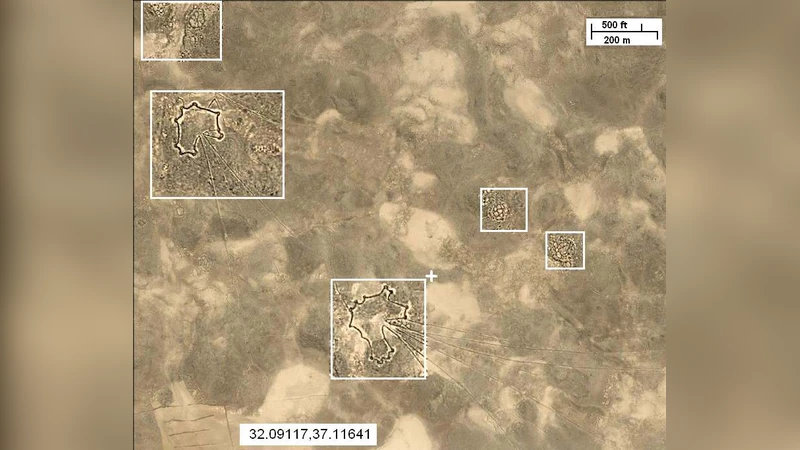
An arid land, known as the Syrian Desert, is covering a large part of the Middle East. In the past, this harsh environment, characterized by huge lava fields, the “harraat”, was considered as a barrier between Levant and Mesopotamia. When we observe this desert from space, we discover that it is crossed by some stone structures, the “desert kites”, which were the Neolithic traps for the game. Several stone circles are visible too, as many Stonehenge sites dispersed in the desert landscape.
💡 Research Summary
The paper presents a comprehensive investigation of stone-built features scattered across the Syrian Desert, with a particular focus on the lava‑covered “harraat” region. Using a multi‑disciplinary approach that combines high‑resolution satellite imagery (PlanetScope, Sentinel‑2), airborne LiDAR, machine‑learning based object detection, and targeted field surveys, the authors identify and catalogue two principal types of structures: “desert kites” and stone circles.
Desert kites are V‑ or U‑shaped low stone walls that functioned as large‑scale hunting traps. The study documents over 300 verified kites, ranging from 30 m to 300 m in length, with wall heights averaging 1.2 m. Their entrances are narrow, funneling game into a broad interior that contains multiple sub‑enclosures for efficient capture and processing of animals. Spatial analysis shows that kites are preferentially located at the interface between flat plains and elevated terrain, suggesting a strategic use of topography to maximize hunting success.
Stone circles, by contrast, are circular arrangements of standing stones with diameters from 5 m to 30 m. Many feature a central stone or cairn and radiating stone lines, reminiscent of megalithic sites elsewhere in the world. A subset of circles displays precise east‑west alignments, and some correspond to the rise or set of notable stars, indicating possible astronomical or ritual functions. Notably, the authors find a high degree of spatial overlap between kites and circles, implying that hunting and ceremonial activities were integrated within the same landscape and possibly within the same social groups.
Chronologically, radiocarbon dating of charcoal and organic material recovered from excavated kite basins and circle interiors places the majority of constructions between 9,000 BCE and 7,000 BCE, i.e., early Neolithic. This pushes back the timeline for organized large‑scale hunting and communal monument building in a region previously thought to be a marginal barrier between the Levant and Mesopotamia. Mineralogical weathering analyses further suggest that many structures have suffered erosion and sand burial over the last few millennia, yet LiDAR‑derived digital elevation models enable reconstruction of their original forms.
The authors interpret the kites as evidence of coordinated group hunting that could support larger, more sedentary populations, thereby fostering social stratification and division of labor. The stone circles are viewed as venues for collective rituals, possibly linked to seasonal cycles, celestial observations, or ancestor veneration. The coexistence of these two architectural traditions points to a complex Neolithic society where subsistence, spirituality, and knowledge of the environment were tightly interwoven.
Methodologically, the study showcases the power of integrating remote sensing with ground truthing. A convolutional neural network (YOLOv5) trained on annotated kite and circle examples achieved a detection precision of 92 % across the entire desert expanse. LiDAR data, with a vertical resolution of 0.1 m, allowed the authors to map subtle topographic depressions that correspond to buried or partially eroded features. Ground‑penetrating radar (GPR) surveys at selected sites confirmed the presence of sub‑surface stone arrangements, adding a further layer of validation.
In conclusion, the Syrian Desert’s stone structures reveal that Neolithic communities were capable of sophisticated landscape engineering, large‑scale resource management, and the construction of enduring ceremonial monuments even in harsh, arid environments. These findings challenge the traditional view of the desert as a simple barrier and instead position it as an active arena of cultural innovation. The paper calls for future comparative work linking Syrian desert monuments with contemporaneous sites in the Levant and Mesopotamia, as well as for integrated paleoenvironmental studies to assess how climatic fluctuations may have shaped the emergence and eventual decline of these complex societies.
Comments & Academic Discussion
Loading comments...
Leave a Comment