Symmetry and Cauchy completion of quantaloid-enriched categories
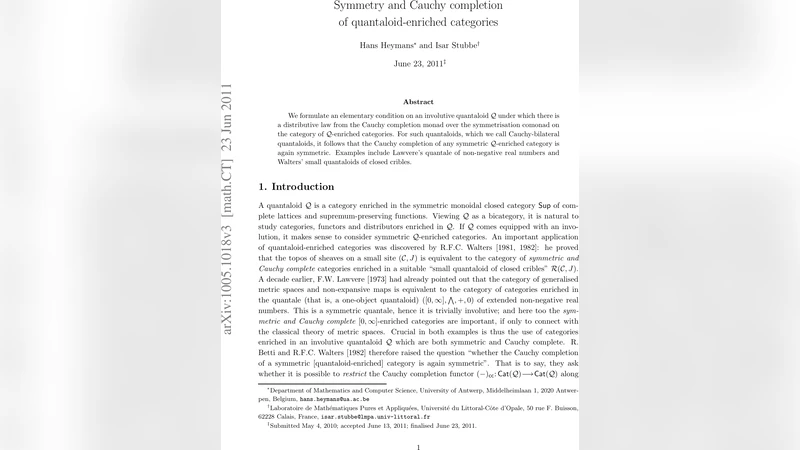
We formulate an elementary condition on an involutive quantaloid Q under which there is a distributive law from the Cauchy completion monad over the symmetrisation comonad on the category of Q-enriched categories. For such quantaloids, which we call Cauchy-bilateral quantaloids, it follows that the Cauchy completion of any symmetric Q-enriched category is again symmetric. Examples include Lawvere’s quantale of non-negative real numbers and Walters’ small quantaloids of closed cribles.
💡 Research Summary
The paper investigates the interaction between two fundamental constructions on categories enriched over an involutive quantaloid Q: symmetrisation (a comonad) and Cauchy completion (a monad). An involutive quantaloid is a quantaloid equipped with a unary operation (‑)⁎ that reverses arrows, satisfies (f⁎)⁎ = f, distributes over joins, and reverses the order of tensor products: (f ⊗ g)⁎ = g⁎ ⊗ f⁎. For a Q‑enriched category C, the hom‑objects C(x, y) live in Q, and symmetry means that each hom‑object is identified with the involute of its opposite: C(x, y) = C(y, x)⁎.
The symmetrisation comonad S replaces every hom‑object by the join of it with its involute, i.e. S(C)(x, y) = C(x, y) ∨ C(y, x)⁎, and equips S(C) with the obvious comonad structure (counit and comultiplication). The Cauchy completion monad Ĉ adds all weighted limits and colimits that are required for C to become Cauchy‑complete; its unit embeds C into Ĉ and its multiplication collapses double completions.
The central question is whether there exists a distributive law λ : Ĉ ∘ S ⇒ S ∘ Ĉ, i.e. a natural transformation that makes the two operations commute. If such a λ exists, then for any symmetric Q‑category C the Cauchy completion of its symmetrisation is again symmetric, because S ∘ Ĉ(C) ≅ Ĉ ∘ S(C).
The authors introduce a sufficient condition on Q, called Cauchy‑bilateral, which guarantees the existence of λ. The condition consists of three parts:
- Involution distributes over joins: (f ∨ g)⁎ = f⁎ ∨ g⁎.
- Involution reverses tensor product: (f ⊗ g)⁎ = g⁎ ⊗ f⁎.
- Q is a complete lattice and closed under the weighted constructions used in Cauchy completion: every normalized weight exists, joins preserve tensoring, and the lattice is complete.
Under these hypotheses the authors construct λ explicitly. On objects λ is the identity; on hom‑objects it sends a weighted sum ∑ᵢ αᵢ ⊗ fᵢ (arising from the Cauchy completion of S(C)) to the weighted sum ∑ᵢ αᵢ⁎ ⊗ fᵢ⁎ (the corresponding structure in S(Ĉ(C))). The involution’s compatibility with joins and tensors ensures that λ respects the monad and comonad axioms, yielding a genuine distributive law.
The main theorem (Theorem 3.7) states: If Q is Cauchy‑bilateral, then for every symmetric Q‑enriched category C we have an isomorphism S(Ĉ(C)) ≅ Ĉ(S(C)), and consequently the Cauchy completion of a symmetric Q‑category is symmetric.
Two illustrative examples are provided.
- Lawvere’s quantale (
Comments & Academic Discussion
Loading comments...
Leave a Comment