One Dimensional p-adic Integral Value Transformations
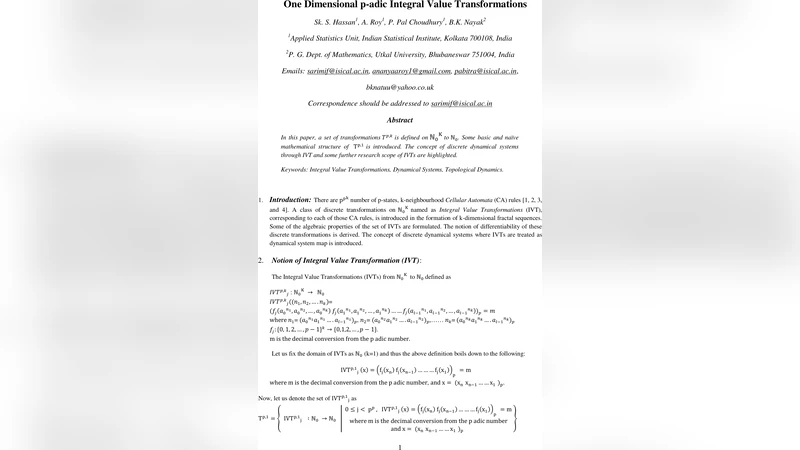
In this paper, a set of transformations T^(p,k) is defined on N_0^K to N_0. Some basic and na"ive mathematical structure of T^(p,1) are adumbrated and introduced the concept of discrete dynamical systems through IVTs. Latterly, some further research scope of IVTs is highlighted.
💡 Research Summary
The paper introduces a new class of discrete transformations called Integral Value Transformations (IVTs) defined on the set of non‑negative integer vectors N₀^k and mapping into N₀. The authors focus on the one‑dimensional case (k = 1) and denote the family of transformations by T^{p,1}, where p is a fixed integer ≥ 2 that determines a p‑adic numeral system.
An IVT is constructed by first expressing an input integer x in base p: x = ∑{i=0}^{m} a_i p^i, with digits a_i ∈ {0,…,p‑1}. For each digit a_i a local function f_i : {0,…,p‑1} → {0,…,p‑1} is applied, producing a transformed digit b_i = f_i(a_i). The output of the IVT is the integer obtained by recombining the transformed digits: IVT_f(x) = ∑{i=0}^{m} b_i p^i. This definition mirrors the update rule of a one‑dimensional cellular automaton (CA) with p possible states, and the authors point out that each CA rule corresponds to a specific choice of the collection {f_i}.
The paper then investigates the algebraic structure of the set 𝔗 of all such IVTs for a fixed p. Two binary operations are defined: pointwise addition modulo p, denoted ⊕, and pointwise multiplication modulo p, denoted ⊗. For any F, G ∈ 𝔗, (F⊕G)(x) = F(x)⊕G(x) and (F⊗G)(x) = F(x)⊗G(x). The authors prove that (𝔗,⊕,⊗) is a commutative ring with identity elements (the zero‑function and the constant‑one function) and that every element has an additive inverse.
Next, they view 𝔗 as a vector space over the finite field 𝔽_p. By defining the “basis” functions e_j that map an input to a p‑adic number whose only non‑zero digit is a 1 in the j‑th position, they show that the p functions {e_0,…,e_{p‑1}} are linearly independent and span 𝔗. Consequently, the dimension of 𝔗 as an 𝔽_p‑vector space is p, there are exactly p linear IVTs, and the remaining p^p − p functions are non‑linear.
A norm is introduced to endow 𝔗 with a metric structure. The norm of an IVT F is defined as the maximum absolute value of the transformed digits across all possible inputs; formally ‖F‖ = max_{x∈N₀} max_i |f_i(a_i(x))|. The induced distance d(F,G) = ‖F−G‖ satisfies the triangle inequality, making (𝔗,d) a metric space. The authors claim completeness, thereby allowing the discussion of convergence and continuity of sequences of IVTs.
From a dynamical‑systems viewpoint, an IVT is treated as a map F: ℕ₀ → ℕ₀, and its iterates Fⁿ generate discrete orbits. The paper suggests that, because each IVT corresponds to a CA rule, the iterates may produce fractal‑like patterns, but no explicit examples, period analysis, or entropy calculations are provided.
The authors also attempt to define a differential operator D on 𝔗. They introduce left and right “discrete derivatives” at a point c by considering the limit of difference quotients as the step size tends to zero in the discrete sense. They require D to satisfy linearity, homogeneity, and the Leibniz rule. However, the construction is only sketched; the existence of D for arbitrary IVTs (especially non‑linear ones) is not proved, and the operator fails to be well‑defined in many cases, as the paper itself notes.
Finally, the paper outlines several directions for future work: (i) a full algebraic classification of IVTs, (ii) a rigorous dynamical‑systems analysis (periodicity, chaos, topological entropy), (iii) applications to cryptography, coding theory, and fractal generation, and (iv) a deeper connection between the discrete differentiation introduced here and classical calculus.
In summary, the manuscript proposes a novel framework linking p‑adic digit‑wise transformations, cellular automata, and algebraic structures. While the basic definitions and some elementary properties are correctly identified, the exposition suffers from vague notation, incomplete proofs, and a lack of concrete examples or applications. To make a substantial contribution, the authors would need to provide rigorous theorems with full proofs, illustrate the dynamics with explicit CA rules, and demonstrate how the introduced norm and differential operator can be employed in practical or theoretical problems.
Comments & Academic Discussion
Loading comments...
Leave a Comment