Noncommutative elliptic theory. Examples
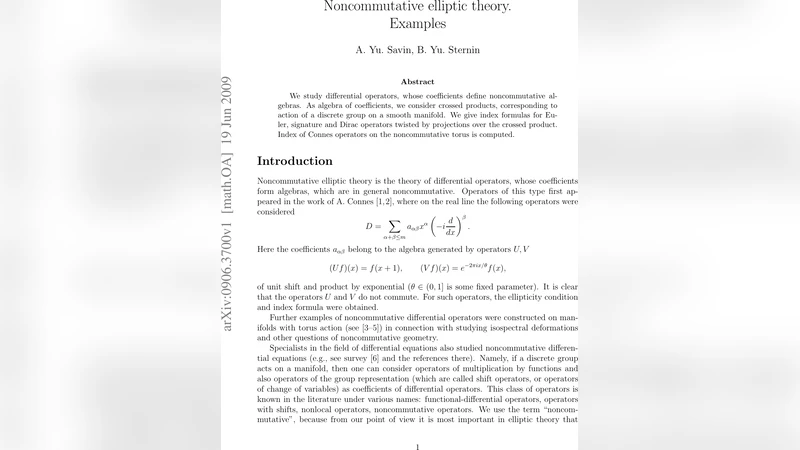
We study differential operators, whose coefficients define noncommutative algebras. As algebra of coefficients, we consider crossed products, corresponding to action of a discrete group on a smooth manifold. We give index formulas for Euler, signature and Dirac operators twisted by projections over the crossed product. Index of Connes operators on the noncommutative torus is computed.
💡 Research Summary
The paper develops a systematic theory of elliptic differential operators whose coefficients belong to non‑commutative algebras arising as crossed products (C^\infty(M)\rtimes\Gamma), where a discrete group (\Gamma) acts smoothly on a compact manifold (M). After recalling the classical Atiyah‑Singer framework, the authors introduce the crossed‑product algebra, describe its basic properties, and explain how it retains a smooth structure while acquiring non‑commutativity from the group action.
A “non‑commutative elliptic operator” is defined as a differential operator whose symbol is a (\Gamma)-invariant function on the cotangent bundle, taking values in the crossed product. The symbol defines a class in the K‑theory group (K^0(T^*M\rtimes\Gamma)). By constructing appropriate (\Gamma)-invariant Sobolev spaces and using the module structure over the crossed product, the authors prove that such operators are Fredholm.
The central result is an index formula for operators twisted by a projection (p\in M_n(C^\infty(M)\rtimes\Gamma)). The index is expressed as a pairing between the non‑commutative Chern character (\operatorname{Ch}(p)) and a Todd class (\operatorname{Td}(TM\rtimes\Gamma)) that incorporates the crossed‑product structure:
\
Comments & Academic Discussion
Loading comments...
Leave a Comment