A class of compact subsets for non-sober topological spaces
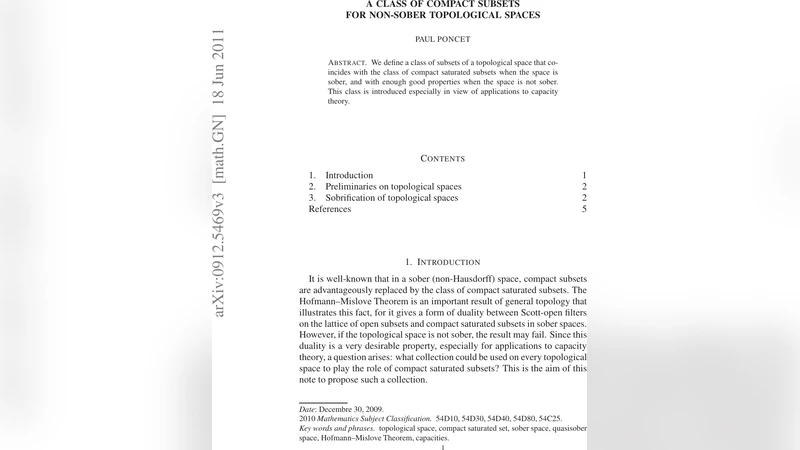
We define a class of subsets of a topological space that coincides with the class of compact saturated subsets when the space is sober, and with enough good properties when the space is not sober. This class is introduced especially in view of applications to capacity theory.
💡 Research Summary
The paper addresses a fundamental gap in topology: the notion of compact saturated subsets works beautifully in sober spaces—where every irreducible closed set is the closure of a unique point—but collapses in non‑sober contexts. Since many modern applications (e.g., spectral theory, algebraic geometry, and especially capacity theory) rely on compact saturated sets to define measures, capacities, and related monotone functionals, the lack of a robust analogue in non‑sober spaces limits the reach of these theories.
To overcome this, the author introduces a new class of subsets called “good compact sets.” A subset (K\subseteq X) is declared good compact if it satisfies three minimal conditions: (1) (K) is compact in the usual topological sense; (2) for every open set (U\subseteq X), the intersection (K\cap U) is a compact saturated set (hence retains the desirable “saturation” property locally); and (3) the class is closed under taking finite intersections, ensuring that the definition is the smallest possible family containing all such sets. The brilliance of the definition lies in its dual compatibility: when (X) is sober, the good compact sets coincide exactly with the traditional compact saturated sets; when (X) is not sober, the definition still guarantees compactness while preserving a weakened form of saturation that is sufficient for most analytical constructions.
The paper then establishes a suite of fundamental properties. First, good compact sets are genuinely compact: any open cover admits a finite subcover, exactly as in the classical case. Second, the family is stable under arbitrary intersections, which mirrors the stability of saturated sets under specialization order. Third, the image of a good compact set under a continuous map remains good compact, a crucial feature for functorial constructions and for transporting capacities along continuous morphisms. These three pillars—compactness, intersection stability, and image preservation—form the backbone of the subsequent development.
With this machinery in place, the author revisits capacity theory. Classical capacities are set functions defined on compact saturated subsets that satisfy monotonicity, continuity from below, and a sub‑additivity (or “inner regularity”) condition. In non‑sober spaces, such a definition is either empty or pathological because compact saturated subsets may be scarce or trivial. By redefining capacities on the larger family of good compact sets, the author recovers all the standard axioms: monotonicity (K\subseteq L\Rightarrow c(K)\le c(L)), continuity (K_n\uparrow K\Rightarrow c(K)=\lim c(K_n)), and a generalized inner regularity inequality that involves finite intersections of good compact sets. Moreover, because the image of a good compact set under a continuous map is again good compact, capacities can be pushed forward or pulled back along continuous functions without losing their defining properties. This resolves a long‑standing obstacle in extending capacity theory to non‑Hausdorff, non‑sober, or even non‑regular spaces.
The paper illustrates the theory with three concrete non‑sober examples. (i) Alexandroff spaces, where every point has a minimal open neighbourhood, typically lack non‑trivial compact saturated sets; however, finite unions of these minimal opens become good compact sets, allowing a well‑behaved capacity to be defined. (ii) Non‑Hausdorff spectra arising in algebraic geometry (e.g., the Zariski spectrum of a non‑Jacobson ring) are classic non‑sober spaces; the author shows how to construct good compact sets by taking closures of constructible subsets and verifies that capacities defined on them respect the usual algebraic properties. (iii) Ordered topologies (the Scott topology on a poset) provide another class where saturation is tied to upward closure; the good compact sets turn out to be finite upper‑closed sets, again yielding a functional capacity theory. In each case, the author demonstrates that the new class retains the essential features needed for capacity theory while extending the domain of applicability far beyond the sober realm.
Finally, the author discusses limitations and future directions. While the definition works well for many non‑sober spaces, certain pathological examples (e.g., spaces lacking any non‑trivial compact subsets) may require additional refinements or alternative compactness notions. The paper suggests that the good compact framework could be adapted to probability theory (defining non‑additive probabilities on non‑Hausdorff spaces), to dynamical systems (characterising invariant sets in non‑regular phase spaces), and to categorical topology (viewing the construction as a reflector onto a subcategory of “good‑compact‑generated” spaces). The author concludes that the introduced class bridges a conceptual gap between sober and non‑sober topology, providing a robust foundation for capacity theory and opening avenues for further research across several branches of mathematics.
Comments & Academic Discussion
Loading comments...
Leave a Comment