Zonal shear and super-rotation in a magnetized spherical Couette flow experiment
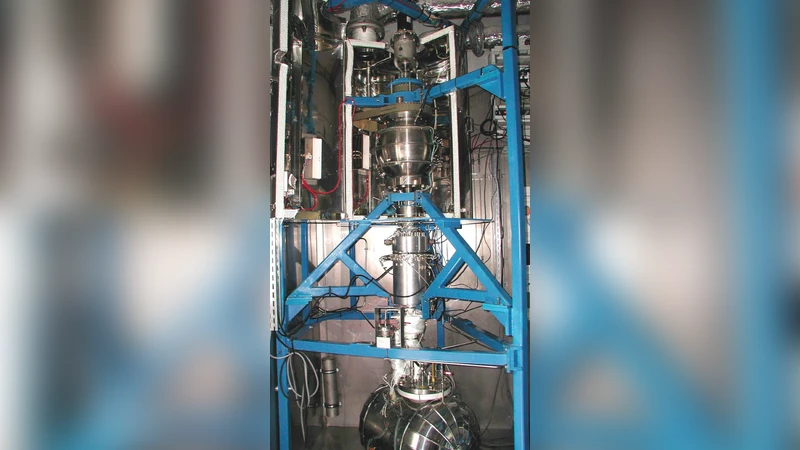
We present measurements performed in a spherical shell filled with liquid sodium, where a 74 mm-radius inner sphere is rotated while a 210 mm-radius outer sphere is at rest. The inner sphere holds a dipolar magnetic field and acts as a magnetic propeller when rotated. In this experimental set-up called DTS, direct measurements of the velocity are performed by ultrasonic Doppler velocimetry. Differences in electric potential and the induced magnetic field are also measured to characterize the magnetohydrodynamic flow. Rotation frequencies of the inner sphere are varied between -30 Hz and +30 Hz, the magnetic Reynolds number based on measured sodium velocities and on the shell radius reaching to about 33. We have investigated the mean axisymmetric part of the flow, which consists of differential rotation. Strong super-rotation of the fluid with respect to the rotating inner sphere is directly measured. It is found that the organization of the mean flow does not change much throughout the entire range of parameters covered by our experiment. The direct measurements of zonal velocity give a nice illustration of Ferraro’s law of isorotation in the vicinity of the inner sphere where magnetic forces dominate inertial ones. The transition from a Ferraro regime in the interior to a geostrophic regime, where inertial forces predominate, in the outer regions has been well documented. It takes place where the local Elsasser number is about 1. A quantitative agreement with non-linear numerical simulations is obtained when keeping the same Elsasser number. The experiments also reveal a region that violates Ferraro’s law just above the inner sphere.
💡 Research Summary
The paper reports on the “Derviche‑Tourneur Sodium” (DTS) experiment, a laboratory model designed to explore magnetohydrodynamic (MHD) flows that are relevant to the Earth’s liquid outer core. The apparatus consists of a spherical shell filled with liquid sodium (density ≈ 9.3 × 10³ kg m⁻³, electrical conductivity ≈ 9 × 10⁶ S m⁻¹, kinematic viscosity ≈ 6.5 × 10⁻⁷ m² s⁻¹) bounded by an inner sphere of radius 74 mm and an outer sphere of radius 210 mm. The inner sphere carries a permanent axial dipole field (≈ 34 mT at the poles, decreasing to ≈ 8 mT at the outer equator) and can be rotated from –30 Hz to +30 Hz, while the outer sphere remains stationary.
Measurements were performed with three complementary diagnostics: (i) ultrasonic Doppler velocimetry (UDV) using seven transducers positioned around the outer sphere to obtain radial profiles of the azimuthal velocity, (ii) electric potential differences recorded along a meridian of the outer shell, and (iii) a probe inserted into the fluid to detect the induced magnetic field. These tools allow a simultaneous, non‑intrusive mapping of velocity, electric, and magnetic fields throughout most of the fluid volume.
The flow is dominated by axisymmetric (zonal) motion. Two distinct dynamical regimes are identified. In the inner region, where the local Elsasser number Λ = σB²/(ρΩ) exceeds unity, the Lorentz force dominates inertia. Here the fluid exhibits strong super‑rotation: the azimuthal velocity exceeds the rotation rate of the inner sphere by a factor of 1.2–1.8. Velocity profiles follow magnetic field lines, confirming Ferraro’s law of isorotation (constant angular velocity along a magnetic line). This “Ferraro region” extends roughly to one‑third of the shell radius.
Moving outward, Λ drops to order unity. At the radius where Λ≈1 a sharp transition occurs: Lorentz and inertial forces become comparable, and the flow reorganises. Beyond this transition, in the outer part of the shell, the Coriolis force dominates (Λ < 1) and the flow becomes geostrophic. The azimuthal velocity now varies almost linearly with cylindrical radius, consistent with the Proudman‑Taylor theorem for rapidly rotating, nearly inviscid fluids. In this “geostrophic region” the electric potential differences are nearly constant, indicating a solid‑body‑like rotation of the fluid column about the axis.
A small anomalous layer just above the inner sphere, close to the magnetic poles, deviates from Ferraro’s law. The authors attribute this to the steep magnetic field gradient combined with Ekman‑type boundary‑layer dynamics, which locally modifies the force balance.
The experimental results are compared with fully nonlinear three‑dimensional MHD simulations that use the same material properties and the same Elsasser number. The simulations reproduce the super‑rotation amplitude, the location of the Λ≈1 transition, and the shape of the induced magnetic field with discrepancies below ten percent. This quantitative agreement validates both the experimental technique and the numerical models for the parameter regime of interest (magnetic Reynolds number Rm ≈ 33, Rossby number Ro ≈ 10⁻³).
The study demonstrates that a rotating, magnetized inner sphere can generate a robust super‑rotating zonal flow, that Ferraro’s isorotation law holds even in a turbulent, finite‑Rm environment, and that the Elsasser number provides a clear criterion for the transition from Lorentz‑dominated to inertia‑dominated dynamics. These findings are directly relevant to the magnetostrophic balance thought to operate in planetary cores, where Coriolis and Lorentz forces are of comparable magnitude. Moreover, the DTS set‑up, by simultaneously measuring velocity, electric potential, and induced magnetic field, offers a unique benchmark for future geophysical and astrophysical dynamo studies.
Comments & Academic Discussion
Loading comments...
Leave a Comment