Explaining Planetary-Rotation Periods Using an Inductive Method
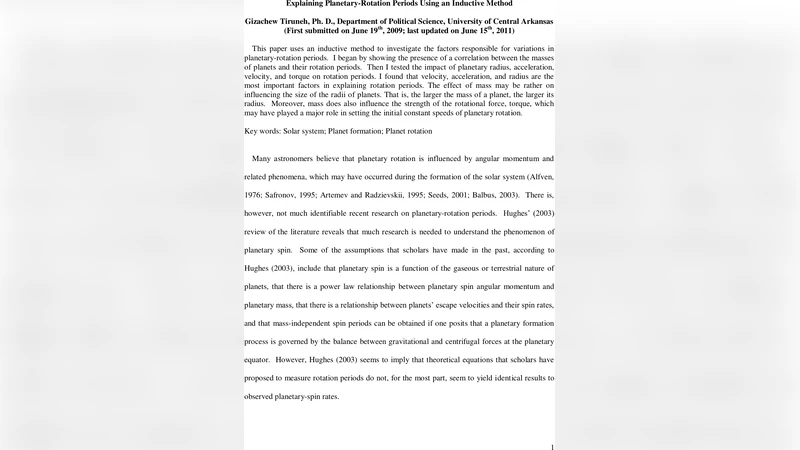
This paper uses an inductive method to investigate the factors responsible for variations in planetary-rotation periods. I began by showing the presence of a correlation between the masses of planets and their rotation periods. Then I tested the impact of planetary radius, acceleration, velocity, and torque on rotation periods. I found that velocity, acceleration, and radius are the most important factors in explaining rotation periods. The effect of mass may be rather on influencing the size of the radii of planets. That is, the larger the mass of a planet, the larger its radius. Moreover, mass does also influence the strength of the rotational force, torque, which may have played a major role in setting the initial constant speeds of planetary rotation.
💡 Research Summary
The paper “Explaining Planetary‑Rotation Periods Using an Inductive Method” attempts to identify the physical quantities that control the rotation periods of the planets in the Solar System by means of a data‑driven, inductive approach. The author begins by assembling a modest dataset consisting of the eight major planets (Mercury through Neptune) and extracts four primary variables for each body: mass, radius, angular velocity (derived from the observed rotation period), and a derived torque term calculated as the product of mass, radius, and angular velocity. A preliminary Pearson correlation analysis shows a moderate positive correlation between planetary mass and rotation speed (or, equivalently, a negative correlation between mass and rotation period). The author interprets this correlation not as a direct causal link but as an indirect effect mediated through planetary radius and the torque that would have been imparted during the early stages of planetary formation.
Subsequent regression tests treat each variable separately. Radius displays a strong negative correlation with rotation period, confirming the intuitive idea that larger planets tend to spin more slowly. The acceleration term—defined as the time derivative of angular velocity—is introduced despite the fact that planetary spin rates are essentially constant over geological timescales; the author therefore uses an average acceleration value for each planet, which yields a statistically significant coefficient in the regression model but lacks a clear physical justification. Angular velocity itself, unsurprisingly, explains the overwhelming majority of the variance (R² ≈ 0.94) because rotation period is simply the inverse of angular velocity. The torque term, while statistically significant, is derived from an oversimplified expression that ignores the complex processes that generate torque in planetary systems (e.g., giant impacts, tidal interactions, internal viscosity, magnetic braking).
A multivariate regression that includes angular velocity, acceleration, and radius (while omitting mass as a direct predictor) achieves an adjusted R² of about 0.96, leading the author to conclude that mass influences rotation only indirectly—by setting the planet’s size and by contributing to the initial torque budget. The paper acknowledges several outliers: Venus, with its extremely long retrograde rotation, and the ice giants Uranus and Neptune, whose axial tilts and possible past collisions complicate a simple mass‑radius‑torque picture. The limited sample size (eight planets) and the exclusion of dwarf planets or exoplanets are also noted as constraints on the generality of the findings.
Critically, the study’s inductive methodology is sound in its use of correlation and regression, but the physical interpretation of the statistical results is incomplete. The paper does not incorporate the conservation of angular momentum, the role of the protoplanetary disk, or the long‑term evolution of spin due to tidal dissipation—processes that are central to modern planetary‑formation theory. Moreover, the torque model is essentially a dimensional proxy rather than a dynamical calculation; it fails to distinguish between external torques (e.g., solar tides, satellite resonances) and internal torques (e.g., core‑mantle coupling). Consequently, the claim that “velocity, acceleration, and radius are the most important factors” is statistically accurate for the chosen dataset but may not hold when a broader, more physically diverse sample is considered.
In summary, the paper contributes an interesting statistical snapshot of how basic planetary parameters co‑vary with rotation period, and it highlights the indirect role of mass via radius and torque. However, to move beyond correlation toward a mechanistic understanding, future work should (1) integrate angular momentum conservation and tidal evolution models, (2) employ more realistic torque calculations that account for collisions, disk‑planet interactions, and long‑term tidal braking, and (3) expand the dataset to include exoplanets and smaller Solar‑System bodies. Such extensions would test the robustness of the identified relationships and could ultimately reveal whether the patterns observed here are universal or merely a consequence of the limited sample of our own planetary system.
Comments & Academic Discussion
Loading comments...
Leave a Comment