Convex hulls of spheres and convex hulls of convex polytopes lying on parallel hyperplanes
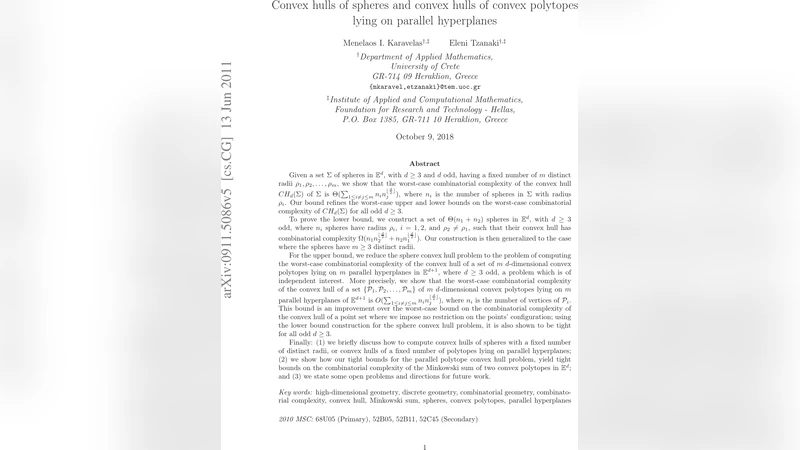
Given a set $\Sigma$ of spheres in $\mathbb{E}^d$, with $d\ge{}3$ and $d$ odd, having a fixed number of $m$ distinct radii $\rho_1,\rho_2,…,\rho_m$, we show that the worst-case combinatorial complexity of the convex hull $CH_d(\Sigma)$ of $\Sigma$ is $\Theta(\sum_{1\le{}i\ne{}j\le{}m}n_in_j^{\lfloor\frac{d}{2}\rfloor})$, where $n_i$ is the number of spheres in $\Sigma$ with radius $\rho_i$. To prove the lower bound, we construct a set of $\Theta(n_1+n_2)$ spheres in $\mathbb{E}^d$, with $d\ge{}3$ odd, where $n_i$ spheres have radius $\rho_i$, $i=1,2$, and $\rho_2\ne\rho_1$, such that their convex hull has combinatorial complexity $\Omega(n_1n_2^{\lfloor\frac{d}{2}\rfloor}+n_2n_1^{\lfloor\frac{d}{2}\rfloor})$. Our construction is then generalized to the case where the spheres have $m\ge{}3$ distinct radii. For the upper bound, we reduce the sphere convex hull problem to the problem of computing the worst-case combinatorial complexity of the convex hull of a set of $m$ $d$-dimensional convex polytopes lying on $m$ parallel hyperplanes in $\mathbb{E}^{d+1}$, where $d\ge{}3$ odd, a problem which is of independent interest. More precisely, we show that the worst-case combinatorial complexity of the convex hull of a set ${\mathcal{P}_1,\mathcal{P}_2,…,\mathcal{P}m}$ of $m$ $d$-dimensional convex polytopes lying on $m$ parallel hyperplanes of $\mathbb{E}^{d+1}$ is $O(\sum{1\le{}i\ne{}j\le{}m}n_in_j^{\lfloor\frac{d}{2}\rfloor})$, where $n_i$ is the number of vertices of $\mathcal{P}_i$. We end with algorithmic considerations, and we show how our tight bounds for the parallel polytope convex hull problem, yield tight bounds on the combinatorial complexity of the Minkowski sum of two convex polytopes in $\mathbb{E}^d$.
💡 Research Summary
The paper investigates the worst‑case combinatorial complexity of the convex hull of a set Σ of spheres in ℝ^d, where d ≥ 3 and d is odd, and the spheres have only m distinct radii ρ₁,…,ρ_m. Let n_i denote the number of spheres of radius ρ_i. The main result is that the complexity of CH_d(Σ) is Θ(∑_{i≠j} n_i n_j^{⌊d/2⌋}). This bound is tight: the authors construct explicit configurations that achieve the lower bound, and they prove an upper bound by reducing the problem to a related one involving convex polytopes lying on parallel hyperplanes in one higher dimension.
Lower‑bound construction.
For the simplest non‑trivial case m = 2, the authors place n₁ spheres of radius ρ₁ and n₂ spheres of radius ρ₂ (ρ₁ ≠ ρ₂) on two parallel hyperplanes H₁ and H₂ in ℝ^d. The centers on each hyperplane are arranged as vertices of a (d‑1)‑dimensional convex polytope. By carefully choosing the distance between H₁ and H₂, each sphere on H₁ touches many spheres on H₂, creating a large number of facets on the convex hull. The construction yields Ω(n₁ n₂^{⌊d/2⌋}+n₂ n₁^{⌊d/2⌋}) facets. The authors then generalize this arrangement to m ≥ 3 radii by inductively adding further layers, preserving the same asymptotic term for each pair of distinct radii.
Upper‑bound reduction.
The key insight is that a sphere can be represented as a point in ℝ^{d+1} together with its radius: map a sphere with center c and radius ρ to the point (c, ρ) on a hyperplane x_{d+1}=ρ. The set of all such lifted points for spheres of the same radius lies on a common hyperplane. The convex hull of the lifted points is exactly the convex hull of a collection of m convex polytopes 𝒫₁,…,𝒫_m, each lying on a distinct parallel hyperplane in ℝ^{d+1}. Consequently, bounding the complexity of CH_d(Σ) reduces to bounding the complexity of CH_{d+1}({𝒫_i}).
In ℝ^{d+1}, the authors analyze the convex hull of m d‑dimensional polytopes placed on parallel hyperplanes. They apply a shear transformation that aligns the hyperplanes, then project the configuration onto a common hyperplane. The projected arrangement is a set of points whose convex hull can be studied with classical high‑dimensional hull algorithms. The crucial geometric observation is that any facet of the hull that involves vertices from two distinct hyperplanes can be expressed as the convex hull of a (d‑1)-dimensional face from one polytope together with up to ⌊d/2⌋ vertices from the other polytope. This yields at most O(n_i n_j^{⌊d/2⌋}) new facets for each ordered pair (i, j). Summing over all i ≠ j gives the overall upper bound O(∑_{i≠j} n_i n_j^{⌊d/2⌋}).
Since the lower‑ and upper‑bound constructions match asymptotically, the authors establish the tight bound Θ(∑_{i≠j} n_i n_j^{⌊d/2⌋}) for the convex hull of spheres with a fixed set of radii.
Algorithmic implications and Minkowski sums.
The reduction to parallel‑hyperplane polytopes also yields an algorithmic pipeline: lift the spheres, compute the convex hull of the lifted polytopes using any optimal d‑dimensional hull algorithm, and project back. The running time matches the output size, i.e., O(∑_{i≠j} n_i n_j^{⌊d/2⌋}) plus the cost of constructing the lifted representation.
Finally, the authors apply the same analysis to the Minkowski sum of two convex polytopes A and B in ℝ^d. By embedding A and B on two parallel hyperplanes in ℝ^{d+1} and taking their convex hull, the Minkowski sum A⊕B is obtained as a cross‑section. Consequently, the combinatorial complexity of A⊕B is Θ(n_A n_B^{⌊d/2⌋}+n_B n_A^{⌊d/2⌋}), which improves upon previously known bounds for odd dimensions and matches the lower bound. This result is of independent interest for computational geometry applications such as motion planning, collision detection, and geometric modeling.
In summary, the paper delivers a complete, tight characterization of the convex hull complexity for spheres with a bounded number of distinct radii, introduces a novel reduction to parallel‑hyperplane polytope hulls, and leverages this framework to obtain optimal bounds for Minkowski sums of convex polytopes in odd dimensions.
Comments & Academic Discussion
Loading comments...
Leave a Comment