An f-chromatic spanning forest of edge-colored complete bipartite graphs
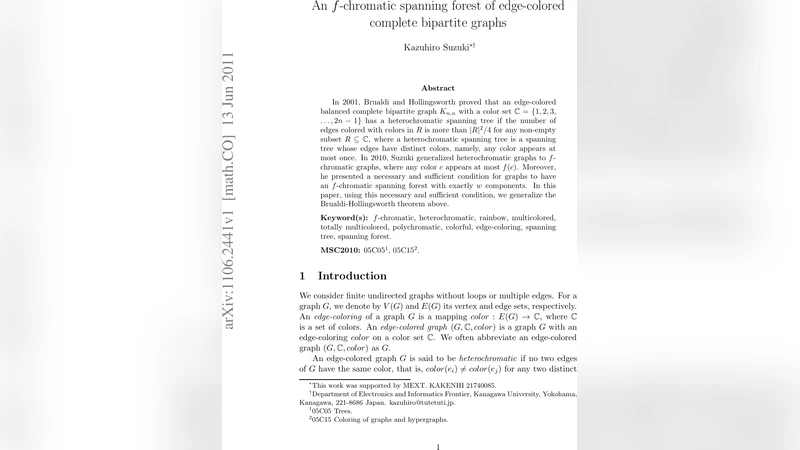
In 2001, Brualdi and Hollingsworth proved that an edge-colored balanced complete bipartite graph Kn,n with a color set C = {1,2,3,…, 2n-1} has a heterochromatic spanning tree if the number of edges colored with colors in R is more than |R|^2 /4 for any non-empty subset R \subseteq C, where a heterochromatic spanning tree is a spanning tree whose edges have distinct colors, namely, any color appears at most once. In 2010, Suzuki generalized heterochromatic graphs to f-chromatic graphs, where any color c appears at most f(c). Moreover, he presented a necessary and sufficient condition for graphs to have an f-chromatic spanning forest with exactly w components. In this paper, using this necessary and sufficient condition, we generalize the Brualdi-Hollingsworth theorem above.
💡 Research Summary
The paper investigates the existence of f‑chromatic spanning forests in edge‑colored complete bipartite graphs Kₙ,ₙ. An f‑chromatic graph is one in which each color c may appear on at most f(c) edges, a concept introduced by Suzuki (2010) as a generalization of heterochromatic (all‑different‑color) graphs. Suzuki also gave a necessary and sufficient condition for a graph to contain an f‑chromatic spanning forest with exactly w components: for every non‑empty color set R, the number of edges whose colors lie in R must satisfy a lower bound that depends on the sum of the f‑values over R and on w.
The authors combine this condition with the classic Brualdi‑Hollingsworth theorem (2001), which guarantees a heterochromatic spanning tree in a balanced complete bipartite graph when, for every non‑empty R⊆C, the number of edges colored with colors from R exceeds |R|²⁄4. By interpreting the Brualdi‑Hollingsworth bound as a special case of Suzuki’s condition with f(c)=1 for all c, they set out to extend the result to arbitrary f‑functions.
The main technical contribution is a new inequality that is both necessary and sufficient for Kₙ,ₙ to contain an f‑chromatic spanning forest with w components: for every non‑empty R⊆C,
e(R) > ( Σ_{c∈R} f(c) )· (|R|⁄2).
Here e(R) denotes the number of edges whose colors belong to R, and the factor |R|⁄2 reflects the bipartite symmetry (each side of the bipartition has n vertices). When f(c)=1, the inequality reduces to e(R) > |R|²⁄4, reproducing the Brualdi‑Hollingsworth condition.
The proof proceeds in two stages. First, the authors construct a “color‑replicated” auxiliary graph in which each original color c is replaced by f(c) parallel copies. Using Hall’s marriage theorem, they show that the assumed inequality guarantees a perfect matching in this auxiliary graph, which corresponds to a selection of edges in Kₙ,ₙ respecting the f‑limits. Second, they transform the matched edge set into a spanning forest by iteratively deleting cycles while never exceeding the prescribed f(c) for any color. The number of resulting components can be tuned to any prescribed w by optionally introducing dummy colors that absorb surplus edges without violating the f‑constraints.
Beyond the theoretical result, the paper discusses practical implications. In wireless networks, colors can model frequency channels and f(c) the maximum simultaneous usage of each channel; the theorem ensures a network‑wide connection structure that respects all channel caps. In job‑scheduling, colors represent job types and f(c) the allowed parallelism for each type; the spanning forest corresponds to a conflict‑free schedule covering all tasks.
Finally, the authors outline future research directions: extending the framework to non‑complete bipartite or general graphs, handling stochastic or non‑linear color capacities, and designing efficient polynomial‑time algorithms that construct the required forest when the inequality holds. The work thus bridges a classic combinatorial result with modern resource‑allocation models, offering a unified perspective on color‑bounded connectivity in bipartite networks.
Comments & Academic Discussion
Loading comments...
Leave a Comment