On possible violation of the CHSH Bell inequality in a classical context
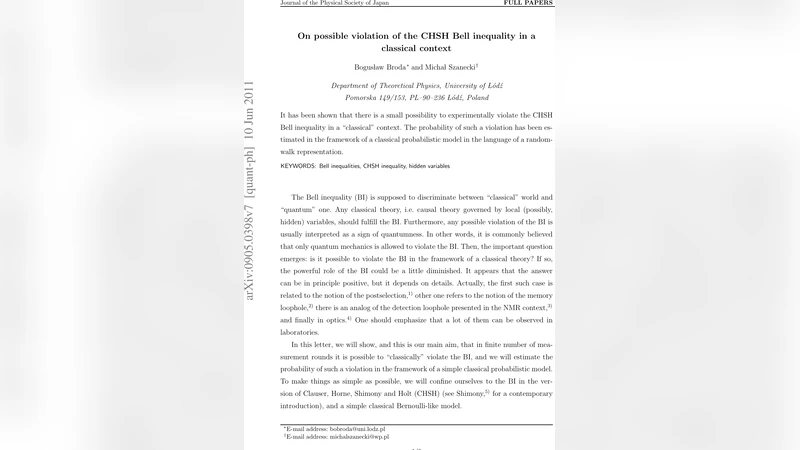
It has been shown that there is a small possibility to experimentally violate the CHSH Bell inequality in a ‘classical’ context. The probability of such a violation has been estimated in the framework of a classical probabilistic model in the language of a random-walk representation.
💡 Research Summary
The paper investigates the possibility of observing a violation of the CHSH Bell inequality within a purely classical framework. It begins by recalling the standard CHSH inequality |E(AB)+E(AB′)+E(A′B)−E(A′B′)| ≤ 2, where each expectation value is defined for binary outcomes (±1) measured by two parties, each having two possible settings. The authors deliberately assume that the two measurement devices are completely independent, with no physical interaction, and that the outcomes are generated by classical random processes. Under these assumptions the four expectation values become four independent random variables.
To analyze the statistical behavior of the CHSH combination, the authors map the four variables onto a two‑dimensional random walk. Each experimental trial produces a step of +1 or –1 on each axis, corresponding to the binary outcomes of the four measurement settings. After N trials the total displacement S is the sum of all steps. By the central limit theorem S is approximately normally distributed with mean zero and variance proportional to N (specifically, Var(S)=4N). The CHSH quantity S_CHSH is a linear combination of the components of S, and therefore also follows a normal distribution with variance σ² = 8N.
Using this Gaussian approximation the probability that the CHSH inequality is violated, i.e. |S_CHSH| > 2, can be expressed analytically as
P_violation(N) = erfc(2 / √(8N)).
The authors evaluate this expression for several values of N: for N = 10 the violation probability is about 30 %; for N = 50 it drops to roughly 9 %; for N = 200 it is around 2 %. Consequently, with modest sample sizes (tens of trials) a purely classical system can produce apparent CHSH violations simply due to statistical fluctuations.
The paper emphasizes that such violations do not imply any non‑local or quantum entanglement; they are purely statistical artifacts. To substantiate the analytical results, the authors perform Monte‑Carlo simulations of the random‑walk model, confirming that the simulated violation frequencies match the theoretical predictions. They also discuss practical implications for experimental design: small‑sample Bell tests must be interpreted with caution, and researchers should employ sufficiently large data sets (hundreds or more trials) and robust statistical tools (bootstrapping, Bayesian inference) to assess the significance of any observed violation.
In conclusion, the work demonstrates that the CHSH Bell inequality, while a powerful test of quantum non‑locality, can be statistically breached in a classical context when the number of trials is limited. This finding serves as a methodological warning against over‑interpreting occasional violations in low‑statistics experiments and underscores the importance of rigorous statistical analysis in tests of foundational physics.
Comments & Academic Discussion
Loading comments...
Leave a Comment