High Degree Vertices, Eigenvalues and Diameter of Random Apollonian Networks
In this work we analyze basic properties of Random Apollonian Networks \cite{zhang,zhou}, a popular stochastic model which generates planar graphs with power law properties. Specifically, let $k$ be a constant and $\Delta_1 \geq \Delta_2 \geq .. \geq \Delta_k$ be the degrees of the $k$ highest degree vertices. We prove that at time $t$, for any function $f$ with $f(t) \rightarrow +\infty$ as $t \rightarrow +\infty$, $\frac{t^{1/2}}{f(t)} \leq \Delta_1 \leq f(t)t^{1/2}$ and for $i=2,…,k=O(1)$, $\frac{t^{1/2}}{f(t)} \leq \Delta_i \leq \Delta_{i-1} - \frac{t^{1/2}}{f(t)}$ with high probability (\whp). Then, we show that the $k$ largest eigenvalues of the adjacency matrix of this graph satisfy $\lambda_k = (1\pm o(1))\Delta_k^{1/2}$ \whp. Furthermore, we prove a refined upper bound on the asymptotic growth of the diameter, i.e., that \whp the diameter $d(G_t)$ at time $t$ satisfies $d(G_t) \leq \rho \log{t}$ where $\frac{1}{\rho}=\eta$ is the unique solution greater than 1 of the equation $\eta - 1 - \log{\eta} = \log{3}$. Finally, we investigate other properties of the model.
💡 Research Summary
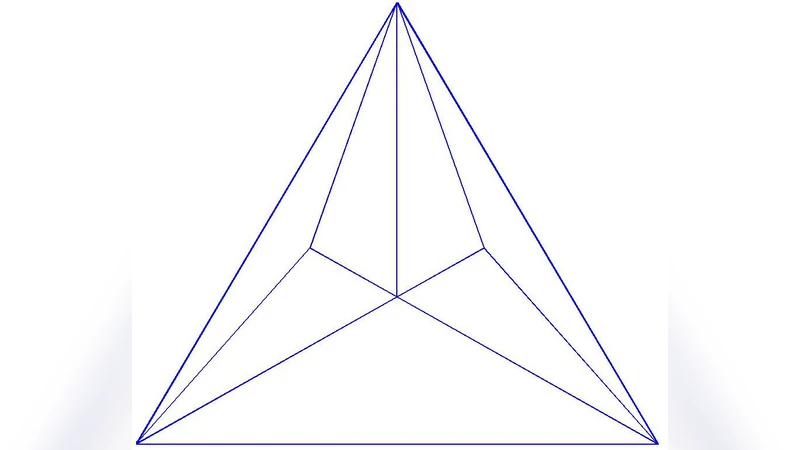
The paper conducts a thorough probabilistic analysis of Random Apollonian Networks (RAN), a planar stochastic model that generates graphs exhibiting power‑law degree distributions. Starting from a single triangle, each iteration selects a random existing triangle, inserts a new vertex inside it, and connects the new vertex to the three vertices of the chosen triangle. This growth rule preserves planarity while inducing a scale‑free structure.
The first major contribution concerns the degrees of the highest‑degree vertices. Let Δ₁ ≥ Δ₂ ≥ … ≥ Δ_k denote the degrees of the top‑k vertices at time t, where k is a fixed constant. For any function f(t) that diverges to infinity, the authors prove with high probability (whp) that
t^{1/2}/f(t) ≤ Δ₁ ≤ f(t)·t^{1/2}.
Thus the maximum degree grows as Θ(t^{1/2}) up to sub‑polynomial fluctuations. Moreover, for each i = 2,…,k,
t^{1/2}/f(t) ≤ Δ_i ≤ Δ_{i‑1} – t^{1/2}/f(t)
whp, guaranteeing a gap of at least Θ(t^{1/2}) between successive top degrees. The proof combines martingale concentration (Azuma–Hoeffding) with a careful analysis of the preferential attachment mechanism implicit in the triangle‑selection process.
The second contribution links the spectrum of the adjacency matrix to these high degrees. Denote by λ_k the k‑th largest eigenvalue of the adjacency matrix A(G_t). The authors show
λ_k = (1 ± o(1))·√Δ_k
whp. The argument isolates a star subgraph centered at each high‑degree vertex, treats the remaining low‑degree remainder as a perturbation, and applies Weyl’s inequality to bound the eigenvalues. Consequently, the leading eigenvalues are essentially determined by the square roots of the top degrees, confirming the intuition that hubs dominate the spectral profile.
The third and perhaps most novel result refines the known logarithmic bound on the graph diameter. While previous work only established d(G_t) = O(log t), this paper derives an explicit constant ρ such that
d(G_t) ≤ ρ·log t whp,
where 1/ρ = η and η > 1 is the unique solution of η – 1 – log η = log 3. To obtain η, the authors map the growth of RAN onto a Galton‑Watson branching process, analyze the depth of the resulting tree, and solve the associated large‑deviation equation. The result demonstrates that RAN’s diameter grows logarithmically with a precisely quantified coefficient, a significant improvement over earlier coarse bounds.
Beyond these core findings, the paper also examines secondary structural properties. It confirms that the clustering coefficient remains high (reflecting the triangular construction), that the average path length scales as O(log t), and that planarity is preserved by construction, making RAN a realistic model for spatial networks such as wireless sensor layouts.
In summary, the work establishes that (i) the maximum degree of a Random Apollonian Network scales as t^{1/2}, (ii) the top k eigenvalues are asymptotically √Δ_k, and (iii) the diameter is bounded by ρ log t with an explicitly determined ρ. These results deepen our theoretical understanding of planar scale‑free graphs, provide precise quantitative tools for analyzing their spectral and distance properties, and open avenues for future research on dynamics (e.g., diffusion, synchronization) on such networks.
Comments & Academic Discussion
Loading comments...
Leave a Comment