An alternative to the plasma emission model: Particle-In-Cell, self-consistent electromagnetic wave emission simulations of solar type III radio bursts
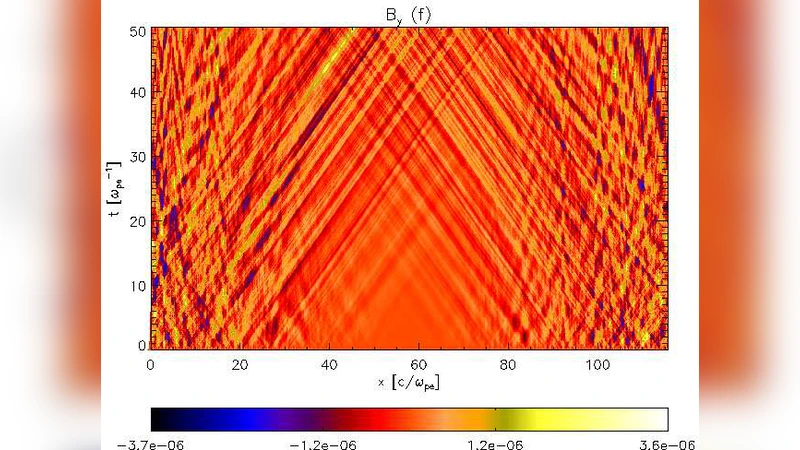
1.5D PIC, relativistic, fully electromagnetic (EM) simulations are used to model EM wave emission generation in the context of solar type III radio bursts. The model studies generation of EM waves by a super-thermal, hot beam of electrons injected into a plasma thread that contains uniform longitudinal magnetic field and a parabolic density gradient. In effect, a single magnetic line connecting Sun to earth is considered, for which several cases are studied. (i) We find that the physical system without a beam is stable and only low amplitude level EM drift waves (noise) are excited. (ii) The beam injection direction is controlled by setting either longitudinal or oblique electron initial drift speed, i.e. by setting the beam pitch angle. In the case of zero pitch angle, the beam excites only electrostatic, standing waves, oscillating at plasma frequency, in the beam injection spatial location, and only low level EM drift wave noise is also generated. (iii) In the case of oblique beam pitch angles, again electrostatic waves with same properties are excited. However, now the beam also generates EM waves with the properties commensurate to type III radio bursts. The latter is evidenced by the wavelet analysis of transverse electric field component, which shows that as the beam moves to the regions of lower density, frequency of the EM waves drops accordingly. (iv) When the density gradient is removed, electron beam with an oblique pitch angle still generates the EM radiation. However, in the latter case no frequency decrease is seen. Within the limitations of the model, the study presents the first attempt to produce simulated dynamical spectrum of type III radio bursts in fully kinetic plasma model. The latter is based on 1.5D non-zero pitch angle (non-gyrotropic) electron beam, that is an alternative to the plasma emission classical mechanism.
💡 Research Summary
The authors present a fully kinetic, relativistic particle‑in‑cell (PIC) study of solar type III radio burst generation that departs from the classical plasma‑emission paradigm. Using a 1.5‑dimensional electromagnetic code (one spatial dimension, two field components), they model a magnetised plasma thread with a uniform longitudinal magnetic field and a parabolic electron‑density gradient, mimicking a single magnetic flux tube extending from the Sun to the Earth. A suprathermal electron beam, representing a small fraction (~1 %) of the background density, is injected into this thread. The beam’s initial drift velocity is set either parallel to the magnetic field (zero pitch angle) or at an oblique angle (30°–45°), thereby creating a non‑gyrotropic (non‑axisymmetric) distribution.
Three principal simulation scenarios are examined:
-
Beam‑free reference case – The plasma without an injected beam remains stable; only low‑amplitude electromagnetic drift‑wave noise is observed, confirming that the numerical set‑up does not spontaneously generate spurious radiation.
-
Parallel‑beam case (zero pitch angle) – The beam excites strong electrostatic standing waves at the local plasma frequency (ω_pe) confined to the injection region. The transverse electromagnetic fields (E⊥, B⊥) remain at noise level, indicating that a purely field‑aligned beam does not couple efficiently to propagating EM modes.
-
Oblique‑beam case (non‑zero pitch angle) – The same beam now drives a transverse current because the electrons gyrate around the magnetic field. This current launches electromagnetic waves that propagate away from the injection site. Simultaneously, electrostatic plasma oscillations at ω_pe persist. Crucially, a wavelet analysis of the transverse electric field shows that as the beam travels into regions of lower density, the central frequency of the emitted EM wave drifts downward, reproducing the hallmark frequency‑time slope of type III bursts. When the density gradient is removed (uniform plasma), the oblique beam still radiates, but the frequency remains fixed, confirming that the gradient is responsible for the observed drift.
The results demonstrate that a non‑gyrotropic electron beam can directly generate escaping electromagnetic radiation without invoking the two‑step Langmuir‑to‑EM conversion required by the conventional plasma‑emission model. The frequency drift emerges naturally from the spatial variation of the plasma frequency along the magnetic field line, rather than from nonlinear wave‑wave coupling.
The study also discusses limitations. The 1.5‑D geometry suppresses transverse mode coupling and cannot capture fully three‑dimensional wave turbulence. Periodic boundary conditions and the relatively high level of numerical noise may affect growth rates. Ion dynamics are treated in a simplified manner, precluding investigation of ion‑acoustic contributions to the emission process. Despite these constraints, the work constitutes the first kinetic simulation that produces a synthetic dynamic spectrum resembling observed type III bursts, offering a viable alternative mechanism based on non‑gyrotropic beam‑driven emission.
In conclusion, the paper provides strong computational evidence that oblique, non‑gyrotropic electron beams in a magnetised, density‑graded plasma can emit type III‑like radio waves directly. This challenges the necessity of the classical plasma‑emission cascade and opens new avenues for interpreting solar radio observations, especially in regimes where strong magnetic fields and steep density gradients coexist. Future work should extend the model to full 2‑D/3‑D geometries, incorporate realistic solar wind parameters, and compare synthetic spectra quantitatively with spacecraft measurements.
Comments & Academic Discussion
Loading comments...
Leave a Comment