Applications of Classical Scaling Symmetry
Any symmetry reduces a second-order differential equation to a first-order equation: variational symmetries of the action (exemplified by central field dynamics) lead to conservation laws, but symmetries of only the equations of motion (exemplified b…
Authors: Sidney Bludman
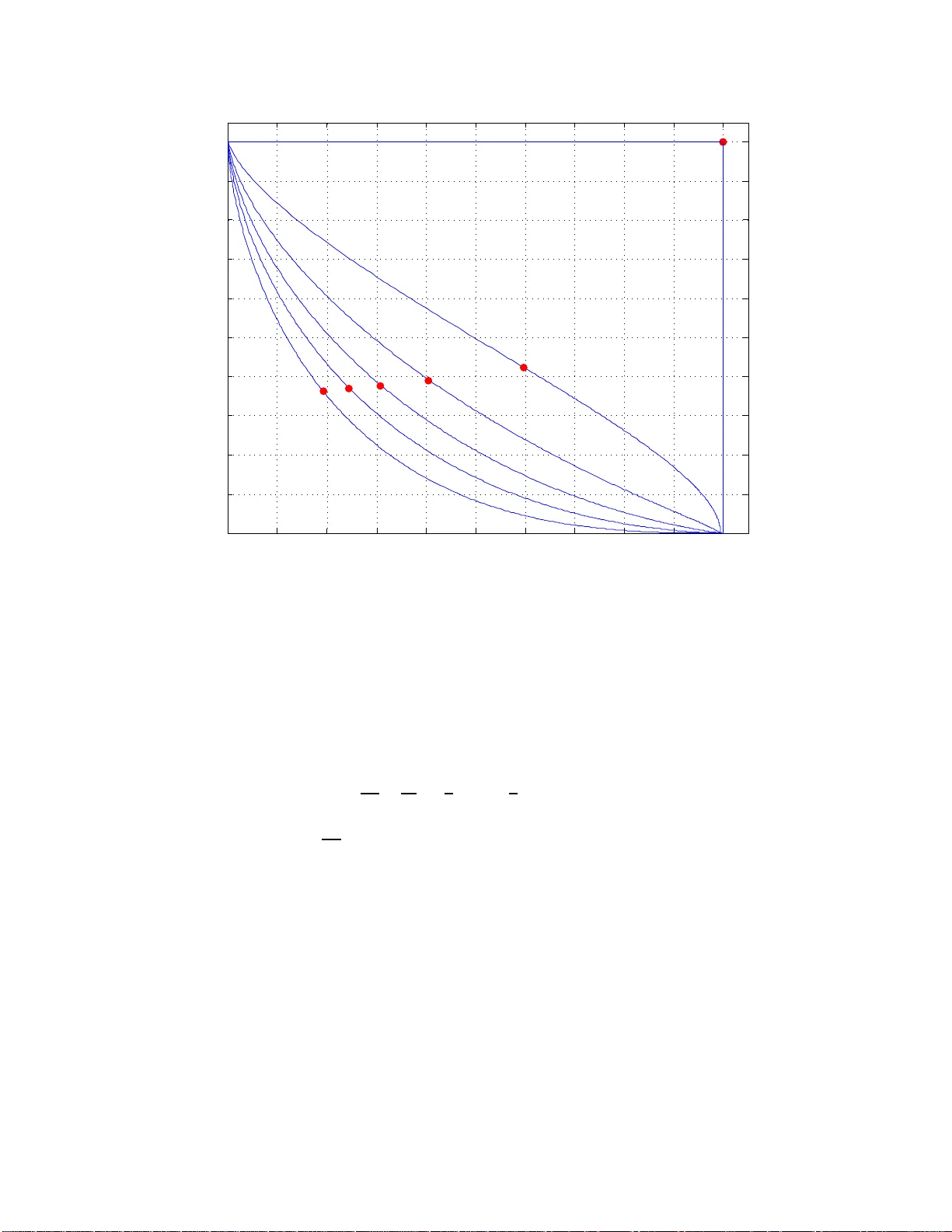
APPLICA TIONS OF CLA SSICAL SCALING SYMMETR Y Sidney Bludman ∗ Dep artamento de Astr onom ´ ıa, Uni versidad de Chi l e, Santiago, Chile (Dated: No vem b er 22, 2021) Any symmetry reduces a second-order differential equation to a first-order equation: va riational symmetries of the action (exemplified by cen t ral field dynamics) lead to conserv ation laws, but symmetries of only the equations of motion (exemplified b y scale-inv arian t hydrostatics), y ield first- order non-c onservat i on laws b etw een inv ariants. W e ob t ain these conserv ation laws by extending No et h er’s Theor em to non-v ariational symmetries, and presen t a v ariational form ulation of spherical adiabatic hydrostatics. F or scale-in vari ant hydrostatics, w e directly recov er all the pub lished p rop- erties of p olytrop es and d efine a c or e r adius , a new measure of mass concentration in p olytrop es of index n . The Emden solutions (regular solutions of the Lane-Emden equation) are fi n ally obt ained, along with useful app ro ximations. A n app endix discusses the sp ecial n = 3 p olytrop e, emphasizing how the same mechanical structure allo ws different thermosta tic structures in relativistic degenerate white d w arfs and and zero age main sequence stars. P ACS num b ers: 45.20.Jj, 45.50.-j, 47.10.A-, 47.10.ab, 47.10.Df , 95.30.Lz, 97.10.Cv I. SYMMETR Y REDUCES THE ORDER OF A D IFFERENTIAL EQUA TION No ether’s Theorem rela tes every variational symmetry to a conser v ation law, a first integral o f the equations o f motion, which can then be in teg rated dir ectly b y qua drature [1]. By an extension of No e ther’s Theorem, non- v ariational symmet ries of the e quations of motion also reduce them to r e duc e d eq ua tions, which a re not conserv atio n laws [2]. Consider any system describ ed by the Lag r angian L ( t, q i , ˙ q i ) and actio n S = R L ( t, q i , ˙ q i ) dt , where the q i are the co ordina tes , the dot desig nates the partial der iv a tive ∂ /∂ t with resp ect to the indep endent v ariable, and the Einstein summatio n co nven tion is assumed for rep eated indices. Under a ny infinitesimal p oint transformation δ ( t, q i ) , δ q j ( t, q i ) g enerated by δ t · ∂ /∂ t + δ q i · ∂ /∂ q i , velo cities a nd Lagr angian transfor m lo cally as δ ˙ q i = dδ q i dt − ˙ q i dδ t dt , δ L = ˙ L δ t + ( ∂ L /∂ q i ) δ q i + ( ∂ L /∂ ˙ q i ) h dδ q i dt − ˙ q i dδ t dt i = h dG dt − L · d ( δ t ) dt + D i · ( δ q i − ˙ q i δ t ) i , (1) in ter ms of the tota l deriv ative of the genera tor of the transforma tion, the No ether char ge G := L · δ t + p i · ( δ q i − ˙ q i δ t ) , (2) and the Euler-La grang e v a r iational deriv ative D i := ∂ L /∂ q i − d ( ∂ L / ∂ ˙ q i ) /dt . The v a riation in action betw een fixe d end p o ints is δ S 12 = Z 1 2 dt δ L = Z 1 2 dt h dG dt − L · d ( δ t ) dt + D i · ( δ q i − ˙ q i δ t ) i = G (1) − G (2) + Z 1 2 dt h δ q i · D i + δ t · d H dt + ∂ L ∂ t i , (3) after integrating the term in d ( δ t ) /dt by parts. The actio n principle asser ts that this v ar iation v anishes for indep endent v ariations δ q i , δ t that v anish at the end points. It implies the E ule r -Lagr ange equa tions D i = 0 and d H /dt = − ∂ L /∂ t , the r ate of c ha ng e of the Hamiltonian in non-holonomic systems. On-shell, w he r e D i = 0, δ S 12 = Z 1 2 ¯ δ L dt = G (1) − G (2) (4) dG dt = ¯ δ L := δ L + L · ( dδ t/dt ) . (5) ∗ Electronic address: sbludman@das.uchile.cl; URL: http://ww w.das.uc hile.cl/ ~ sbludman 2 This extension of No ether’s T he o rem describ es the evolution o f any genera to r or No ether charge, in terms of the transformatio n of the Lag rangia n it genera tes. It ex presses the Euler-L a grang e equatio ns of motion as the divergence of a No e ther charge, which v anis hes for a v ariatio nal symmetry , but not for a ny other symmetry tr ansformatio n (Section I). Our primar y purp ose is to contrast these different w ays of reducing second-o rder differential equa tions to fir s t-order, by compa ring tw o familiar physical examples : Cen tral Fiel d M o tion in a Static P o te n tial whic h is co mpletely integrable by vir tue of energy and a ng ular mo- men tum co nserv ation, whether or not the s y stem is scale inv ar iant (Section I I). Hydrostatic Gaseous Sphe res in Adiabatic Equilibrium which a re in teg rable only if they are sca le inv ariant (po lytrop es) (Sectio n I I I). Although generally not a conserv atio n law, a ny symmetry of the equations of motion implies a useful dynamical or str uc tur al first-o rder equation [1]. Scaling symmetr y is the mos t gener al simplificatio n that one can make for any dynamical system. F or the r adial sca ling transformatio ns we will consider, δ r = r , the Lag rangia n sca les as some sca lar densit y δ L = − 2 ˜ ω L and the action sca les as δ S = (1 − 2 ˜ ω ) S . The Noether c harge gener ating the scale transformatio n evolves accor ding to a non-c onservation law dG dt = (1 − 2 ˜ ω ) L [2], a first-order eq uation encapsulating all of the consequences of scaling symmetr y . All the published prop erties [3 – 5] of index- n p olytrop es follow directly from this first-orde r equation. Our secondar y purpos e is to pres ent our or ig inal v ar iational formulation o f spherical hydrostatics, o ur dir e ct ap- plication of the scaling non-conserv ation law deriv ing from our extension o f No ether’s Theorem to non-v ar iational scaling symmetry , o ur definition o f a c or e r adius , inside which a ll po lytrop es exhibit a common mass density str ucture (Sections II I, IV). Section V completes the integration of the La ne-Emden eq uation by qua dratures a nd o btains useful approximations to the Emden function θ n ( ξ ). An a ppe ndix r eviews the thermo dyna mic pro per ties of the physically impo rtant po lytrop es of index n = 3 [2, 4, 5]. What is or iginal here is the explanation of the the differences betw ee n relativistic degenera te white dwarf s tars and ideal g as s tars on the zer o-age main sequence (ZAMS), following from their different entrop y str uctures. Our or iginal approximations to θ 3 ( ξ ) should pro ve useful in such stars. II. V ARIA TIONAL SYMMETRIES IMPL Y CONSER V A TION LA WS Time tr anslation and spatial rotations are v ar iational symmetrie s of the a ction integral, S = Z L ( r , ˙ r , ˙ θ ) dt , L := T ( r , ˙ r, ˙ θ ) − V ( r ) = m 2 ( ˙ r 2 + r 2 ˙ θ 2 ) − V ( r ) , (6) so that the energy and angular momentum E ( r , ˙ r ) = ( m/ 2) ˙ r 2 + V ( r ) = ( m/ 2)( ˙ r 2 + ( l/ mr ) 2 ) + V ( r ) , l = mr 2 ˙ θ, (7) are conser ved. Beca use of these tw o first integrals, cons e rv ative central field motion is co mpletely integrable by quadrature θ ( r ) = θ 0 + Z r r 0 dr/ p 2 mr 4 [ E − V ( r )] /l 2 − r 2 (8) t ( r ) = t 0 + Z r r 0 dr/ p 2 r 2 [ E − V ( r )] − ( l/ m ) 2 , (9) where θ 0 , r 0 are initial v alues at time t 0 . These tw o first integrals imply the first- order differential equatio ns ˙ θ = l /mr 2 , ˙ r = r 2 m [ E − V ( r )] − ( l mr ) 2 . (10) and the orbit e quation dr dθ = p 2 mr 4 [ E − V ( r )] /l 2 − r 2 . (11) 3 T ABLE I: Peri o d- Amplitude Relations and Virial Theorems for Inverse P ow er-Law Poten tials V ∼ 1 /r n n System P eriod-amp litud e relation t ∼ r 1+ n/ 2 Virial theorem -2 isotropic harmonic oscillator p eriod indep en dent of amp litude h K i = h V i -1 uniform gra v itational field falling from rest, e.g., z = g t 2 / 2 h K i = h V i / 2 0 free particles constant velocity r ∼ t h K i = 0 1 Newtonian p otential Kepler’s Third Law t 2 ∼ r 3 h K i = −h V i / 2 2 inv erse-cu b e force t ∼ r 2 h K i = −h V i What a dditional consequences fo llow if, V ( r ) ∼ 1 /r n , s o that the equations o f motio n a re a lso inv a riant under the infinitesimal sc ale tra n sformation , δ t = (1 + n/ 2) t , δ r = r , δ ˙ r = ( − n/ 2) ˙ r, (12) which is not a v aria tional symmetry of the a c tio n? Instead of a nother cons e rv ation law, scale inv ar iance implies t/r (1+ n/ 2) = cons t a nt and the p erio d-amplitude rela tions in T able I. Because the kinetic and po tent ial ener gies transform infinitesimally as δ K = − nK , δ V = − n V , (13) the time deriv ative of the virial A := P p i · r i of a man y- b o dy system ob eys ˙ A = 2 K + nV . (14) In a b ounded system its time average < ˙ A = 0 > , so that the time av erag es < K >, < V > ob ey the generalized virial theorems in the last column of T able I [2]. II I. SCALING SYMMETR Y MAKES HYD R OST A TIC ST ELLAR STR UCTURE INTEGRABLE A. V ariational Principle for Spherical Hydrostatics A no n- rotating gaseo us sphere in hydrostatic equilibr ium o be ys the equations of h ydro static equilibrium and mass contin uity − dP / ρdr = Gm/r 2 , dm/dr = 4 π r 2 ρ , (15) where the pressure, mass density , and included mass P ( r ) , ρ ( r ) , m ( r ) de p end on radius r . As dependent v ariables, we prefer to use the g ravitational p o tential V ( r ) = R r ∞ Gm/r 2 dr and sp e cific en thalpy (ejection energy , thermostatic po tent ial) H ( r ) = R P ( r ) 0 dP /ρ , so that (15) and its integrated form − dH/ dr = dV /dr, V ( r ) + H ( r ) = − GM R , (16) express the conserv ation of the sp ecific energy as sum o f gravitational and internal energie s , in a star of mass M and radius R . In terms of the en thalpy H ( r ), these tw o first-order eq uations (15) are equiv alent to the second-o rder equation o f hydrostatic equilibr ium (17) 1 r 2 d dr r 2 dH dr + 4 π Gρ ( H ) = 0 , (17) which is Poisson’s Law for the gravitational po tent ial V ( r ) = − H ( r ) − GM R . Because ρ ( r ) , P ( r ) , H ( r ) are even functions of the radius r , at the origin to order r 2 , s pherical symmetry dP /dr = 0 and mass contin uity r e q uires, ρ ( r ) = ρ c (1 − Ar 2 ) , m ( r ) = 4 π r 3 3 · (1 − 3 5 Ar 2 ) = 4 π r 3 3 · ρ 2 / 5 c ρ ( r ) 3 / 5 . (18) Thu s, the av erag e mas s density inside radius r is ¯ ρ ( r ) := m ( r ) 4 π r 3 / 3 = ρ 2 / 5 c ρ ( r ) 3 / 5 . 4 The second-order equatio n of h ydr ostatic equilibrium (17) follows fro m the v ariational pr inciple δ W = 0 minimizing the Gibbs free ene r gy W := Z R 0 dr L ( r, H, H ′ ) (19) [2] . The Lagrangia n L ( r , H, H ′ ) = 4 π r 2 [ − H ′ 2 / 8 π G + P ( ρ )] , ′ := d/dr , (20) is the s um of the gravitational and internal specific energies p er radia l shell dr . The canonical mo men tum and Hamiltonian a r e m := ∂ L /∂ H ′ = − r 2 H ′ /G , H ( r, H, m ) = − Gm 2 / 2 r 2 − 4 π r 2 P ( H ) (21) are the included mass and energy p er mass shell. The ca nonical eq uations are ∂ H /∂ m = H ′ = − Gm/ r 2 , ∂ H / ∂ H = − m ′ = − 4 π r 2 ρ . (22) Spherical g eometry makes the system nonautonomo us, so that ∂ H /∂ r = − ∂ L /∂ r = − 2 L /r v anishes only asymptoti- cally , a s the mass shells approach pla narity . B. First-Order Equation B etw een Scale In v ariants The e quations of h ydrostatic equilibr ium (1 5) can alw ays b e rewritten d log u/d log r = 3 − u ( r ) − w ( r ) , d log w/d log r = u ( r ) − 1 + w ( r ) /n ( r ) − d log [1 + n ( r )] /d lo g r , (23) in ter ms of the lo garithmic deriv atives u ( r ) := d log m/ d log r , v ( r ) := − d log ( P / ρ ) /d log r, w ( r ) := n ( r ) v ( r ) = − d log ρ/d lo g r , (24) and an index n ( r ) n ( r ) := d log ρ/d log ( P /ρ ) , 1 + 1 n ( r ) := d log P /d log ρ , (25) which depends on the lo cal therma l structure. Our homolo gy mass density inv ariant w ( r ) will make e x plicit the universal mas s density str ucture of all stellar cores, w hich is not appar ent in the conv entional pressure in v aria nt v n . Because stars never hav e uniform mass density ( n ( r ) 6 = 0), their action cannot b e inv aria n t under radial tr anslation. A h ydr o static struc tur e will still b e completely integrable, if the structural equations (15 ) a re in v aria nt under the infinitesimal sc aling tra n sformation δ r = r , δ ρ = − n ˜ ω n ρ, δ H = − ˜ ω n H, δ H ′ = − (1 + ˜ ω n ) H ′ , ˜ ω n := 2 / ( n − 1 ) , (26) generated by the No ether charge G n := −H · r − m · ( ˜ ω n H ) = r 2 [( H ′ 2 2 G + 4 π P ( H )) · r + 2 H H ′ G ( n − 1) ] . (27) The L agrang ian (20 ) then transforms as a scala r density of w eight − 2 ˜ ω n δ L = − 2 ˜ ω n L , δ S 12 = (1 − 2 ˜ ω n ) · S 12 , (28) so that only fo r ˜ ω n = 1 / 2, the n = 5 poly trop e , is the action inv a riant and scaling a v ariationa l s ymmetry . Both s tructural eq uations (23 ) will b e autonomous, if and only if n is constant, so that, P ( r ) = K ρ ( r ) 1+ 1 n , with the s a me consta nt K (related to the entropy) at each ra dius. When this is so, du/d lo g r = u (3 − u − w n ) , dw n /d log r = w n ( u − 1 + w n n ) (29 ) d log w n u − 1 + w n n = d log u (3 − u − w n ) = d log r = d log m u (30) 5 n = 5 n = 4 n = 3 n = 2 n = 1 n = 0 0.0 0.5 1.0 1.5 2.0 2.5 3.0 0 1 2 3 4 5 6 7 u = dlog m dlogr = 3 Ρ Ρ w n =- dlog Ρ n d log r FIG. 1: Po ly trop e den sity gradien t steep ens as t he b oundary is approac h ed ( u → 0). All solutions are tangen t to the same density structure w n ( z ) → w 5 = (5 / 3)(3 − u ) at th e center ( u = 3), b ut differ for u < 2, outside t h e core radii marked by red dots. Ap proac h ing t he outer b oundary ( u → 0), the density ρ n ( r ) falls rapidly , so that its gradien t w n → n [ 0 ω n − 1 n /u ] 1 /n diverges , for n < 5. [10]. In this section, w e consider only the firs t equality (30), the firs t-order equation dw n du = w n ( u − 1 + w n /n ) u (3 − u − w n ) , (31) encapsulating all the effects of scale inv a riance [2]. W e w ill co nsider only p olytrop es with finite central density ρ c , so that the regular ity condition (18) requir es that a ll w n ( u ) b e tangent to 5 3 (3 − u ). Such Emden p olytr op es are the regular solutions w n ( u ) of the fir st-order equation, for which w n ( u ) → 5 3 (3 − u ) for u → 3. In place of u , w e now int r o duce a new ho mology in v aria nt z := 3 − u = − d log ¯ ρ n /d log r , where ¯ ρ n := 3 m ( r ) / 4 π r 3 is the a verage mas s density inside radius r . In term of z , w n , the characteristic differ ent ial equations (30) are dz (3 − z )( w n − z ) = d log w n 2 − z + w n n = d log r = d log m 3 − z . (32) Incorp ora ting the b o undary condition, the first of equations (32 ) takes the form of a V olterra int egral equa tion [6] w n ( z ) = Z z 0 dz w n (2 − z + w n /n ) (3 − z )( w n − z ) ≈ (5 /J n )[1 − (1 − z / 3) J n ] := w n Pic ( z ) , J n := (9 n − 10 ) / (7 − n ) . (33) On the rig ht side, the Pic ar d appr oximation is defined by inserting the cor e v alues w n ( z ) ≈ (5 / 3) z inside the integral. F or n = 0 , 5, this Pica rd approximation is everywhere exact. F or in ter mediate p olytro pic indices 0 < n < 5 , the Picard approximation breaks down approaching the b o undary , where w n diverges as w n → n [ 0 ω n − 1 n /u ] 1 /n , and is po orest for n ≈ 3. Figure 1 shows the exact w n ( u ) fo r n=0 , 1, 2, 3 , 4. 5. The seco nd-order equation of hydrostatic equilibrium (17), takes the dimensio nless form of the L ane-Emden e quation d dξ ξ 2 dθ n dξ + ξ 2 θ n n = 0 , (34) in ter ms of the dimensio nal co nstant, dimensiona l ra dius and dimensiona l en tha lpy α 2 := ( n + 1) 4 π G K ρ 1 /n − 1 c , ξ := r /α , H = H c θ n , where H c ≡ ( n + 1 ) P c ρ c ≡ ( n + 1) K ρ 1 /n c . (35) The dimensionles s enthalp y is θ n ( ξ ) and the dimensional r a dius, central density , included ma ss, mas s density , av er age included ma ss density , s p ecific gravitational for ce ar e r := αξ , ρ c , m ( r ) = 4 π ρ c α 3 · ( − ξ 2 θ ′ n ) , ρ n ( r ) = ρ c · θ n n ( ξ ) , ¯ ρ n ( r ) := m ( r ) 4 π r 3 / 3 = ρ c · ( − 3 θ ′ n /ξ ) , g ( r ) = 4 π ρ c α 2 ( − θ ′ n ) (36) 6 T ABLE I I: Scaling Exp onents, Core Para m eters, Surface Parame ters, and Mass-Radius Relations for Polytropes of Increasing Mass Concentration. Columns 3-5 are we ll-known [3–5], but column s 6-7 present a new measure of core concentration. n ˜ ω n ξ 1 n ρ cn ( R ) / ¯ ρ n ( R ) 0 ω n r ncor e /R = ξ ncor e /ξ 1 m ncor e / M Radius-Mass Relation R 3 − n ∼ M 1 − n / 0 ω n 0 - 2 2.449 1 0.333 1 1 R ∼ M 1 / 3 ; mass u niformly d istributed 1 ± ∞ 3.142 3.290 ... 0 .66 0.60 R indep end ent of M 1.5 4 3.654 5.991 132.4 0.55 0.51 R ∼ M − 1 / 3 2 2 4.353 11.40 3 10.50 0.41 0.41 3 1 6.897 54.18 3 2.018 0.24 0.31 M indep en dent of R 4 2/3 14.972 622.408 0.729 0.13 0.24 4.5 4/7 31.836 6189.47 0.394 0.08 0.22 5 1/2 ∞ ∞ 0 0 0.19 R = ∞ for any M ;mass infi nitely concentrated; where pr ime des ignates the deriv ative ′ := d/dξ . The scale in v ariants are u = − ξ θ n n /θ ′ n , v n = − ξ θ ′ n /θ n , ω n := ( uv n n ) 1 / ( n − 1) = − ξ 1+ ˜ ω n θ ′ n . (37) The No e ther charge G n ( ξ ) = − H 2 c G · n ξ 2 · h ξ θ ′ 2 n 2 + θ n +1 n n + 1 + ( 2 n − 1 ) θ n θ ′ n i , (38) evolv es r adially acco rding to dG n dξ = − H 2 c G · d dξ n ξ 2 · h ξ θ ′ 2 n 2 + θ n +1 n n + 1 + ( 2 n − 1 ) θ n θ ′ n io = n − 5 n − 1 · ( − H 2 c G ) · ξ 2 θ ′ n 2 − θ n +1 n n + 1 . (39) This non-co nserv ation law expr esses the r adial evolution of energ y densit y p er ma ss shell, from en tirely internal ( θ n +1 n / ( n + 1)) a t the cen ter , to en tirely g ravitational ( θ ′ 2 n / 2) a t the stellar sur fa ce. F or n = 5, scaling is a v ariationa l symmetry a nd (39) reduces to a co nserv ation la w for the No ether charge G 5 = H 2 c G · ξ 2 [ ξ ( θ ′ 2 5 2 + θ 6 5 6 ) + 1 2 θ 5 θ ′ 5 ] = H 2 c G · ( uv 3 5 ) 1 / 2 · [ − v 5 − u/ 3 + 1] = constant . (40) F or the Emden s o lution, v 5 is finite at the stellar b oundar y u = 0 , the co ns tant v anishes, s o that w 5 ( u ) = 5 v 5 = 5 3 (3 − u ) everywhere. F or n < 5, v n diverges at the stellar r adius ξ 1 , but ω n → 0 ω n , a finite cons tant characterizing ea ch Emden function. A t the boundar y u = 0, our density inv ariant w n ( u ) diverges as n [ 0 ω n − 1 n /u ] 1 /n , and ( − ξ 2 θ ′ n ) 1 = 0 ω n · ξ n − 3 n − 1 1 . (41) T able I I lists these co ns tants ξ 1 , 0 ω n , along with the glo bal mass density ratios ρ cn ( R ) / ¯ ρ n ( R ) = ( ξ 3 3 0 ω n ) 1 and the ensuing dimensional radius- ma ss rela tion M n − 1 = [ G/ ( n + 1) K ] n · (4 π / 0 ω n n − 1 ) R n − 3 . Figure 1 shows w n ( u ) for n = 0 , 1 , 2 , 3 , 4 , 5. Besides the well-kno wn [3 – 5] third, four th and fifth columns refer ring to the sur face, we hav e added the sixth and sev enth columns referring to the core radius, to be disc us sed in Section V. W e ha ve ca lculated al l of T able I I dir e ctly from the first-or der equation (31), encapsulating all the e ffects o f scale in v ar iance [2] IV. EMDEN SOLUTIONS AND T HEIR APPR OXIMA TIONS After obtaining w n ( z ) := − d lo g ρ n /d log r , either numerically or by Picar d approximation, another integration gives [6] ρ n ( z ) / ρ cn = exp n − Z z 0 dz w n ( z ) [ w n ( z ) − z ](3 − z ) o ≈ (1 − z / 3) 5 / 2 (42) θ n = [ ρ n ( z ) / ρ cn ] 1 /n = exp n − Z z 0 dz w n ( z ) n [ w n ( z ) − z ](3 − z ) o ≈ (1 − z / 3 ) 5 / 2 n := θ n Pic (43) 7 T ABLE I I I: T a y lor Series and Picard A pproximations θ n Pic ( ξ ) to Emden F un ctions θ n ( ξ ) n Emden F un ction θ n ( ξ ) and T aylor Series N n := 5 / (3 n − 5) Picard Approximation θ n Pic ( ξ ) := (1 + ξ 2 / 6 N n ) − N n 0 1 − ξ 2 / 6 -1 1 − ξ 2 / 6 1 sin ξ /ξ = 1 − ξ 2 / 6 + ξ 4 / 120 − ξ 6 / 5040 + · · · -5/2 (1 − ξ 2 / 15) 5 / 2 = 1 − ξ 2 / 6 + ξ 4 / 120 − ξ 6 / 10800 + · · · n 1 − ξ 2 / 6 + nξ 4 / 120 − n (8 n − 5) / 15120 ξ 6 + · · · 5 / (3 n − 5) (1 + ξ 2 / 6 N n ) − N n = 1 − ξ 2 / 6 + nξ 4 / 120 − n (6 n − 5) ξ 6 / 10800 + · · · 5 (1 + ξ 2 / 3) − 1 / 2 1/2 (1 + ξ 2 / 3) − 1 / 2 m ( z ) / M = ( z 3 ) 3 / 2 · exp n Z z 3 dz n 1 [ w n ( z ) − z ] − 3 2 z oo ≈ ( z 3 ) 3 / 2 (44) r ( z ) /R = ξ / ξ 1 n = ( z 3 ) 1 / 2 · exp n Z z 3 dz n 1 (3 − z )[ w n ( z ) − z ] − 1 2 z oo ≈ (3 z ) 1 / 2 3 − z . (45) All the s c a le de p enda nce now app ears in the integration constants M and R ( M ), which dep ends on M , except for n = 3 . The P icard appr oximations θ n Pic ( ξ ) = (1 + ξ 2 / 6 N n ) − N n , N n := 5 / (3 n − 5 ) (46) to the Emden functions are defined by inser ting the core v a lues w n ( z ) ≈ (5 / 3) z inside the in tegral and tabulated in the las t column of T able II I. F or p olytro pic indices n = 0 , 5, this closed for m is exa ct. F or intermediate p olytropic indices 0 < n < 5, the Picar d approximation remains a go o d a pproximation through o rder ξ 6 , but breaks down approaching the outer b oundary . Unfortunately , the Picard approximation is po o rest nea r n = 3 , the as trophysically most imp orta n t p oly trop e. This n = 3 p olytrop e, which is realized in relativistic deg enerate white dwarfs and in the Eddingto n standard mo del for lumino us zero - age ma in sequence (ZAMS) stars, is dis ting uished by a unique M − R relation: the mass M = ( √ 4 π / 0 ω 3 )( G/ 4 K ) 3 / 2 is independent of radius R , dep ending only on the constant K := P /ρ 4 / 3 . In these stars, the gravitational and internal energie s ca ncel, ma king the tota l energy W = Ω + U = 0 , leaving them in ne utr al mechanical equilibrium at any radius. Figure 2 compares three appr oximations to this mos t imp orta nt Emden function, shown in yello w, whos e T aylor series expansion is θ 3 ( ξ ) = 1 − ξ 2 / 6 + ξ 4 / 40 − (19 / 504 0) ξ 6 + (619 / 1088 640) ξ 8 − (2743 / 3 9916 800) ξ 10 + · · · . (47) T enth-order p olynomial appro ximation to this T aylor ser ies ex pa nsion 1 − 0 . 1666 6 67 ξ 2 + 0 . 025 ξ 4 − 0 . 0037 698 ξ 6 + 0 . 0005 686 ξ 8 − 0 . 0000 6872 ξ 10 , (48) shown in red, diverges badly for ξ > 2 . 5 ≈ 1 . 7 ξ 3 cor e . Picard appro ximation θ 3Pic ( ξ ) = (1 + 2 ξ 2 / 15) − 5 / 4 = 1 − ξ 2 / 6 + ξ 4 / 40 − 13 ξ 6 / 3600 + · · · (49) = 1 − 0 . 1 66666 7 ξ 2 + 0 . 025 ξ 4 − 0 . 0036 11 ξ 6 + · · · , (50) shown in dashed green, conv erge s a nd r e mains a goo d a ppr oximation o ver the bulk of the sta r , with ≤ 10% error out to ξ ≈ 3 . 9, more tha n twice the co re radius and more than half-way out to the stella r b oundar y a t ξ 13 = 6 . 897. This approximation suffices in white dwarf and ZAMS star s, ex cept for their outer env elop es, which contain little ma s s and a re never p olytropic. Because it s atisfies the central b o unda ry condition, but no t the outer b oundary co ndition, the Picard approximation underestimates θ ′ ( ξ ) and ov er estimates θ ( ξ ) o utside ξ ∼ 3 . 9. P ad´ e rational approximation [7]: θ 3Pad = 1 − ξ 2 / 108 + 11 ξ 4 / 4536 0 1 + 17 ξ 2 / 108 + ξ 4 / 1008 = 1 − 0 . 16 6 667 ξ 2 +0 . 025 ξ 4 − 0 . 003 7698 4 ξ 6 +0 . 000 5686 ξ 8 − 0 . 000 0857 618 ξ 10 + · · · , (51) shown in dashed heavy black, is a muc h better and simpler a pproximation. In fact, this Pad´ e approximation is almost ex act out to ξ 1 = 6 . 921, very close to the outer b oundary ξ 13 = 6 . 897. These simple a nalytic approximations to θ 3 ( ξ ), simplify structural mo de ling of massive white dwarfs and ZAMS star s. 8 0 1 2 3 4 5 6 7 0.0 0.2 0.4 0.6 0.8 1.0 Ξ Θ 3 H Ξ L FIG. 2: The exact Emden function θ 3 ( ξ ) (solid yello w) and its p olynomial (red), Picard ( green d ashed) and Pad ´ e (solid b lack dashed) approximations. Ev en in this wo rst case, the Picard approximation is holds out to twice the core radius at 2 ξ 3 cor e = 3 . 3, b efore b reaking do wn near the bound ary . The Pad ´ e approximation is indistinguishable from the exact solution, vanis hing at ξ 1 = 6 . 921, very close to the exact zero ξ 13 = 6 . 897. V. A NEW MEASURE FOR C ONCENTRA TION INCREASING WITH POL YTROPI C INDEX Emden funct ions are the norma lized solutions o f the La ne-Emden equa tio n (34) fo r which the mass dens ity is finite at the orig in, so that θ n (0) = 1 , θ ′ n (0) = 0. E ach Emden function o f index n is c har acterized by its first zero θ n ( ξ 1 n ), at dimensionless bo unda ry ra dius ξ 1 n . As a new measure of co re conce n tration, we also define the c or e r adius ξ cor e implicitly by u ( ξ cor e ) := 2, where gravitational and pres sure gradient forces are maximal and w n ≈ 2 , ρ ncor e /ρ nc ≈ 0 . 4 for a ll p oly tr op es n ≥ 1 . Inside the c o re, the sp ecific internal energ y density dominates ov er the gravitational po tential, so that for n ≥ 1, w n ( u ) ≈ w 5 ( u ) = 5 3 (3 − u ) , θ n ( ξ ) ≈ 1 − ξ 2 / 6 , for u > 2 , ξ < ξ cor e , (52) consistent with the univ er s al density structure (18) a ll stars enjoy near their center. Inside the co r e, the enthalp y H ( r ) ∼ θ n ( ξ ) decreases as exp ( − ξ 2 / 6) for all polytr op es. Outside the core, the gr avitational p otential V(r) dominates as it increases towards − GM / R at the s tellar s urface. The core co ncentration is illustrated in Fig ur es 3 and 4, which show the lo cal density ρ n /ρ nc = θ n n as function o f included ma ss fraction m M = ξ 2 θ ′ n ( ξ 2 θ ′ n ) 1 and of fractio nal ra dius r R = ξ ξ 1 resp ectively . On each cur ve n in Figures 1, 3, 4, the co re radii is mar ked by a red dot. The sixth and seven th columns in T able II list dimensionless v alues for the fr actional core radius r ncor e /R = ξ ncor e /ξ 1 and frac tio nal included mass m ncor e / M . F or n = 0 , the mass is uniformly distr ibuted, a nd the entire star is core . As 0 < n < 5 i ncreases, the fr actional cor e r adius shrinks r cor e /R → 0, the mass concentrates to wards the cen ter, m ncor e / M → 0 . 19: F or 1 < n < 3 , the radius R decre a ses with mass M . Nonr elativistic deg enerate star s have n = 3 / 2. F or n=3, the radius R is indep endent of mass M . This astrophysically imp or ta nt case will b e dis cussed in Section V and the Appe ndix. F or n > 3 , the ra dius R increases with mass M . As n → 5, the stellar r adius incr eases ξ 1 n → 3 ( n + 1) / (5 − n ), the core radius shrinks ξ cor e → p 10 / 3 n , the fractio nal core radius r cor e /R = ξ cor e /ξ 1 n → 0 . 0 45(5 − n ), m ncor e / M → 0 . 19 , and 0 ω n → p 3 /ξ 1 n → 0 . 9 0 0.1 0.2 0.3 0.4 0.5 0.6 0.7 0.8 0.9 1 0 0.1 0.2 0.3 0.4 0.5 0.6 0.7 0.8 0.9 1 m /M ρ n ( m ) / ρ nc n = 4 n = 1 n = 0 n = 3 n = 2 n = 5 FIG. 3: Normalized densit y profiles as a function of fractio nal included mass m/ M , for polytrop es of mass concentration increasing with n . The red dots mark the core radii, at which the densities stay near ρ ( r cor e ) /ρ c ≈ 0 . 4, for all n ≥ 1. F or uniformly distributed mass ( n = 0), the p olytrop e is all core. As the mass concentration increases ( n → 5), the core shrinks to 20% of th e mass. F or n = 5 , the stellar radius R = ∞ for any mass M , while the inc luded mas s m ( r ) is concentrated tow ar ds finite r . Scaling b ecomes a v ar iational symmetry , so that the No ether c ha rge G 5 in (36) is c o nstant. F o r the Emden solution, this constant v anishes G 5 ∼ [ ξ ( θ ′ 2 5 2 + θ 6 5 6 ) + 1 2 θ 5 θ ′ 5 ] = 1 2 θ 5 θ ′ 5 ( v 5 − u/ 3 − 1) = 0 , (53) so that v 5 = 1 − u/ 3 , θ ′ 5 = − ξθ 3 5 3 . Integrating then yields θ 5 ( ξ ) = (1 + ξ 2 / 3) − 1 / 2 , ρ 5 = ρ 5 c (1 + ξ 2 / 3) − 5 / 2 , (54) after nor malizing to θ 5 (0) = 1 . F or n > 5 the cen tra l densit y diverges, s o that the to ta l mass M would b e infinite. VI. CONCLUSIONS W e have disting uished tw o wa y s in which symmetry reduces a second-or der differen tia l equation to a first-order equation: V ariational Symme try (ep i tomized b y cen tral fie ld dynamics): The s y mmetries o f the action lead to conser- v ation laws, first in tegr als of the or iginal equatio ns of motion 10 n = 1 n = 2 n = 3 n = 4 n = 0 n = 5 0.0 0.2 0.4 0.6 0.8 1.0 0.0 0.2 0.4 0.6 0.8 1.0 r R Ρ n H r L Ρ nc FIG. 4: Normalized d ensity profiles as function of fractio n al radius r/R . The density is uniform for n = 0, but is maximally concentrated at finite rad iu s for the n = 5 p olytrop e, which is unb ounded ( R = ∞ ). The densit y at the core radius stays ab out ρ ( r cor e ) /ρ c ∼ 0 . 4, for any n ≥ 1. Non-v ariational Symm etry of the Equations of Motio n(e pitomized by scale inv arian t h ydrostatics): Yields a first- o rder equation b etw een scale in v ar iants which, altho ug h not a first in tegr al, s till leads to int e gration by quadra tures. In the la tter ca se, we obtained all the familia r pr op erties of p olytrop es, dir e ctly from the first-or der equation b etw een inv ariants. W e obser ved that, like all stars, polytr op es o f index n share a common core densit y profile and defined a c or e r adius outside of which their env elop es differ. The Emden functions θ n ( ξ ), solutions of the La ne-Emden equation that a re regula r at the or igin, were finally o btained, along with us eful a pproximations. The Appendix rev iews the as trophysically mos t imp ortant n = 3 polytr op e, describing relativistic white dw arf sta rs and zero age main sequence stars. While r eviewing these well-kno wn applications [4, 5], w e stress how these same mechanical structure s differ t hermo dynamic al ly and the usefulness of o ur o r iginal (Section V) approximations to these Emden functions. APPENDIX: IMPOR T ANT ASTROP HY SICAL APPLICA TIONS OF n = 3 POL YTROPES The n = 3 p olytrop e, which is realized in white dwarfs of nearly maximum mass and in the Eddington standard mo del for luminous zero-a ge main sequence (ZAMS) stars that ha ve just star ted to burn h ydr ogen, is disting uished by a unique M − R relation: the mass M = 4 π 0 ω 3 ( K/π G ) 3 / 2 is indep endent of ra dius R , dep ending o n the cons tant K := P /ρ 4 / 3 . In these stars, the gravitational and internal energies cancel, making the total energy W = Ω + U = 0, leaving them in dyna mical equilibr ium a t a n y radius [4, 5]. 1. Relati v istic Degenerate Stars: K Fixe d by F undamental Constan ts White dwarfs of nearly maximal mass a re supp orted by the deg eneracy press ure of r e lativistic electrons, with num b er density n e = ρ/µ e m H , where m H is the atomic mass unit and the num b e r of electrons p er atom µ e = Z/ A = 2, bec ause these white dwarfs ar e compo sed of pure He or C 12 /O 16 mixtures. Consequently , K W D = hc 8 [ 3 π ] 1 / 3 m H µ e − 4 / 3 depe nds only on fundamen tal constants. This univ ersal v alue of K W D leads to the limiting Chandrase k har mass M C h = π 2 8 √ 15 M ⋆ /µ 2 e = 5 . 824 M ⊙ /µ 2 e = 1 . 456 M ⊙ · ( 2 µ ) 2 [4, 5]. 11 2. Zero-Age Main Seque nce Stars: K ( M ) Dep ends on Sp ecific Radiation En tropy In an ideal ga s supported by b oth ga s pressure P gas = R ρT /µ := β P and radia tion press ur e P rad = aT 4 / 3 := (1 − β ) P , the radiatio n/ gas pressur e ratio is P r ad P gas := 1 − β β = T 3 ρ · aµ 3 R . (A.55) The s pe cific ra dia tion and ideal mo natomic gas en tr opies are S rad = 4 aT 3 3 ρ , S gas ( r ) = ( R µ ) · log ( T ( r ) 5 / 2 ρ ( r ) ) , (A .56) so that the gas ent ropy gradient dS gas d log P = ( 5 R 2 µ ) · ( ∇ − ∇ ad ) = ( R µ ) · ( ∇ ∇ ad − 1) (A.57) depe nds o n the difference b etw ee n the a diabatic gr adient ∇ ad = 2 / 5 and the star’s actual thermal gra die nt ∇ := d log T /d lo g P , which dep ends on the radiation tra nsp ort. Bound in a p olytr op e of order n , the ideal gas thermal gradient and gas entropy gradient are ∇ := 1 / ( n + 1) , dS gas d log P = ( R µ ) · ( 5 2( n + 1) − 1) . (A.58) F or n > 3 / 2, the ther mal gradient is subadiaba tic, the star’s ent ropy increas es out wards, so that the star is stable against convection. Zero-a ge main sequence s tars (ZAMS), with mass 0 . 4 M J < M < 15 0 M J , hav e nearly constant radiation entrop y S rad ( M ), b eca use ra diation transp ort leaves the luminos ity gener ated by interior nuclear burning everywhere prop o r- tional to the lo cal transpa rency (inv erse o pacity) κ − 1 . Assuming consta nt S rad ( M ), we hav e Eddington ’s standar d mo del , an n = 3 p o lytrop e with S rad ( M ) = 4( R /µ ) · (1 − β ) /β and K ( M ) = P /ρ 4 / 3 = { [3(1 − β ) /a ]( R /µβ ) 4 } 1 / 3 , (A.59) depe nds only on β ( M ), whic h is itself determined b y Eddi n gton ’s quartic e quation [3 – 5] 1 − β β 4 = M µ 2 M ⋆ 2 , M ⋆ := 3 √ 10 0 ω 3 π 3 hc Gm 4 / 3 H 3 / 2 = 18 . 3 M ⊙ . (A.60) The luminosity L = L E dd [1 − β ( M )] depends o n the Eddington luminosity L E dd := 4 π cGM /κ p through the photospheric opacity κ p . F ro m E ddington’s quar tic formula, the stellar luminosit y L = L E dd (0 . 003) µ 4 β 4 ( M / M ⊙ ) 3 . (A.61) This mass- lumino sity relation is co nfirmed [4] in ZAMS star s: On the low er -mass Z AMS, β ≈ 1 , L ∼ M 3 ; on the upper -mass ZAMS, β ≈ M µ 2 M ⋆ − 2 ≪ 1 , L ∼ M . Ackno wledgme nt s Thanks to Dallas Kennedy (The MathW or ks) for long collab or ations on this to pic. Thanks to Andr´ es E. Guzm´ a n (Univ e r sidad de Chile) for calculating the figur es with Ma thematica and pro ofrea ding the manuscript. This work was suppo rted by the Millennium Center for Super nov a Scienc e throug h grant P 06-0 4 5-F funded by Progr ama Bicen tena rio de Cie ncia y T e cnolog ´ ıa de CONICYT and Prog rama Inicia tiv a Cient ´ ıfica Milenio de MIDEPLAN. [1] G. W. Bluman and S. C. A nco, Symm etry and Inte gr ation Metho ds for Differ ential Equations (Springer-V erlag, 2010). 12 [2] S . Bludman and D. C. K en nedy , J. Math. Phys. 52 , 042092 (2011). [3] S . Chandrasekhar, An Intr o duction T o The Study Of Stel lar Structur e (Univers ity of Chicago, 1939), chapters I I I, IV . [4] C. J. Hansen and S . D . Kaw aler, Stel lar Interiors: Physic al Principles, Structur e, and Evolution ( Springer-V erlag, 1994), section 1.2; Figures 7.4, 7.5. [5] R . Kipp enhahn and A. W eigert, Stel lar Structur e A nd Evolution (Sp ringer-V erlag, 1990), ISBN 3-540-50211-4, figure 22.2, T able 20.1. [6] S . A. Bludman and D. C. K ennedy , Astroph. J. 525 , 1024 (1999), figures 2, 3; T able 1. [7] Z. F. Seidov, T ech. Rep., Research Institute, College of Judea and Samaria, Ariel, I srael (2001), app roximation P A(4,4). [8] W. E. Bo yce and R. C. DiPrima, Elementary D i ffer ential Equations and Boundary V al ue Pr oblems (John Wiley and Sons, 2001), seventh ed. [9] D. W. Jordon and P . Smith, Nonline ar Or di nary Differ ential Equations (Oxford Universit y Press, 1999), 3rd ed., problem 2.13. [10] These characteristic equations are equiv alent to a predator/prey equation in popu lation dynamics [8, 9]. With time t replacing − log r , they are Lotka-V olterra equations, mo dified by additional spontaneous growth terms − u 2 , w 2 n /n on th e righ t side. The uw cross-terms lead to gro wth of the p redator w at th e exp ense of the prey u , so that a p opulation th at is exclusivel y prey initially ( u = 3 , w = 0) is ultimately d evoured u → 0. F or th e w eake st predator/prey interaction ( n = 5), the predator takes an infinite time to reach the finite val ue w = 5. F or stronger predator/prey interaction ( n < 5), the predator grows infinitely w → ∞ in finite time.
Original Paper
Loading high-quality paper...
Comments & Academic Discussion
Loading comments...
Leave a Comment