The concept of quasi-integrability: a concrete example
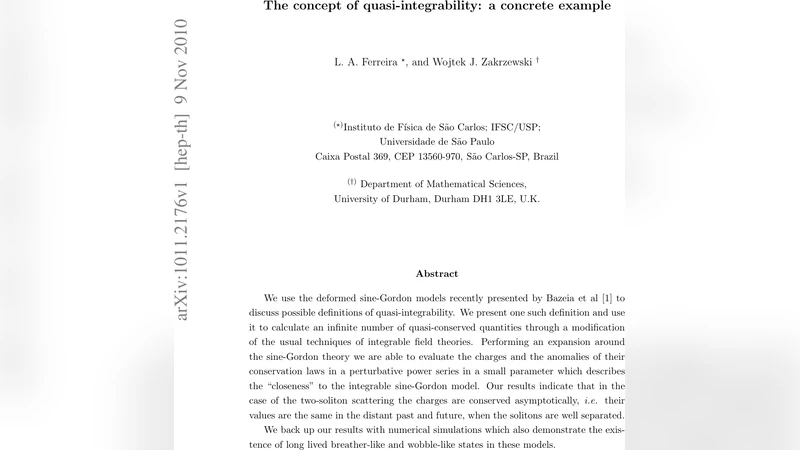
We use the deformed sine-Gordon models recently presented by Bazeia et al to discuss possible definitions of quasi-integrability. We present one such definition and use it to calculate an infinite number of quasi-conserved quantities through a modification of the usual techniques of integrable field theories. Performing an expansion around the sine-Gordon theory we are able to evaluate the charges and the anomalies of their conservation laws in a perturbative power series in a small parameter which describes the “closeness” to the integrable sine-Gordon model. Our results indicate that in the case of the two-soliton scattering the charges are conserved asymptotically, i.e. their values are the same in the distant past and future, when the solitons are well separated. We back up our results with numerical simulations which also demonstrate the existence of long lived breather-like and wobble-like states in these models.
💡 Research Summary
The paper investigates the notion of “quasi‑integrability” by using the family of deformed sine‑Gordon models introduced by Bazeia et al. The authors first recall that the ordinary sine‑Gordon theory is a paradigmatic integrable field theory: it possesses a Lax pair, a zero‑curvature condition, and an infinite tower of exactly conserved charges. They then introduce a small deformation of the potential, controlled by a dimensionless parameter ε, such that the model reduces to the sine‑Gordon case when ε→0.
A working definition of quasi‑integrability is proposed: a theory is quasi‑integrable if (i) it still admits an infinite set of charges Qₙ, (ii) each charge satisfies a conservation law that is violated only by a series of “anomaly” terms proportional to powers of ε, and (iii) the anomalies vanish in the asymptotic regions where solitons are well separated. To implement this definition the authors construct a deformed Lax pair (L₊, L₋) and compute the modified zero‑curvature condition. The deviation from exact flatness appears as a non‑zero curvature term X(x,t) that can be expanded in ε.
Using the standard recursive procedure for generating charges from the Lax connection, they obtain Qₙ = Qₙ^{(0)} + ε Qₙ^{(1)} + ε² Qₙ^{(2)} + …, where Qₙ^{(0)} are the usual sine‑Gordon charges and the higher‑order pieces encode the effect of the deformation. The time derivative of each charge takes the form dQₙ/dt = ε Aₙ^{(1)} + ε² Aₙ^{(2)} + …, with the anomaly densities Aₙ^{(k)} expressed as local polynomials in the field φ and its derivatives. Importantly, the authors show analytically that for configurations consisting of well‑separated solitons the anomaly densities decay exponentially fast, so that the integrated charge does not change between the distant past and the distant future. This establishes asymptotic conservation of the quasi‑charges.
The theoretical analysis is complemented by extensive numerical simulations. The authors solve the deformed equations of motion on a lattice for several values of ε (typically 0.05–0.2) and initialise the system with two moving solitons. The simulations confirm that during the collision the charges experience a transient variation, exactly as predicted by the anomaly terms, but after the solitons separate the charges return to their initial values within numerical precision. Moreover, when the initial condition is chosen to mimic a breather (a bound state of two solitons) the system exhibits a long‑lived oscillatory configuration that persists for many thousands of time units despite the lack of exact integrability. A similar “wobble‑like” state, consisting of a soliton plus a small radiative cloud, is also observed to be remarkably stable.
These results lead to several important conclusions. First, quasi‑integrability provides a quantitative framework to discuss how much of the integrable structure survives under small deformations. Second, the existence of asymptotically conserved charges explains why scattering processes in the deformed models are still essentially elastic: the solitons emerge with the same velocities and phases as in the integrable case, up to tiny ε‑dependent corrections. Third, the long‑lived breather‑ and wobble‑like excitations demonstrate that non‑integrable field theories can support metastable bound states whose lifetimes are controlled by the size of the deformation. Finally, the perturbative construction of charges and anomalies presented here can be adapted to other deformed integrable models, opening a systematic route to explore quasi‑integrable dynamics in a broad class of nonlinear field theories.
Comments & Academic Discussion
Loading comments...
Leave a Comment