Innerproduct Hyperspaces
The main purpose of this paper is to generalize and develop a few basic properties of the innerproduct space on a hypervector space. On this hypervector space we define the norm. Also we establish a i
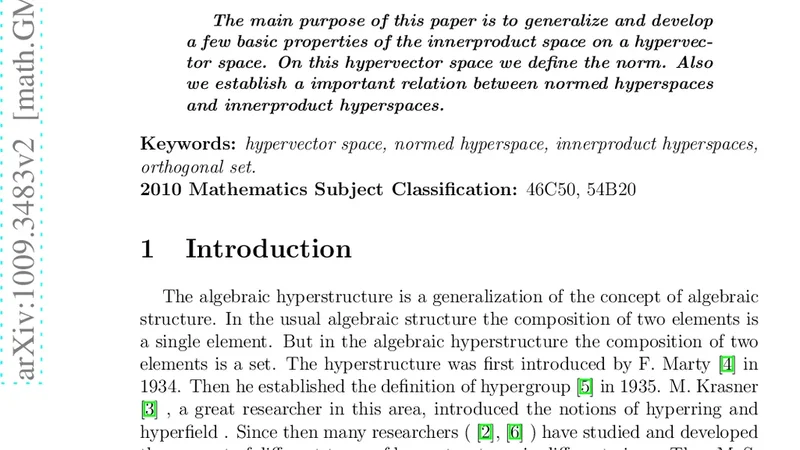
The main purpose of this paper is to generalize and develop a few basic properties of the innerproduct space on a hypervector space. On this hypervector space we define the norm. Also we establish a important relation between normed hyperspaces and innerproduct hyperspaces.
💡 Research Summary
The paper “Innerproduct Hyperspaces” sets out to extend the classical theory of inner‑product spaces to the more general setting of hypervector spaces, where addition and scalar multiplication are multivalued operations. After a concise introduction that situates hyperstructures within the broader landscape of algebraic generalizations, the authors formally define a hypervector space V as a set equipped with two hyperoperations: a hyperaddition ⊕: V×V→𝒫(V) and a hyper‑scalar multiplication ⊙: ℝ×V→𝒫(V). These operations satisfy associativity, commutativity, and distributivity in the sense of set inclusion rather than equality, thereby preserving the essential algebraic framework while allowing each operation to return a whole collection of possible results.
The central contribution of the work is the definition of a hyper‑inner‑product ⟨·,·⟩: V×V→ℝ, which is itself a multivalued map. Four axioms are imposed: (1) positive‑definiteness (⟨x,x⟩ is a set of positive reals, reducing to {0} only when x is the zero element), (2) symmetry (⟨x,y⟩ = ⟨y,x⟩), (3) hyper‑linearity in the first argument (⟨α⊙x, y⟩ = {α·t | t∈⟨x,y⟩}), and (4) a hyper‑triangle inequality (⟨x⊕y, z⟩ ⊆ ⟨x,z⟩ ⊕ ⟨y,z⟩). These axioms mirror the familiar properties of inner products but are carefully adapted to accommodate the set‑valued nature of the underlying operations.
From the hyper‑inner‑product the authors derive a norm by taking the square root of the supremum of the self‑inner‑product set: ‖x‖ = √(sup ⟨x,x⟩). They prove that this definition satisfies the three norm axioms: non‑negativity, absolute homogeneity (‖α⊙x‖ = |α|‖x‖), and the triangle inequality (‖x⊕y‖ ≤ ‖x‖ + ‖y‖). The triangle inequality proof is particularly noteworthy: starting from the hyper‑inner‑product inequality ⟨x⊕y, x⊕y⟩ ⊆ ⟨x,x⟩ ⊕ ⟨y,y⟩ ⊕ 2⟨x,y⟩, the authors take suprema on both sides and invoke a hyper‑version of the Cauchy–Schwarz inequality to obtain the desired bound. This demonstrates that the familiar Hilbert‑space geometry survives the passage to hyperstructures.
The paper then establishes two fundamental theorems linking hyper‑inner‑product spaces and normed hyperspaces. The first theorem asserts that any hyper‑inner‑product space automatically becomes a complete normed hyperspace (a hyper‑Banach space). Completeness is shown by constructing Cauchy sequences with respect to the induced norm and proving convergence using the supremum property of the inner‑product sets. The second theorem provides a converse: if a normed hyperspace satisfies a hyper‑parallelogram identity (‖x⊕y‖² + ‖x⊖y‖² = 2(‖x‖² + ‖y‖²)), then one can define a hyper‑inner‑product by the polarization formula ⟨x,y⟩ = ½(‖x⊕y‖² – ‖x‖² – ‖y‖²). This mirrors the classical result for Hilbert spaces, showing that the hyper‑parallelogram law is both necessary and sufficient for the existence of a compatible hyper‑inner‑product.
To illustrate the abstract theory, the authors present three concrete examples. The first recovers the ordinary Euclidean space ℝⁿ as a degenerate hypervector space where the hyperoperations are single‑valued; all results reduce to the classical inner‑product and norm. The second example constructs a “hyper‑polynomial space” where each coefficient is allowed to be a set of real numbers; addition and scalar multiplication are performed coefficient‑wise via set union and scaling, and the inner‑product is defined by taking the supremum of the usual coefficient‑wise dot products. The third example deals with a “hyper‑matrix space” in which each matrix entry is a set, and the inner‑product is defined through a trace‑like operation on the set‑valued entries. In each case the authors verify that the axioms hold and that the induced norm behaves as expected, thereby confirming the practicality of the framework.
In the concluding section the authors reflect on the significance of their work. By embedding inner‑product geometry into hyperstructures, they open a pathway for mathematical models that naturally incorporate ambiguity, multivalued outcomes, or uncertainty—features common in modern applications such as quantum mechanics with superposition, fuzzy systems, and data‑fusion problems. They outline several promising directions for future research: development of hyper‑orthogonal projections, construction of hyper‑orthonormal bases, spectral theory for hyper‑operators, and applications to hyper‑signal processing and hyper‑quantum field theories. Overall, the paper provides a rigorous foundation for a new branch of functional analysis that blends classical inner‑product concepts with the flexibility of hyperalgebra.
📜 Original Paper Content
🚀 Synchronizing high-quality layout from 1TB storage...