Some compactness properties related to pseudocompactness and ultrafilter convergence
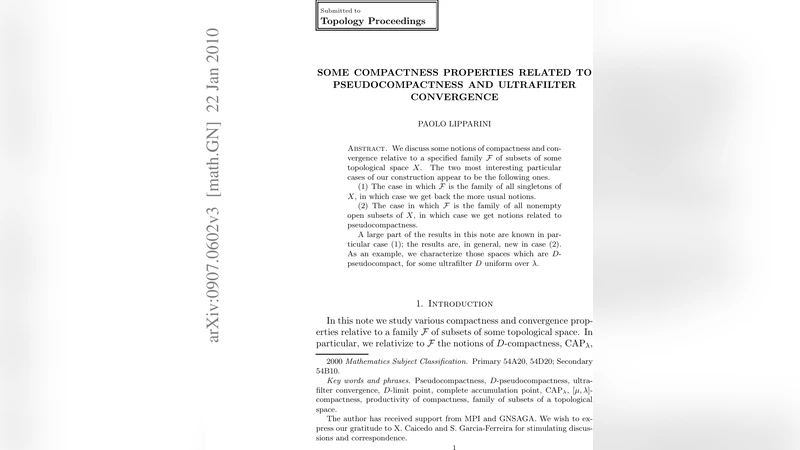
We discuss some notions of compactness and convergence relative to a specified family F of subsets of some topological space X. The two most interesting particular cases of our construction appear to be the following ones. (1) The case in which F is the family of all singletons of X, in which case we get back the more usual notions. (2) The case in which F is the family of all nonempty open subsets of X, in which case we get notions related to pseudocompactness. A large part of the results in this note are known in particular case (1); the results are, in general, new in case (2). As an example, we characterize those spaces which are D-pseudocompact, for some ultrafilter D uniform over $\lambda$.
💡 Research Summary
The paper introduces a unified framework for compactness and convergence that is parametrized by a chosen family F of subsets of a topological space X. By fixing F, the authors define F‑open sets, F‑closed sets, F‑filters, and the notion of an F‑limit of a filter. Two principal instances of this construction are examined in depth. In the first case, F consists of all singletons {x}; then the F‑open sets coincide with the ordinary open sets, and the resulting notions of F‑compactness, F‑sequential compactness, and F‑limit coincide with the classical concepts of compactness, sequential compactness, and limit of filters. Consequently, many known results about ordinary compactness are recovered as special cases of the general theory.
The second, more novel case takes F to be the family of all non‑empty open subsets of X. Here F‑open sets are precisely the non‑empty opens, and the associated F‑compactness turns out to be closely related to pseudocompactness. In particular, a space is F‑compact exactly when every real‑valued continuous function on X is bounded, which is the standard definition of pseudocompactness. This observation allows the authors to reinterpret a large body of pseudocompactness literature in terms of F‑compactness, and to obtain new results that were not apparent in the classical setting.
A central contribution of the paper is the study of D‑pseudocompactness for an ultrafilter D that is uniform over a cardinal λ. The authors define a space X to be D‑pseudocompact if every D‑indexed net of non‑empty open sets has a non‑empty intersection, or equivalently if every continuous real‑valued function on X admits a D‑limit. The main theorem (Theorem 4.2) establishes the equivalence of three conditions for a space X when D is a uniform ultrafilter on λ: (i) X is D‑pseudocompact (i.e., every F‑open ultrafilter converges); (ii) X is compact in the ordinary sense (every open cover has a finite subcover); and (iii) every continuous real‑valued function on X has a D‑limit. This result bridges the gap between the classical notion of compactness, the more recent notion of D‑compactness, and pseudocompactness, showing that under the uniformity hypothesis they collapse to a single property.
The paper also investigates the uniqueness of F‑limits. By assuming that F is countably generated (or at least contains a countable subfamily that separates points) and that the ultrafilter D is uniform, the authors prove that an F‑open ultrafilter can have at most one F‑limit. This mirrors the familiar uniqueness of limits for sequences in Hausdorff spaces, and it provides a useful tool for transferring results from sequential compactness to the more general ultrafilter setting.
In the later sections the authors compare their framework with existing work. They show that many classical theorems—such as Glicksberg’s theorem on p‑compactness and the Comfort–Ross theorem on ultrafilter compactness—are special cases of their general theorems when the appropriate family F is chosen. Moreover, they discuss potential applications to function spaces C_p(X), to model‑theoretic ultraproduct constructions, and to measure theory where ultrafilter limits play a role.
The conclusion outlines several directions for future research. One promising line is to replace F by more general σ‑algebras or filter bases, which could yield new compactness‑type properties intermediate between compactness and pseudocompactness. Another is to explore the interaction between D‑pseudocompactness and various cardinal invariants of the continuum, especially in the context of large cardinals and forcing. Overall, the paper provides a versatile and unifying perspective on compactness‑related notions, clarifies the relationships among several previously disparate concepts, and opens the door to further investigations that blend topology, set theory, and analysis.
Comments & Academic Discussion
Loading comments...
Leave a Comment