We present several new characterizations of correlated equilibria in games with continuous utility functions. These have the advantage of being more computationally and analytically tractable than the standard definition in terms of departure functions. We use these characterizations to construct effective algorithms for approximating a single correlated equilibrium or the entire set of correlated equilibria of a game with polynomial utility functions.
Deep Dive into Correlated Equilibria in Continuous Games: Characterization and Computation.
We present several new characterizations of correlated equilibria in games with continuous utility functions. These have the advantage of being more computationally and analytically tractable than the standard definition in terms of departure functions. We use these characterizations to construct effective algorithms for approximating a single correlated equilibrium or the entire set of correlated equilibria of a game with polynomial utility functions.
In finite games correlated equilibria are simpler than Nash equilibria in several sensesmathematically at least, if not conceptually. The set of correlated equilibria is a convex polytope, described by finitely many explicit linear inequalities, while the set of (mixed) Nash equilibria need not be convex or connected and can contain components which look like essentially any real algebraic variety (set described by polynomial equations on real variables) [7]. The existence of correlated equilibria can be proven by elementary means (linear programming or game theoretic duality [15]), whereas the existence of Nash equilibria seems to require nonconstructive methods (e.g., fixed point theorems as in [22,14]) or the analysis of complicated algorithms [19,10,12]. Computing a sample correlated equilibrium or a correlated equilibrium optimizing some quantity such as social welfare can be done efficiently [13,23]; strong evidence in complexity theory suggests that the corresponding problems for Nash equilibria are hard [6,4,13].
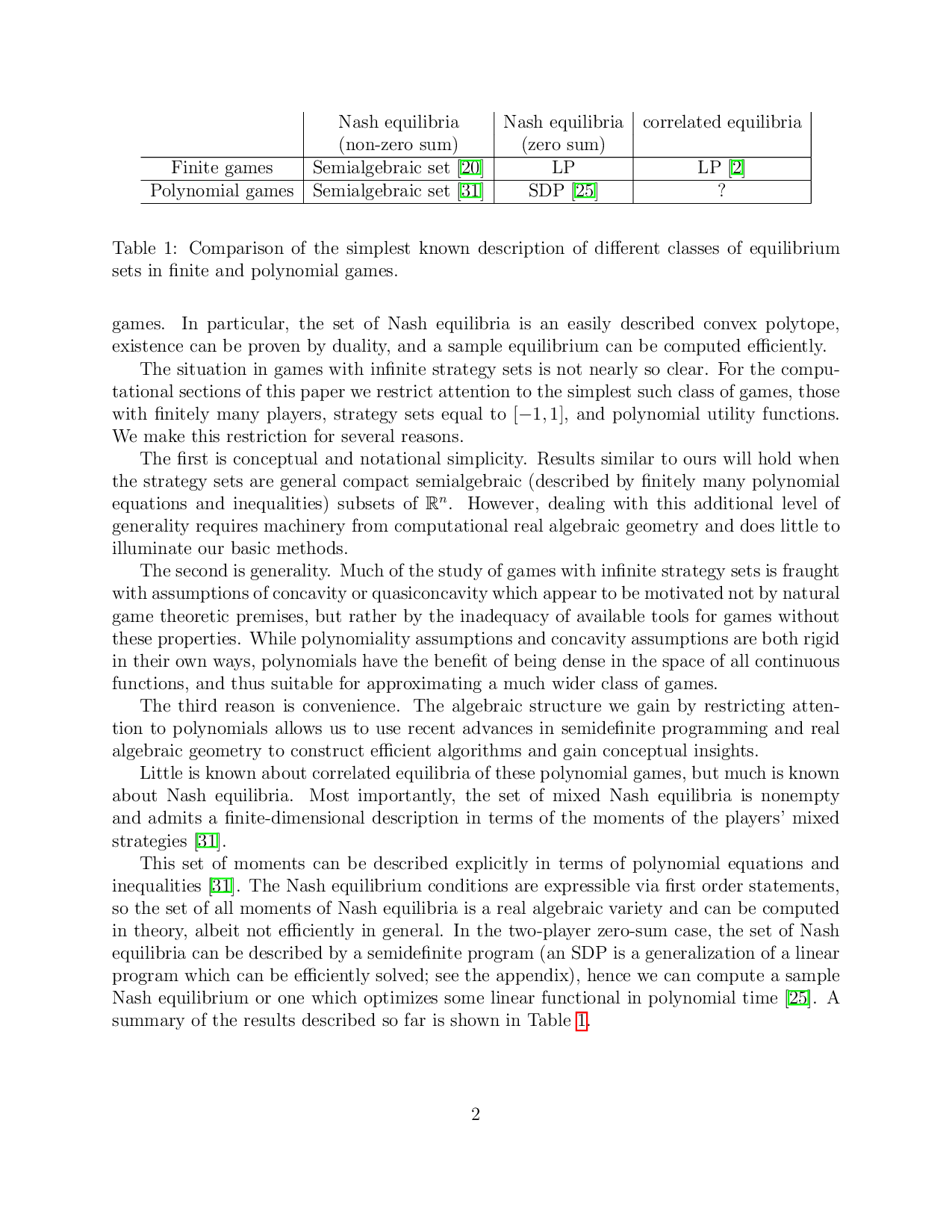
There are several exceptional classes of games for which the above problems about Nash equilibria become easy. The most important here are the zero-sum games. Broadly speaking, Nash equilibria of these games have complexity similar to correlated equilibria of general Nash equilibria Nash equilibria correlated equilibria (non-zero sum) (zero sum) Finite games
Semialgebraic set [20] LP LP [2] Polynomial games Semialgebraic set [31] SDP [25] ?
Table 1: Comparison of the simplest known description of different classes of equilibrium sets in finite and polynomial games.
games. In particular, the set of Nash equilibria is an easily described convex polytope, existence can be proven by duality, and a sample equilibrium can be computed efficiently.
The situation in games with infinite strategy sets is not nearly so clear. For the computational sections of this paper we restrict attention to the simplest such class of games, those with finitely many players, strategy sets equal to [-1, 1], and polynomial utility functions. We make this restriction for several reasons.
The first is conceptual and notational simplicity. Results similar to ours will hold when the strategy sets are general compact semialgebraic (described by finitely many polynomial equations and inequalities) subsets of R n . However, dealing with this additional level of generality requires machinery from computational real algebraic geometry and does little to illuminate our basic methods.
The second is generality. Much of the study of games with infinite strategy sets is fraught with assumptions of concavity or quasiconcavity which appear to be motivated not by natural game theoretic premises, but rather by the inadequacy of available tools for games without these properties. While polynomiality assumptions and concavity assumptions are both rigid in their own ways, polynomials have the benefit of being dense in the space of all continuous functions, and thus suitable for approximating a much wider class of games.
The third reason is convenience. The algebraic structure we gain by restricting attention to polynomials allows us to use recent advances in semidefinite programming and real algebraic geometry to construct efficient algorithms and gain conceptual insights.
Little is known about correlated equilibria of these polynomial games, but much is known about Nash equilibria. Most importantly, the set of mixed Nash equilibria is nonempty and admits a finite-dimensional description in terms of the moments of the players’ mixed strategies [31].
This set of moments can be described explicitly in terms of polynomial equations and inequalities [31]. The Nash equilibrium conditions are expressible via first order statements, so the set of all moments of Nash equilibria is a real algebraic variety and can be computed in theory, albeit not efficiently in general. In the two-player zero-sum case, the set of Nash equilibria can be described by a semidefinite program (an SDP is a generalization of a linear program which can be efficiently solved; see the appendix), hence we can compute a sample Nash equilibrium or one which optimizes some linear functional in polynomial time [25]. A summary of the results described so far is shown in Table 1.
Contributions The impetus for this paper was to address the bottom right cell of Table 1, the one with the question mark. The table seems to suggest that the set of correlated equilibria of a polynomial game should be describable by a semidefinite program. We will see that this is approximately true, but not exactly. The contribution of this paper is twofold.
• First, we present several new characterizations of correlated equilibria in games with continuous utility functions (polynomiality is not needed here). In particular we show that the standard definition of correlated equilibria in terms of measurable departure functions is equivalent to other definitions in which the utilities are inte
…(Full text truncated)…
This content is AI-processed based on ArXiv data.