Niche as a determinant of word fate in online groups
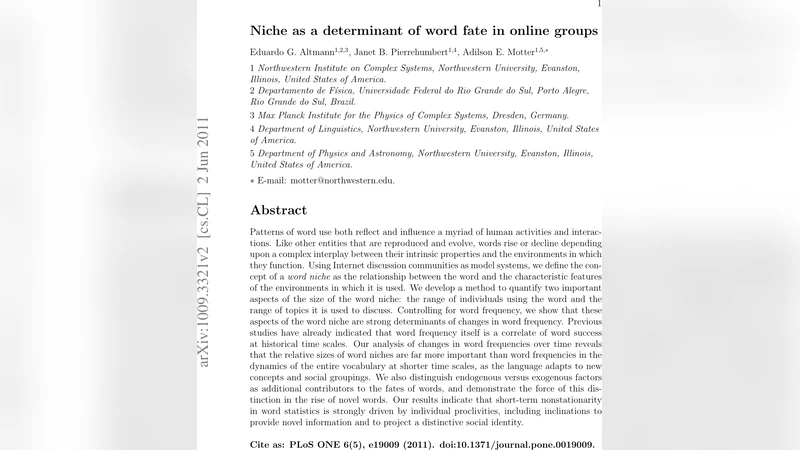
Patterns of word use both reflect and influence a myriad of human activities and interactions. Like other entities that are reproduced and evolve, words rise or decline depending upon a complex interplay between {their intrinsic properties and the environments in which they function}. Using Internet discussion communities as model systems, we define the concept of a word niche as the relationship between the word and the characteristic features of the environments in which it is used. We develop a method to quantify two important aspects of the size of the word niche: the range of individuals using the word and the range of topics it is used to discuss. Controlling for word frequency, we show that these aspects of the word niche are strong determinants of changes in word frequency. Previous studies have already indicated that word frequency itself is a correlate of word success at historical time scales. Our analysis of changes in word frequencies over time reveals that the relative sizes of word niches are far more important than word frequencies in the dynamics of the entire vocabulary at shorter time scales, as the language adapts to new concepts and social groupings. We also distinguish endogenous versus exogenous factors as additional contributors to the fates of words, and demonstrate the force of this distinction in the rise of novel words. Our results indicate that short-term nonstationarity in word statistics is strongly driven by individual proclivities, including inclinations to provide novel information and to project a distinctive social identity.
💡 Research Summary
The paper “Niche as a determinant of word fate in online groups” investigates how the “niche” of a word—its spread across users and topics—governs its short‑term dynamics in Internet discussion communities. Using two large Usenet groups (comp.os.linux.misc and rec.music.hip‑hop) as empirical testbeds, the authors first define two quantitative dissemination measures. For each word w they count the total occurrences Nw, the number of distinct users who ever used it (Uw), and the number of distinct threads (topics) in which it appears (Tw). They then construct a Poisson‑based random‑baseline model that predicts the expected number of users ˜U and threads ˜T for a word of frequency Nw if word tokens were shuffled uniformly across all posts. The dissemination indices are defined as DU = Uw/˜U (user‑level spread) and DT = Tw/˜T (topic‑level spread). Values greater than 1 indicate a word is more widely disseminated than random expectation; values below 1 indicate concentration (clustering) among a few users or topics.
The authors restrict analysis to words with Nw > 5 (to avoid discreteness artifacts) and partition the data into non‑overlapping six‑month windows. Across all windows, the median DU and DT fall well below the 10th percentile of the random baseline, showing that most words are strongly clustered. This clustering is present at all frequencies, though high‑frequency function words behave slightly differently.
The core of the study examines whether DU and DT predict future changes in word frequency over a two‑year horizon. For each word observed in a window t1, the authors compute its DU (and DT) and then measure the log‑frequency change Δlog f between t1 and a window t2 = t1 + 2 years. They find a robust, monotonic relationship: words with low DU (e.g., DU ≈ 0.4) almost invariably lose frequency, while words with high DU (≈ 1.0) tend to maintain or increase frequency. The same pattern holds for DT, though the predictive power of DU consistently exceeds that of DT. A regression analysis (Table 1) confirms that DU explains the largest share of variance in Δlog f, DT is secondary, and raw frequency log f contributes only marginally.
Furthermore, the authors explore the correlation between changes in dissemination (ΔDU, ΔDT) and frequency change. Both ΔDU and ΔDT are negatively correlated with Δlog f (≈ ‑0.5), indicating that when a word’s frequency rises without a corresponding spread across users or topics, its dissemination indices actually decline, placing it at risk of subsequent decay. This “buzz‑then‑fade” scenario mirrors ecological dynamics where a species exploiting a narrow niche may boom temporarily but later crash.
To illustrate the role of external versus internal drivers, the paper conducts a case study on two classes of rising words. “P‑words” (product names, public figures) typically surge due to exogenous events (product launches, political crises). “S‑words” (slang, novel vernacular) emerge from endogenous social processes within the community. Both sets are matched for overall frequency, but P‑words show higher initial frequency spikes with lower DU/DT, whereas S‑words display slower but broader dissemination. The analysis suggests that exogenously triggered spikes are less sustainable unless the word also expands its niche, while endogenous slang can achieve lasting presence by gradually occupying a larger user‑topic space.
The authors draw an explicit analogy to ecological niche theory: just as a species’ geographic range predicts its extinction risk, a word’s “niche size” (DU and DT) predicts its linguistic survival. While prior work linked word frequency to long‑term historical change, this study shows that at short (two‑year) timescales, niche measures dominate. Consequently, predictive models of lexical evolution should incorporate user‑ and topic‑level dissemination alongside raw frequency.
In summary, the paper makes four major contributions: (1) introduces rigorously defined, frequency‑controlled metrics for user‑ and topic‑level word spread; (2) demonstrates that these metrics are strong, statistically robust predictors of short‑term frequency trajectories; (3) differentiates the impact of exogenous events versus endogenous community dynamics on word adoption; and (4) bridges linguistic dynamics with ecological concepts, highlighting the centrality of niche breadth in lexical survival. These findings have implications for computational linguistics, sociolinguistics, and any domain where tracking the rise and fall of terminology (e.g., marketing, meme propagation, scientific terminology) is crucial.
Comments & Academic Discussion
Loading comments...
Leave a Comment