Analytical Expression of the Expected Values of Capital at Voting in the Stochastic Environment
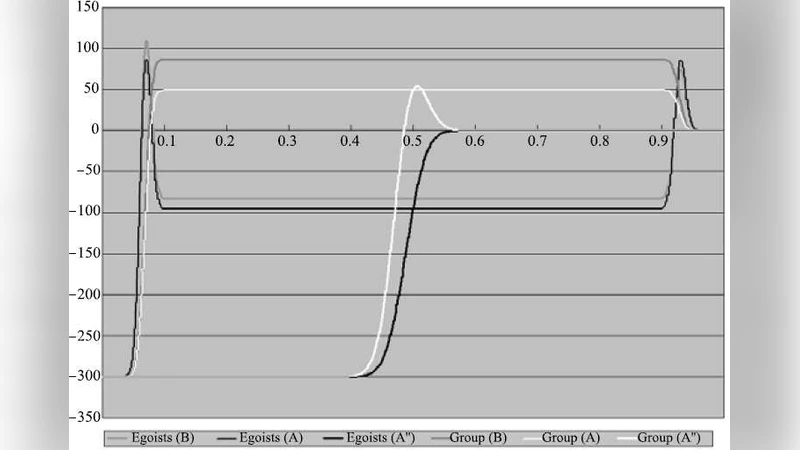
In the simplest version of the model of group decision making in the stochastic environment, the participants are segregated into egoists and a group of collectivists. A “proposal of the environment” is a stochastically generated vector of algebraic increments of participants’ capitals. The social dynamics is determined by the sequence of proposals accepted by a majority voting (with a threshold) of the participants. In this paper, we obtain analytical expressions for the expected values of capitals for all the participants, including collectivists and egoists. In addition, distinctions between some principles of group voting are discussed.
💡 Research Summary
The paper investigates a stylized model of collective decision‑making in a stochastic environment, where a population of N agents is divided into two types: egoists, who act purely in their own interest, and collectivists, who act as a group. At each discrete time step the “environment” proposes a vector X = (x₁,…,x_N) of capital increments. Each component x_i is drawn independently from a normal distribution N(μ, σ²). Whether a proposal is implemented is decided by a majority‑vote rule with a threshold T (i.e., at least T agents must vote “yes”).
The authors formalize the voting behavior. An egoist votes “yes” if and only if his own increment x_i is positive; the probability of a “yes” for any egoist is therefore p_e = Φ(μ/σ), where Φ denotes the standard normal cumulative distribution function. Collectivists may follow one of two internal voting principles:
-
Individual‑yes principle – each collectivist votes “yes” exactly as an egoist does, i.e., when his own x_i > 0. In this case the number of “yes” votes from the collectivist block is a binomial random variable with parameters (M, p_e).
-
Representative‑yes principle – the collectivist block votes as a single entity. The block votes “yes” if the average increment of its members, (\bar{x}g = \frac{1}{M}\sum{j=1}^{M} x_j), is positive. Because (\bar{x}_g) is normally distributed with mean μ and variance σ²/M, the probability that the block votes “yes” is p_g = Φ(μ/(σ/√M)). When the block votes “yes”, all M members cast a “yes” vote simultaneously.
The total number of “yes” votes, S, is the sum of the egoist votes (a binomial B(N−M, p_e)) and the collectivist contribution (either another binomial B(M, p_e) under the individual‑yes principle or a deterministic M·p_g under the representative‑yes principle). The authors apply a normal approximation to S (via the Central Limit Theorem) and obtain a closed‑form expression for the acceptance probability
\
Comments & Academic Discussion
Loading comments...
Leave a Comment