The BG-simulation for Byzantine Mobile Robots
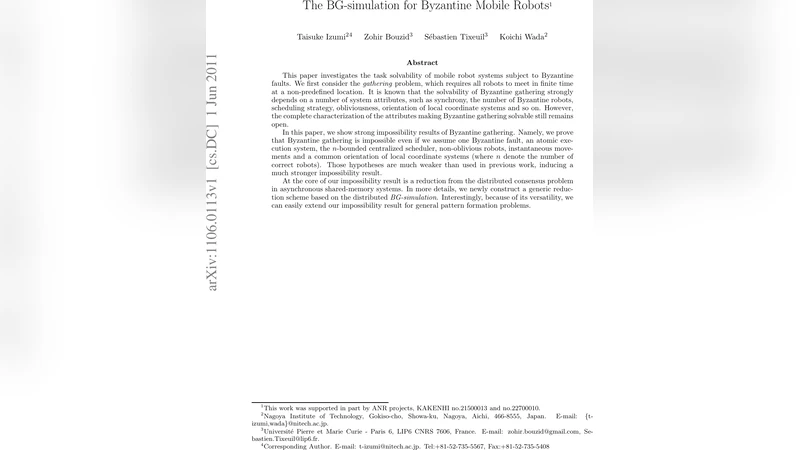
This paper investigates the task solvability of mobile robot systems subject to Byzantine faults. We first consider the gathering problem, which requires all robots to meet in finite time at a non-predefined location. It is known that the solvability of Byzantine gathering strongly depends on a number of system attributes, such as synchrony, the number of Byzantine robots, scheduling strategy, obliviousness, orientation of local coordinate systems and so on. However, the complete characterization of the attributes making Byzantine gathering solvable still remains open. In this paper, we show strong impossibility results of Byzantine gathering. Namely, we prove that Byzantine gathering is impossible even if we assume one Byzantine fault, an atomic execution system, the n-bounded centralized scheduler, non-oblivious robots, instantaneous movements and a common orientation of local coordinate systems (where n denote the number of correct robots). Those hypotheses are much weaker than used in previous work, inducing a much stronger impossibility result. At the core of our impossibility result is a reduction from the distributed consensus problem in asynchronous shared-memory systems. In more details, we newly construct a generic reduction scheme based on the distributed BG-simulation. Interestingly, because of its versatility, we can easily extend our impossibility result for general pattern formation problems.
💡 Research Summary
This paper investigates the fundamental limits of cooperative tasks in mobile robot networks when Byzantine faults are present. The authors focus on the gathering problem—requiring all correct robots to eventually meet at a single, a‑priori unknown point—and extend their analysis to a broad class of pattern‑formation tasks. Their main contribution is a strong impossibility result: even under very favorable assumptions (atomic ATOM execution, an n‑bounded centralized scheduler, non‑oblivious and non‑uniform robots, instantaneous movements, and a common orientation of local coordinate axes), the presence of a single Byzantine robot makes gathering impossible.
The technical core of the work is a reduction from the classic binary consensus problem in asynchronous shared‑memory systems to Byzantine‑resilient gathering in robot networks. The authors adapt the Borowsky‑Gafni (BG) simulation, a well‑known technique that allows a synchronous algorithm to be simulated in an asynchronous environment. They construct a generic reduction scheme: given any algorithm that solves 1‑Byzantine‑resilient gathering under the robot model described, they show how to use it to implement a 1‑crash‑resilient binary consensus algorithm in an asynchronous SWMR shared‑memory system with atomic snapshots. Since FLP impossibility tells us that binary consensus cannot be solved with even a single crash fault in such a model, the existence of a correct gathering algorithm would contradict this fundamental result. Consequently, gathering (and, by extension, any pattern‑formation problem that can be expressed as a specific geometric configuration) is impossible under the stated robot assumptions.
The paper’s system model is carefully defined. Robots operate in a two‑dimensional Euclidean plane, each equipped with a local Cartesian coordinate system whose origin is its current position; axes are parallel across robots, providing a common direction but no shared origin or scale. Robots are non‑oblivious (they retain internal state) and may run distinct code (non‑uniform). Observations are exact, including strong multiplicity detection (robots can count how many peers occupy a given point). Execution proceeds in atomic cycles (ATOM model): in each round a scheduler activates a subset of robots, each of which performs “look‑compute‑move” atomically. The scheduler is centralized, fair, and k‑bounded (the n‑bounded variant used in the paper ensures that between any two activations of a given correct robot, any other robot can be activated at most k times). A single Byzantine robot may deviate arbitrarily from the prescribed algorithm but is still subject to the same k‑bounded movement restriction, preventing it from moving arbitrarily many times between two activations of a correct robot.
The reduction proceeds by mapping each robot to a process in the shared‑memory system. The robots’ “look” operation corresponds to an atomic snapshot of all shared registers; the “compute” step mirrors the local computation of a process; the “move” step corresponds to writing a new value. The Byzantine robot plays the role of a crashed process: it may stop updating its register or update it arbitrarily, but its activity is limited by the k‑bound, mirroring the crash‑resilience constraint. By orchestrating the robots’ actions according to the BG‑simulation protocol, the authors emulate the steps of a consensus algorithm. If gathering were solvable, the simulated consensus would terminate with agreement, violating the FLP impossibility theorem.
Beyond gathering, the authors argue that the same reduction applies to any pattern‑formation problem that can be expressed as a fixed geometric configuration (e.g., forming a line or a circle). Since such configurations can be reduced to a gathering instance (by treating the target pattern as a set of points that all correct robots must occupy), the impossibility extends to a broad class of formation tasks.
In summary, the paper makes three notable contributions: (1) it establishes a strong impossibility result for Byzantine gathering under assumptions that are stronger than those previously considered, thereby tightening the known lower bounds; (2) it introduces a novel application of the BG‑simulation to bridge mobile‑robot algorithms and classic distributed‑computing impossibility proofs; and (3) it shows that this technique generalizes to many pattern‑formation problems, highlighting a deep connection between synchrony, fault models, and geometric coordination. The work closes a long‑standing gap in the literature regarding the exact conditions under which Byzantine‑tolerant coordination is impossible, and it opens avenues for future research to explore weaker models or additional capabilities (e.g., limited communication, stronger sensors) that might circumvent the presented impossibility.
Comments & Academic Discussion
Loading comments...
Leave a Comment