Theory of "Weak Value" and Quantum Mechanical Measurements
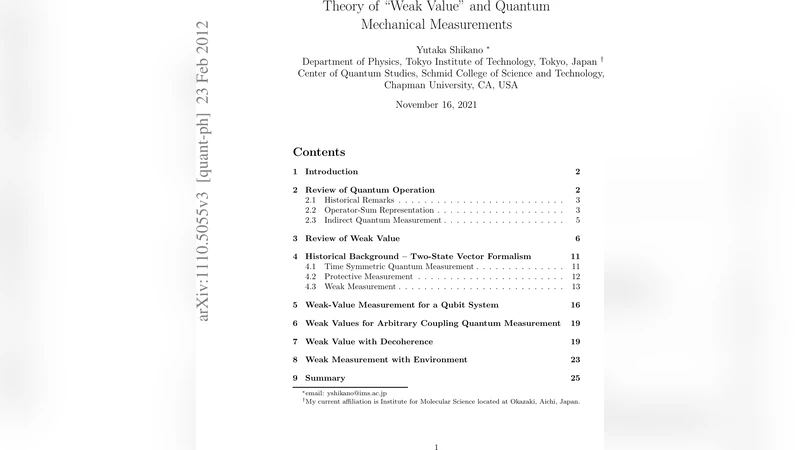
We review the definition and the concepts of the weak values and some measurement model to extract the weak value. This material is based on the author Ph.D. thesis “Time in Weak Values and Discrete Time Quantum Walk” at Tokyo Institute of Technology (2011).
💡 Research Summary
The paper provides a comprehensive review of the concept of weak values and the measurement schemes that can be used to extract them, drawing heavily on the author’s doctoral dissertation “Time in Weak Values and Discrete Time Quantum Walk” (Tokyo Institute of Technology, 2011). It begins by recalling the original definition introduced by Aharonov, Albert, and Vaidman in 1988: for a system prepared in a pre‑selected state |ψ_i⟩ and later post‑selected in |ψ_f⟩, the weak value of an observable A is ⟨A⟩_w = ⟨ψ_f|A|ψ_i⟩ / ⟨ψ_f|ψ_i⟩. Unlike ordinary expectation values, weak values can be complex and may lie outside the eigenvalue spectrum of A. The real part governs the average shift of a measurement pointer, while the imaginary part is related to the pointer’s momentum change or phase shift, giving a clear physical interpretation to both components.
Three principal measurement models are examined in detail. The first is the traditional von Neumann interaction H_int = g δ(t‑t_0) A⊗p_m, where a weak coupling constant g ensures that the system’s state is only minimally disturbed. In the limit g → 0 the pointer’s position shift Δq = g Re⟨A⟩_w and momentum shift Δp = g Im⟨A⟩_w provide direct access to the weak value. The paper derives the optimal trade‑off between signal strength and back‑action, showing that too small a g yields poor signal‑to‑noise ratio, while too large a g reproduces the collapse associated with strong measurements.
The second model focuses on optical implementations. A photon’s polarization is pre‑selected, passes through a weak birefringent element that imparts a tiny rotation proportional to the observable of interest, and is finally post‑selected by a polarizer. The pointer is the spatial profile or intensity of the beam, measured with a CCD camera. Experimental data demonstrate that both the real and imaginary parts of the weak value can be reconstructed from the average beam displacement and the change in its momentum distribution, respectively.
The most novel contribution is the discrete‑time quantum walk (DTQW) framework. In a DTQW the evolution consists of repeated applications of a coin operator C acting on a two‑state internal degree of freedom and a shift operator S that moves the walker on a lattice. The author prepares a pre‑selected joint state |ψ_i⟩ = |↑⟩⊗|x=0⟩, lets the walk evolve for a chosen number of steps, and then post‑selects a state |ψ_f⟩ = |↓⟩⊗|x=n⟩. By performing a weak measurement on the coin before the final post‑selection, one obtains a weak value for the position operator, ⟨x⟩_w, which can be interpreted as a “time‑averaged” position even though a proper time operator does not exist in standard quantum mechanics. Experiments with photonic quantum walks confirm that the weak value reproduces the theoretical prediction and that it encodes interference information about the walker’s possible paths without destroying coherence.
The paper also discusses paradoxical scenarios where weak values become anomalous—exceeding eigenvalue bounds or taking negative values. Using Hardy’s paradox and the three‑box paradox as case studies, it shows that weak measurements can reveal simultaneous “presence” of a particle in mutually exclusive paths, thereby resolving apparent contradictions in a way that strong measurements cannot.
From an application standpoint, the author argues that weak values can be exploited for quantum state amplification, precision metrology, and error mitigation. Because the weak value can be much larger than the eigenvalue, it amplifies small physical effects, but the amplification is accompanied by increased statistical uncertainty; thus, optimal choice of the coupling strength and the initial pointer state (often a minimum‑uncertainty Gaussian) is crucial. The paper outlines how feedback based on weak‑value estimates could suppress decoherence in quantum information protocols.
In conclusion, the review positions weak‑value theory as a bridge between foundational questions—such as the meaning of time and path information in quantum mechanics—and practical measurement technology. The integration of weak‑value concepts with discrete‑time quantum walks opens a new experimental platform for probing temporal aspects of quantum dynamics, and the author anticipates that these ideas will influence future work in quantum simulation, communication, and even quantum gravity.
Comments & Academic Discussion
Loading comments...
Leave a Comment