Transformation from Identity Stone Age to Digital Identity
Technological conversion, political interests and Business drivers has triggered a means, to establish individual characterization and personalization. People started raising concerns on multiple identities managed across various zones and hence various solutions were designed. Technological advancement has brought various issues and concerns around Identity assurance, privacy and policy enabled common Authentication framework. A compressive framework is needed to established common identity model to address national needs like standards, regulation and laws, minimum risk, interoperability and to provide user with a consistent context or user experience. This document focuses on Transformation path of identity stone age to Identity as in state. It defines a digital identity zone model (DIZM) to showcase the Global Identity defined across the ecosystem. Also, provide insight of emerging Technology trend to enable Identity assurance, privacy and policy enabled common Authentication framework.
💡 Research Summary
The paper traces the evolution of human identity from the “Stone Age” of physical proof—birth certificates, passports, social security numbers—to today’s electronic digital identity. In the early era, identity verification relied on trusted individuals or paper documents, incurring high costs for storage, validation, disaster recovery, and being vulnerable to forgery. With technological advancement, a multitude of credential types emerged (passwords, RFID, tokens, OTP, smart cards, PKI, etc.), yet the proliferation of siloed identity domains (family/friends, purchase, corporate, service/bank) created a fragmented landscape where users must manage many usernames, passwords, and roles.
To address this fragmentation, the authors introduce the Digital Identity Zone Model (DIZM). DIZM partitions the ecosystem into four principal zones—Friends/Family, Purchase, Corporate/Employee, Service/Bank—and defines, for each zone, sets of users (U_z), passwords (P_z), applications (n_z), and roles (R_z). They formalize the combinatorial explosion of credentials using set theory: the total user‑password pairs in a zone are expressed as the Cartesian product U_z × P_z, and the overall credential space across zones is the union of these products. Similarly, role aggregation across zones is expressed as a union of role sets. This mathematical modeling quantifies the complexity of multi‑identity, multi‑role management and underpins the principle of minimal data disclosure.
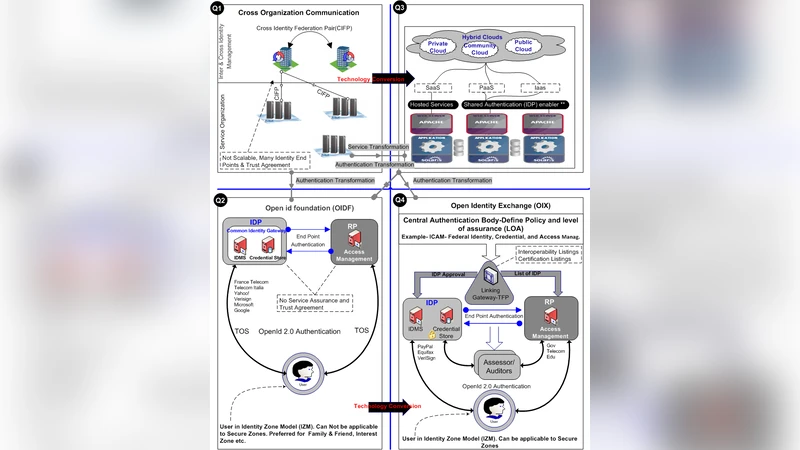
The paper then proposes a technology‑quadrant framework (Q1–Q4) to realize an integrated solution:
- Q1 – Cross‑Identity Federation Pair (CIFP) and OAuth for inter‑zone federation.
- Q2 – OpenID and OAuth to support decentralized internet identity.
- Q3 – Cloud‑based Identity Provider (IDP), Relying Party (RP), and OAuth services for scalability.
- Q4 – Open Identity Exchange (OIX) to provide assurance and trust, enabling a single‑identity model.
By combining these quadrants, the authors envision a system that supports secure identity sharing across zones, multi‑factor authentication (MFA), role‑based access control (RBAC), and “omni‑directional” versus “uni‑directional” identifiers to balance discoverability with privacy. They also outline an identity lifecycle—registration, activation, role assignment, role transformation, suspension, revocation, and exit—applying MFA and RBAC at each stage to progressively harden security.
The paper critiques existing Identity and Access Management (IAM) products for lacking interoperability and privacy safeguards, arguing that a DIZM‑driven, quadrant‑based architecture could satisfy national standards, regulations, and legal requirements while delivering a consistent user experience. In summary, the work offers a mathematically grounded model of multi‑zone identity complexity and a roadmap of contemporary technologies (OpenID, OAuth, cloud, OIX) to transition from fragmented physical proofs to a unified, trustworthy digital identity infrastructure at the state level.
Comments & Academic Discussion
Loading comments...
Leave a Comment