Time-Dependent 2-D Vector Field Topology: An Approach Inspired by Lagrangian Coherent Structures
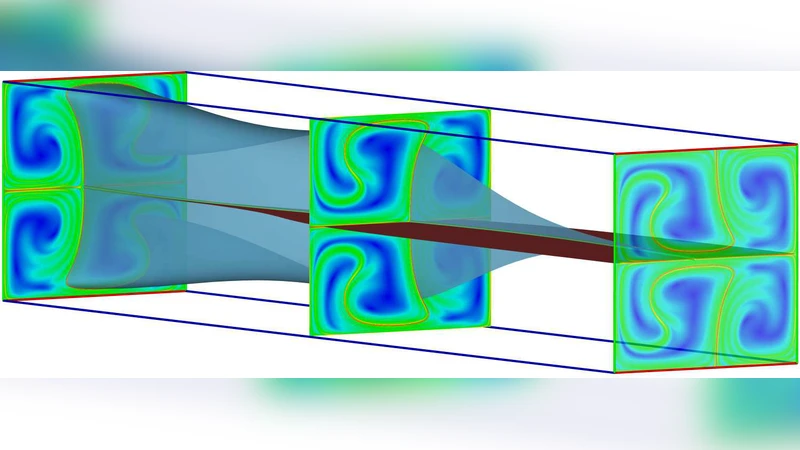
This paper presents an approach to a time-dependent variant of the concept of vector field topology for 2-D vector fields. Vector field topology is defined for steady vector fields and aims at discriminating the domain of a vector field into regions of qualitatively different behaviour. The presented approach represents a generalization for saddle-type critical points and their separatrices to unsteady vector fields based on generalized streak lines, with the classical vector field topology as its special case for steady vector fields. The concept is closely related to that of Lagrangian coherent structures obtained as ridges in the finite-time Lyapunov exponent field. The proposed approach is evaluated on both 2-D time-dependent synthetic and vector fields from computational fluid dynamics.
💡 Research Summary
The paper addresses a fundamental limitation of classical vector‑field topology, which is defined only for steady (time‑independent) 2‑D vector fields and therefore provides a purely instantaneous description of flow structure. To extend this concept to unsteady flows, the authors propose a generalized vector‑field topology (GVFT) that replaces static streamlines with generalized streak lines (GSL) and static critical points with hyperbolic trajectories, concepts originally introduced in the Lagrangian coherent structures (LCS) literature.
In steady fields, streamlines and streak lines coincide, so GVFT reduces to the traditional topology. In a time‑dependent field, however, streak lines advect with the flow, and a moving seed point can trace material lines that act as separatrices. Hyperbolic trajectories are one‑dimensional invariant manifolds that attract trajectories in forward time and repel them in backward time (or vice‑versa). By seeding GSLs on these trajectories, the authors obtain time‑varying analogues of stable and unstable manifolds, i.e., generalized separatrices.
A central technical contribution is the use of hyperbolicity time as a scalar field for locating hyperbolic trajectories. Hyperbolicity time measures how long a particle remains in a region where the velocity‑gradient determinant is negative (a hyperbolic region). Unlike the finite‑time Lyapunov exponent (FTLE), hyperbolicity time is evaluated per trajectory, is less sensitive to the chosen integration interval, and does not suffer from the same sampling‑dependency. The authors compute forward and backward hyperbolicity times on a dense grid, extract ridge surfaces (height ridges) from each field, and intersect these ridges to obtain candidate seed points. To mitigate aliasing caused by the extreme thinness of the ridges, they employ supersampling within each pixel and a bisection search to pinpoint the exact exit time from hyperbolic regions.
Once seed points are identified, the method verifies Haller’s theorem‑1 conditions (negative determinant of the velocity gradient, appropriate eigenvalue ratios, and consistent eigenvector orientation) along the candidate trajectory. Validated hyperbolic trajectories are then used to launch GSLs in the appropriate time direction, producing space‑time streak manifolds that serve as generalized separatrices. These manifolds are Galilean‑invariant, parameter‑free except for a user‑defined geometric length, and can be generated directly without the costly ridge‑extraction step required for FTLE‑based LCS.
The authors evaluate GVFT on several test cases: synthetic analytical flows with known hyperbolic structures, a buoyancy‑driven cavity flow, and a turbulent CFD simulation. In all cases, the GSLs align closely with FTLE ridges, confirming that the generalized separatrices capture the same material‑line barriers identified by LCS analysis. Moreover, GVFT provides explicit critical‑point information (the hyperbolic trajectories) and a clear topological skeleton, which FTLE alone cannot deliver. The method also demonstrates robustness to Galilean transformations, a known weakness of classical topology, because hyperbolic regions are defined by the sign of the velocity‑gradient determinant, an invariant quantity.
The paper acknowledges that extensions to other types of static critical points—nodes, foci, centers, and periodic orbits—are not yet addressed within the GVFT framework and are left for future work. Nonetheless, the presented approach offers a practical, computationally efficient, and theoretically sound pathway to bring the powerful concepts of vector‑field topology into the realm of unsteady 2‑D flows, bridging the gap between classical dynamical‑systems analysis and modern Lagrangian coherent‑structure techniques.
Comments & Academic Discussion
Loading comments...
Leave a Comment