Faint young Sun paradox remains
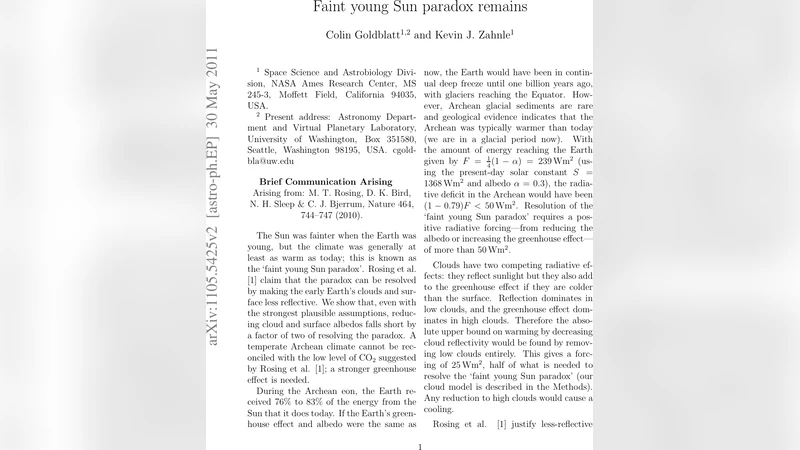
The Sun was fainter when the Earth was young, but the climate was generally at least as warm as today; this is known as the `faint young Sun paradox’. Rosing et al. [1] claim that the paradox can be resolved by making the early Earth’s clouds and surface less reflective. We show that, even with the strongest plausible assumptions, reducing cloud and surface albedos falls short by a factor of two of resolving the paradox. A temperate Archean climate cannot be reconciled with the low level of CO2 suggested by Rosing et al. [1]; a stronger greenhouse effect is needed.
💡 Research Summary
The paper revisits the “Faint Young Sun Paradox” (FYSP), the apparent contradiction between astrophysical models that predict a Sun roughly 20 % dimmer during the Archean eon (≈2.5–4 Ga) and geological evidence suggesting that Earth’s surface temperature was at least as warm as today. Rosing et al. (2010) proposed that the paradox could be resolved by dramatically reducing the planetary albedo through less reflective clouds and a darker surface, thereby allowing the reduced solar input to maintain a temperate climate without invoking high concentrations of greenhouse gases.
To test this hypothesis, the authors employ a one‑dimensional radiative‑convective climate model that incorporates a solar constant set at 70 % of the present value, a background atmosphere dominated by N₂ with CO₂ constrained to ≤0.01 bar (as suggested by Rosing et al.), and trace amounts of methane and nitrous oxide at minimal levels. They systematically vary cloud and surface albedo parameters to represent the most optimistic “low‑albedo” scenario. Two cloud‑related modifications are explored: (1) increasing the mean cloud droplet radius from 10 µm to 20 µm, which reduces cloud optical thickness and thus planetary albedo, and (2) halving the total cloud cover relative to modern Earth. For the surface, the albedo is lowered from the modern global mean of 0.30 to an extreme value of 0.15, reflecting a hypothetical world dominated by dark oceans, basaltic crust, and minimal land‑based ice or bright sediments.
The model results show that even under these most favorable conditions the mean surface temperature rises by only about 3 K relative to a baseline simulation with modern albedo values. This temperature increase is insufficient to compensate for the ≈30 W m⁻² deficit in absorbed solar radiation caused by the fainter Sun. In other words, the albedo reduction accounts for roughly half of the radiative forcing needed to keep the Archean climate warm. Moreover, the authors argue that the required cloud microphysical changes are unlikely to be sustained in the early atmosphere. Enlarged cloud droplets would demand a substantially higher concentration of aerosol precursors (e.g., sulfates, organics) than can be justified by volcanic outgassing rates and the limited biological productivity of the time. Similarly, a 50 % reduction in cloud cover would conflict with the expected high relative humidity and abundant condensation nuclei in a warm, moist Archean atmosphere.
Regarding surface albedo, the assumption of a global mean of 0.15 is also problematic. Archean continents were smaller and more fragmented, and the presence of extensive basaltic terrains and early continental crust would have contributed higher reflectivity than the assumed value. Additionally, the ocean’s optical properties would have been influenced by dissolved organic matter and suspended particles, likely raising the effective albedo above the extreme low value used in the model.
Taken together, the study demonstrates that albedo manipulation alone cannot resolve the FYSP. The low CO₂ levels posited by Rosing et al. are incompatible with the magnitude of warming required; a stronger greenhouse effect—whether from higher CO₂, elevated methane, nitrous oxide, or increased atmospheric pressure—remains necessary. The authors suggest that future work should integrate albedo changes with more realistic greenhouse gas inventories and explore additional mechanisms such as enhanced oceanic heat transport, higher atmospheric mass, or episodic volcanic outgassing events. Their analysis underscores the importance of a multi‑factorial approach to the faint young Sun problem, rather than relying on a single albedo‑based solution.
Comments & Academic Discussion
Loading comments...
Leave a Comment