A note on K-theory and triangulated derivators
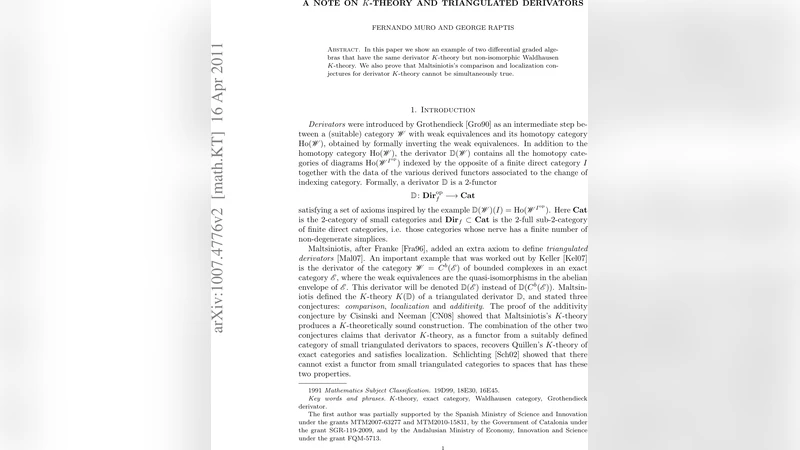
In this paper we show an example of two differential graded algebras that have the same derivator K-theory but non-isomorphic Waldhausen K-theory. We also prove that Maltsiniotis’s comparison and localization conjectures for derivator K-theory cannot be simultaneously true.
💡 Research Summary
The paper investigates the relationship between two prominent approaches to algebraic K‑theory: Waldhausen’s K‑theory, which is built on a model‑category‑like structure of cofibrations and weak equivalences, and derivator K‑theory, which extracts K‑theoretic information from the triangulated derivator associated to a homotopy theory. The authors begin by recalling Maltsiniotis’s two conjectures concerning derivator K‑theory: the comparison conjecture, which predicts that derivator K‑theory coincides with Waldhausen K‑theory for any suitable Waldhausen category, and the localization conjecture, which asserts that exact sequences of triangulated derivators give rise to long exact sequences in derivator K‑theory, mirroring the classical localization theorem for Waldhausen K‑theory.
To test these expectations, the authors construct an explicit counterexample using differential graded algebras (DGAs). They exhibit two DGAs, denoted A and B, that are quasi‑isomorphic and therefore give rise to equivalent derived categories. Consequently, the associated triangulated derivators are isomorphic, and the derivator K‑theories of A and B agree. However, the Waldhausen structures on the categories of perfect DG‑modules over A and B differ: the classes of cofibrations and weak equivalences are defined in a way that reflects the underlying DGA’s specific model structure. By applying Waldhausen’s S‑construction, the authors compute the low‑dimensional K‑groups and find that K₀ and K₁ for A and B are not isomorphic. This demonstrates that derivator K‑theory can fail to detect distinctions that are visible to Waldhausen K‑theory, highlighting a fundamental limitation of the derivator approach when only triangulated information is retained.
Armed with this example, the authors then address the compatibility of Maltsiniotis’s conjectures. Assuming the comparison conjecture, the equality of derivator K‑theories for A and B would force the equality of their Waldhausen K‑theories, contradicting the explicit computation. Conversely, assuming the localization conjecture would imply that the exact sequence of triangulated derivators induced by the inclusion of perfect modules into all modules yields a long exact sequence in derivator K‑theory, again forcing the Waldhausen K‑theories to coincide. Since the computed K‑groups differ, the two conjectures cannot both hold in general. The paper therefore concludes that at least one of the conjectures must be false, or must be suitably weakened.
In the discussion, the authors reflect on the broader implications. The counterexample shows that derivator K‑theory, being insensitive to the finer model‑categorical data, cannot serve as a universal replacement for Waldhausen K‑theory. It also suggests that any successful comparison theorem must incorporate additional structure beyond the triangulated derivator, perhaps by enriching the derivator with homotopical or higher‑categorical information. The failure of simultaneous validity of the comparison and localization conjectures prompts a re‑examination of the foundations of derivator K‑theory and points toward the development of refined invariants that bridge the gap between triangulated and model‑categorical perspectives.
Overall, the paper makes a significant contribution by providing a concrete example that separates derivator and Waldhausen K‑theories, and by rigorously proving that Maltsiniotis’s two central conjectures cannot both be true. This work clarifies the limits of current derivator techniques and sets a clear agenda for future research aimed at reconciling these two powerful frameworks in algebraic K‑theory.
Comments & Academic Discussion
Loading comments...
Leave a Comment