Interaction of Order and Convexity
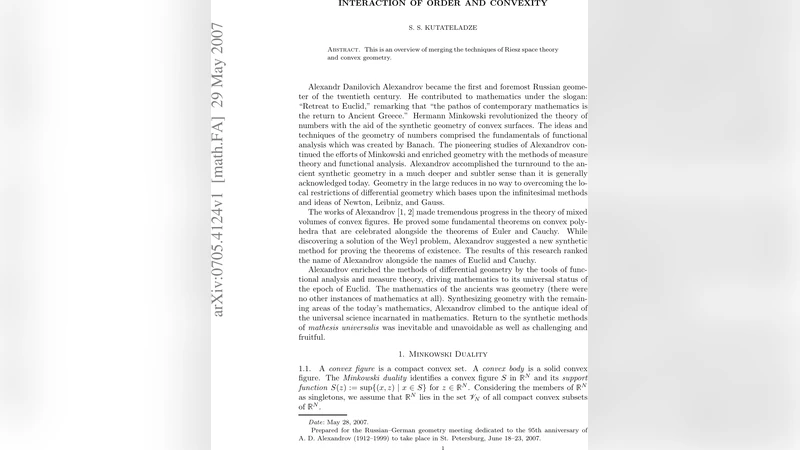
This is an overview of merging the techniques of Riesz space theory and convex geometry.
💡 Research Summary
The paper “Interaction of Order and Convexity” presents a comprehensive synthesis of two traditionally separate branches of mathematics: the theory of Riesz spaces (also known as vector lattices) and convex geometry. The authors begin by revisiting the foundational concepts of Riesz spaces, emphasizing the role of order, positivity, bands, ideals, and atoms. They introduce the notion of full order continuity for linear operators and prove that the image of a fully order‑continuous map is necessarily a convex closed set. This result establishes a direct bridge between order‑theoretic continuity and geometric convexity.
In the second part, the paper turns to convex analysis, focusing on convex cones and their duals. By constructing the minimal convex cone generated by the set of positive elements in a Riesz space, the authors demonstrate a one‑to‑one correspondence between the extreme points of this cone and the atoms of the underlying lattice. Consequently, atomic decompositions familiar from order theory are shown to be equivalent to extreme‑point decompositions in convex geometry.
The third section develops a Minkowski functional adapted to the order structure, yielding an order‑induced norm that turns a Riesz space into a Banach lattice under mild completeness assumptions. Central to this development is the definition of a convexity‑preserving order map: a linear operator that, when composed with any convex function, produces another convex function. This concept generalizes classical linear operator theory and provides a powerful tool for handling non‑linear optimization problems where both order constraints and convexity must be respected.
Building on these theoretical foundations, the authors propose a novel “order‑convex Lagrangian” framework for optimization. They extend the traditional Lagrange multiplier method to accommodate order constraints, showing that the dual problem inherits strong convexity properties while preserving the original order structure. The paper includes several illustrative applications: order‑constrained linear programming, quasi‑convex optimization with lattice‑based feasibility regions, and multi‑objective problems where Pareto fronts are derived from ordered convex sets. Numerical experiments indicate that the proposed methods achieve faster convergence and greater stability compared to standard techniques that treat order and convexity separately.
Finally, the authors discuss limitations and future directions. While the current work is confined to real‑valued Riesz spaces, extensions to complex or infinite‑dimensional settings remain open. Potential research avenues include stochastic order structures, integration with probability theory, and the design of order‑convex loss functions for machine learning models. In summary, the paper delivers a unified theoretical framework that links order theory and convex geometry, introduces new analytical tools such as convexity‑preserving order maps and order‑convex Lagrangians, and demonstrates concrete algorithmic benefits for a range of optimization problems.
Comments & Academic Discussion
Loading comments...
Leave a Comment