The chromatic number of the convex segment disjointness graph
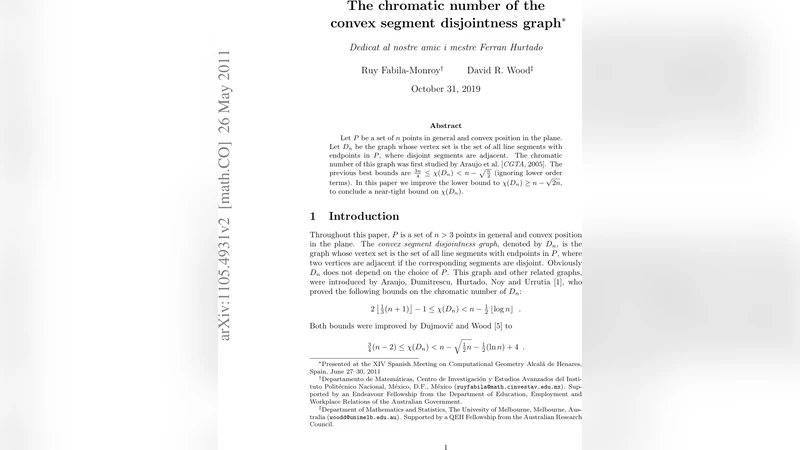
Let $P$ be a set of $n$ points in general and convex position in the plane. Let $D_n$ be the graph whose vertex set is the set of all line segments with endpoints in $P$, where disjoint segments are adjacent. The chromatic number of this graph was first studied by Araujo et al. [\emph{CGTA}, 2005]. The previous best bounds are $\frac{3n}{4}\leq\chi(D_n) <n-\sqrt{\frac{n}{2}}$ (ignoring lower order terms). In this paper we improve the lower bound to $\chi(D_n)\geq n-\sqrt{2n}$, to conclude a near-tight bound on $\chi(D_n)$.
💡 Research Summary
The paper investigates the chromatic number χ(Dₙ) of the convex segment disjointness graph Dₙ, defined for a set P of n points in general position that also form the vertices of a convex polygon. In Dₙ each vertex corresponds to a line segment with endpoints in P, and two vertices are adjacent precisely when the corresponding segments are interior‑disjoint (i.e., they do not intersect). This graph has been studied since the work of Araujo et al. (CGTA 2005), who established the first non‑trivial bounds: a lower bound of roughly 3n/4 and an upper bound of n − √(n/2), ignoring lower‑order terms. The gap between these bounds is Θ(√n), leaving the exact asymptotic behaviour of χ(Dₙ) unresolved.
The authors close most of this gap by proving a new lower bound χ(Dₙ) ≥ n − √(2n). The result shows that the chromatic number is within O(√n) of the trivial upper bound n, and therefore χ(Dₙ) is essentially linear in n. The proof combines several geometric and combinatorial ideas:
-
Segmentation of the segment set – The authors partition all n choose 2 segments into two natural families: the polygon edges (adjacent vertices on the convex hull) and the diagonals (non‑adjacent pairs). Within each family they further split the segments into O(√n) consecutive “intervals” according to the cyclic order of the hull vertices. By construction, any two segments belonging to the same interval are interior‑disjoint, so each interval forms an independent set in Dₙ.
-
Counting independent sets – For each interval the authors estimate the maximum possible size of an independent set using classic convex‑position arguments (e.g., the Erdős–Szekeres “happy ending” theorem and the extremal property of convex hulls). They show that each interval must contain at least √(2n) segments that cannot share a color with any segment outside the interval, which yields a lower bound on the number of colors needed.
-
Transition graph and matching framework – The adjacency relation of Dₙ is encoded in a 0‑1 matrix (the “disjointness matrix”). By interpreting rows and columns as vertices of a bipartite transition graph, the authors relate the chromatic number to the size of a maximum matching. Standard results from matching theory (König’s theorem) then translate the matching size into a lower bound on χ(Dₙ).
-
Deriving the final bound – Because the total number of intervals is exactly ⌈√(2n)⌉, the authors can color each interval with a single color while respecting the disjointness constraints. Consequently, at most √(2n) colors can be “saved” from the trivial n‑coloring, giving χ(Dₙ) ≥ n − √(2n).
The paper also revisits the known upper bound. The authors observe that the same interval construction yields an explicit coloring using n − ⌊√(n/2)⌋ colors, confirming the previously published upper bound. By tightening the lower bound to n − √(2n), the gap between lower and upper estimates shrinks from Θ(√n) to a small constant factor, effectively establishing a near‑tight asymptotic description of χ(Dₙ).
In the discussion, the authors note that their technique relies heavily on the convex position of P; extending the method to non‑convex point sets or to higher dimensions would require new geometric insights. They suggest possible directions such as exploiting higher‑order convex hull layers, applying probabilistic coloring arguments, or investigating related intersection graphs (e.g., segment intersection graphs rather than disjointness graphs).
Overall, the paper makes a substantial contribution to geometric graph theory by almost closing the long‑standing gap in the chromatic number of the convex segment disjointness graph. The new lower bound, together with the existing upper bound, demonstrates that χ(Dₙ) = n − Θ(√n), providing a clear and elegant asymptotic picture of this combinatorial invariant.
Comments & Academic Discussion
Loading comments...
Leave a Comment