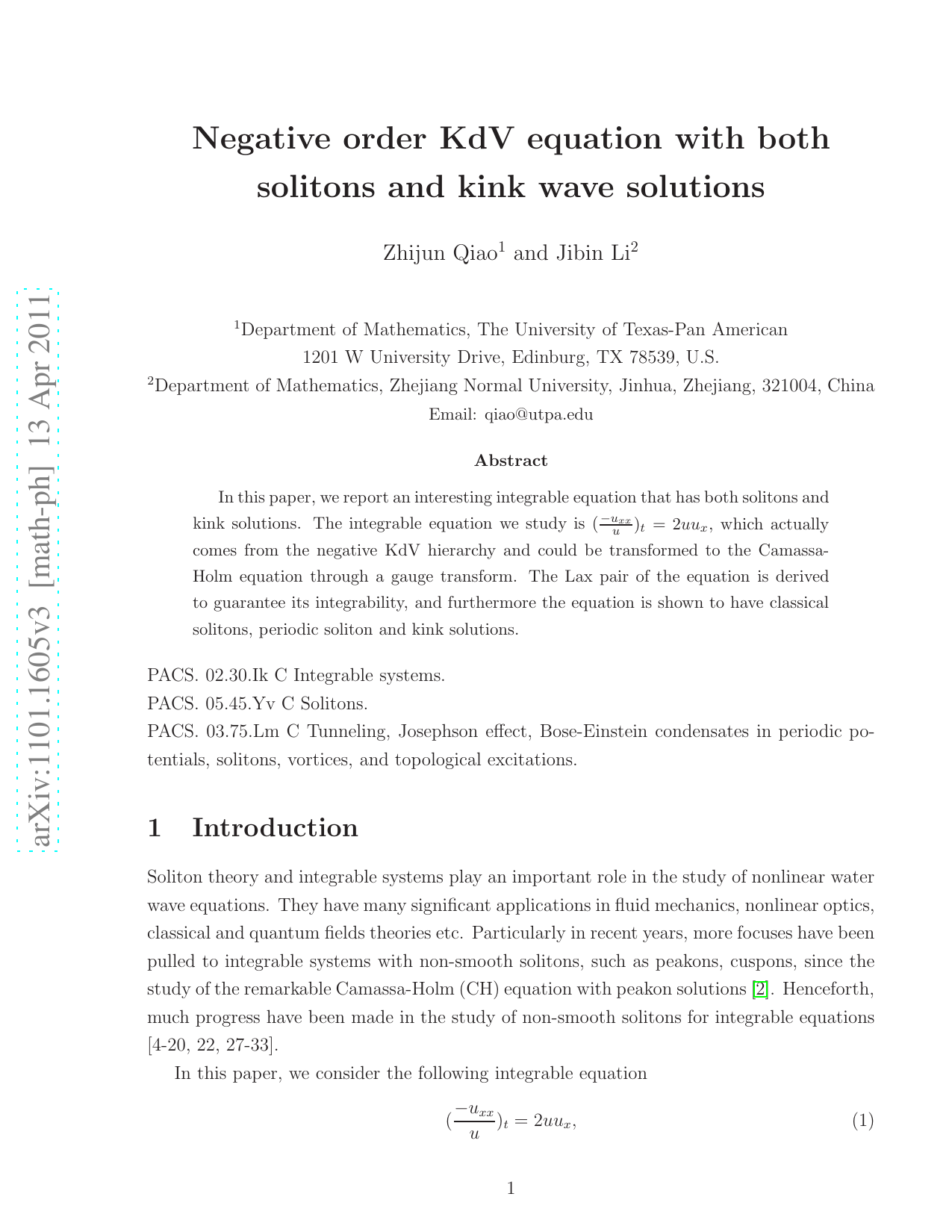
In this paper, we report an interesting integrable equation that has both solitons and kink solutions. The integrable equation we study is $(\frac{-u_{xx}}{u})_{t}=2uu_{x}$, which actually comes from the negative KdV hierarchy and could be transformed to the Camassa-Holm equation through a gauge transform. The Lax pair of the equation is derived to guarantee its integrability, and furthermore the equation is shown to have classical solitons, periodic soliton and kink solutions.
Deep Dive into Negative order KdV equation with both solitons and kink wave solutions.
In this paper, we report an interesting integrable equation that has both solitons and kink solutions. The integrable equation we study is $(\frac{-u_{xx}}{u})_{t}=2uu_{x}$, which actually comes from the negative KdV hierarchy and could be transformed to the Camassa-Holm equation through a gauge transform. The Lax pair of the equation is derived to guarantee its integrability, and furthermore the equation is shown to have classical solitons, periodic soliton and kink solutions.
Soliton theory and integrable systems play an important role in the study of nonlinear water wave equations. They have many significant applications in fluid mechanics, nonlinear optics, classical and quantum fields theories etc. Particularly in recent years, more focuses have been pulled to integrable systems with non-smooth solitons, such as peakons, cuspons, since the study of the remarkable Camassa-Holm (CH) equation with peakon solutions [2]. Henceforth, much progress have been made in the study of non-smooth solitons for integrable equations [4-20, 22, 27-33].
In this paper, we consider the following integrable equation
which is actually the first member in the negative KdV hierarchy [29]. Equation ( 1) is proven equivalent to the Camassa-Holm (CH) equation: m t + m x u + 2mu x = 0, m = u -u xx through a gauge transform (see Remark 1 in the paper). Therefore, we find a simpler reduced form of the CH equation. The Lax pair of the equation ( 1) is derived to guarantee its integrability, and furthermore the equation is shown to have classical solitons, periodic solitons and kink solutions.
Let us consider the Schrödinger-KdV spectral problem:
where λ is an eigenvalue, ψ is the eigenfunction corresponding to the eigenvalue λ, and v is a potential function. One can easily get the following Lenard operator relation:
where ∇λ ≡ δλ δv = ψ 2 is the functional gradient of the spectral problem (2) with respect to v, K = 1 4 ∂ 3 + 1 2 (v∂ + ∂v) and J = ∂ are two Hamiltonian operators as known in the literature [1].
By setting v = -uxx u , we have the product form of operators K, L, L and their inverses
where L = J -1 K and its inverse L -= K -1 J are the recursion operators for the positive order and negative order KdV hierarchy that we study below. Now, according to the Lenard’s operators K and J, we construct the entire KdV hierarchy, and then we show the integrability of the hierarchy through solving a key operator equation.
We define the Lenard’s sequence
where L, L -1 are defined by Eq. ( 2). Therefore we generate a hierarchy of nonlinear evolution equations (NLEEs):
which is called the entire KdV hierarchy. We will see below that the positive order (k ≥ 0)
gives the regular KdV hierarchy usually mentioned in the literature [1], while the negative order (k < 0) produces some interesting equations gauge-equivalent to the Camassa-Holm equation [2]. Apparently, this hierarchy possesses the bi-Hamiltonian structure because of the Hamiltonian properties of K, J. Let us now give special equations in the entire KdV hierarchy (5).
• Choosing G 0 = 2 ∈ Ker J (therefore G 1 = u) leads to the second positive member of the hierarchy (5):
which is exactly the well-known KdV equation. Here there is nothing new. Therefore, the positive order (k ≥ 0) in the hierarchy (5) yields the regular KdV hierarchy usually studied in the literature [1].
• Now, let us find kernel elements G -1 ∈ Ker K in order to get the negative member of the hierarchy (5). Due to the product form of K and K -1 , G -1 = K -1 0 has the following three seed solutions:
where f (t n ), g(t n ), h(t n ) are three arbitrarily given functions with respect to the time variables t n , but independent of x. They produce three iso-spectral (λ t k = 0) negative order KdV hierarchies of Eq. ( 5)
When k = -1, their representative equations are:
Remark 1. Apparently, the first one is differential and simpler and exactly recovers the equation (1) after setting f (t n ) = 1, which we focus on in the current paper. Actually, these three representative equations ( 8), (9), and (10)
This equation is exactly the one studied by Fuchssteiner [16] (see equations (7.1) and (7.22) there. Equations (7.1) in [16] has a typo and should be same as (11). From [16], the Camassa-Holm (CH) equation is gauge-equivalent to equation (11) through some hodograph transformations (7.11) and (7.12) in [16]. In our paper, through using v = -uxx u we further reduce equation (11) to a more simple form (i.e. equation (1)):
In other words, we found a very interesting fact that equation (12) can be viewed as a reduction form of the CH equation due to the above gauge-equivalence. In next section, we will solve this form.
In the paper [19], the author dealt with equation (∂ 2 + 4v + 2v x ∂ -1 )v t = 0 by using the positive KdV hierarchy approach, and all soliton solutions were given implicitly. This equation could be transformed to (- Of course, we may generate higher order nonlinear equations by selecting different members in the hierarchy. In the following, we will see that all equations in the KdV hierarchy (5) are integrable. Particularly, the above three equations ( 8), (9), and (10) are integrable.
Let us return to the spectral problem (2). Apparently, the Gateaux derivative matrix
which is obviously an injective homomorphism, i.e. U * (ξ) = 0 ⇔ ξ = 0.
For any given C ∞ -function G, one may consider the following operator equation [3] with
Theorem 1. For the spectra
…(Full text truncated)…
This content is AI-processed based on ArXiv data.