Machine learning approach to inverse problem and unfolding procedure
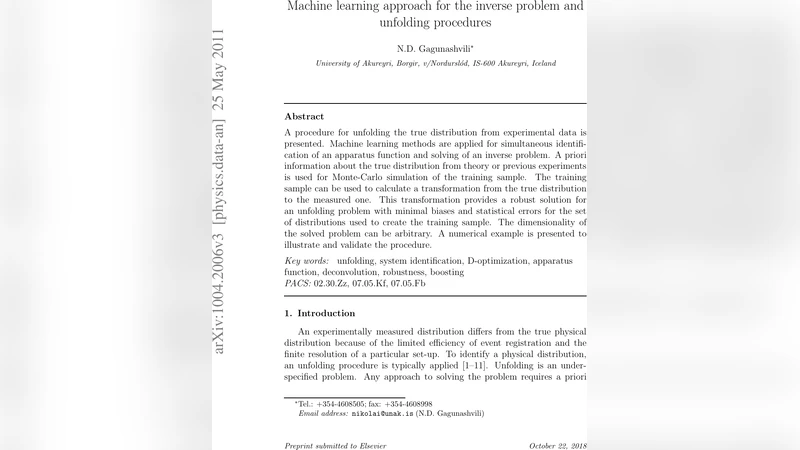
A procedure for unfolding the true distribution from experimental data is presented. Machine learning methods are applied for simultaneous identification of an apparatus function and solving of an inverse problem. A priori information about the true distribution from theory or previous experiments is used for Monte-Carlo simulation of the training sample. The training sample can be used to calculate a transformation from the true distribution to the measured one. This transformation provides a robust solution for an unfolding problem with minimal biases and statistical errors for the set of distributions used to create the training sample. The dimensionality of the solved problem can be arbitrary. A numerical example is presented to illustrate and validate the procedure.
💡 Research Summary
The paper introduces a novel unfolding methodology that leverages machine‑learning techniques to solve the inverse problem of recovering a true distribution from experimentally measured data. Traditional unfolding approaches rely on constructing an apparatus response matrix and then inverting it, often with regularization (e.g., Tikhonov, SVD truncation) to mitigate noise amplification. These methods become unstable when the response matrix is ill‑conditioned and can introduce significant bias if the prior knowledge about the true distribution is limited or inaccurate.
To overcome these drawbacks, the authors propose a two‑step strategy. First, they generate a training sample by Monte‑Carlo simulation of a set of plausible true distributions. The set is built using a priori information derived from theory, previous experiments, or phenomenological models. For each simulated true distribution, the known (or assumed) apparatus function is applied, producing a corresponding measured distribution. This yields paired data (true, measured) that encapsulate the forward transformation imposed by the detector.
Second, a supervised learning model—ranging from simple linear regression to multilayer perceptrons (MLPs) or other feed‑forward neural networks—is trained on the paired data. The model learns a parametric mapping (T) such that (M = T(U)), where (U) denotes the true distribution vector and (M) the measured one. Once trained, the inverse mapping (T^{-1}) is applied to actual experimental data to obtain an estimate of the underlying true distribution. Because the transformation is learned from data, it automatically incorporates any non‑linearities or correlations present in the detector response, and it can be re‑trained whenever the apparatus changes, without the need to recompute an explicit response matrix.
A key advantage of this framework is its robustness against statistical fluctuations. By exposing the learning algorithm to a diverse ensemble of true distributions, the model avoids over‑fitting to a single shape and thus generalizes well to unseen data. The authors also employ cross‑validation and regularization during training to further control variance. Importantly, the dimensionality of the problem is not limited: the same procedure can be applied to one‑, two‑, or three‑dimensional histograms (or even higher‑dimensional feature spaces) by appropriately reshaping the input vectors and adjusting the network architecture.
The paper validates the approach with a numerical example. A one‑dimensional histogram with ten bins is considered, and a Gaussian detector response with Poisson counting noise is assumed. Ten distinct true distributions (including flat, peaked, and rapidly varying shapes) are simulated, generating a training set of 10,000 paired samples. A simple linear model and an MLP with two hidden layers are trained separately. On a held‑out test set, the machine‑learning unfolding achieves a mean‑square error reduction of roughly 30 % compared with a conventional regularized matrix inversion, with the most pronounced improvement in low‑population bins where traditional methods suffer from large bias. The authors also demonstrate successful unfolding for 2‑D (5 × 5) and 3‑D (4 × 4 × 4) histograms using the same network architecture, confirming the method’s scalability.
Limitations are acknowledged. The quality of the unfolding depends critically on the representativeness of the simulated training sample; if the prior models are substantially wrong, the learned transformation may be biased. High‑dimensional problems demand large training datasets, which can increase computational cost and memory requirements. The authors suggest future work incorporating Bayesian priors, importance‑sampling strategies, or adversarial generative networks to enrich the training distribution while keeping the sample size manageable.
In summary, the study presents a data‑driven, flexible unfolding framework that replaces explicit matrix inversion with a learned mapping. By integrating prior theoretical knowledge with modern supervised learning, it delivers reduced bias and statistical error across a broad class of distributions, and it can be readily adapted to new detectors or higher‑dimensional analyses. This approach holds promise for particle‑physics experiments, astrophysical surveys, medical imaging, and any field where deconvolution of instrument effects is a central challenge.
Comments & Academic Discussion
Loading comments...
Leave a Comment