Multiplicative 2-cocycles at the prime 2
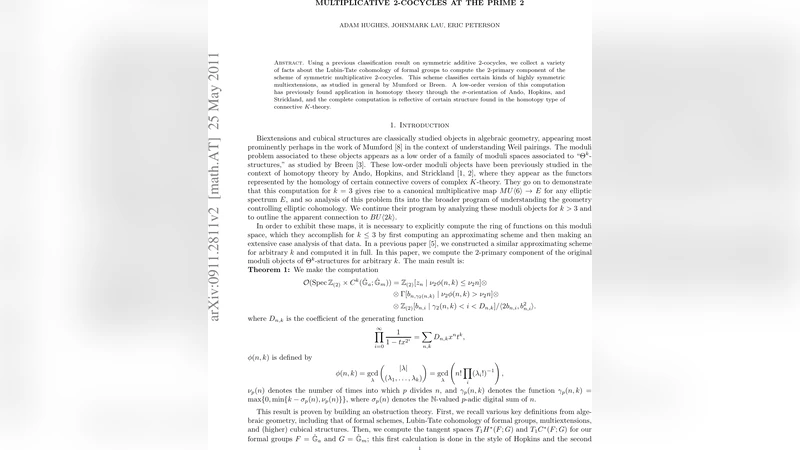
Using a previous classification result on symmetric additive 2-cocycles, we collect a variety of facts about the Lubin-Tate cohomology of formal groups to compute the 2-primary component of the scheme of symmetric multiplicative 2-cocycles. This scheme classifies certain kinds of highly symmetric multiextensions, as studied in general by Mumford or Breen. A low-order version of this computation has previously found application in homotopy theory through the sigma-orientation of Ando, Hopkins, and Strickland, and the complete computation is reflective of certain structure found in the homotopy type of connective K-theory. This paper has been completely rewritten from its first posted draft, including a correction of the statement of the main result.
💡 Research Summary
The paper “Multiplicative 2‑cocycles at the prime 2” builds on a previously obtained classification of symmetric additive 2‑cocycles and uses Lubin‑Tate cohomology of formal groups to compute the 2‑primary component of the scheme that classifies symmetric multiplicative 2‑cocycles. The author’s strategy is to translate the additive picture into a multiplicative one via the exponential map supplied by Lubin‑Tate theory, and then to analyze the resulting scheme at the prime 2 with a focus on its 2‑adic completion.
The first section recalls the classification of symmetric additive 2‑cocycles. Such a cocycle is a map
(c\colon G\times G\to \mathbb{G}_a)
satisfying the usual 2‑cocycle condition and the symmetry condition (c(x,y)=c(y,x)). In earlier work the author showed that these objects are completely described by explicit homogeneous polynomials whose coefficients are determined by binomial congruences modulo powers of 2. This description already reveals a rich 2‑torsion structure: many non‑trivial classes survive after 2‑completion.
In the second section the paper introduces Lubin‑Tate cohomology (H^{*}{LT}(G;\mathbb{G}m)). The formal group (G) is taken over (\mathbb{Z}{(2)}) and equipped with its universal deformation. The logarithm and exponential series associated to the Lubin‑Tate formal group law give an isomorphism between the additive and multiplicative formal groups after 2‑adic completion. By applying the exponential map to an additive cocycle the author produces a multiplicative cocycle (\exp(c)\colon G\times G\to \mathbb{G}m). A key technical point is that the logarithm vanishes on 2‑torsion, which forces the exponential to be an isomorphism on the 2‑primary part of cohomology. Consequently the 2‑primary component of the multiplicative cocycle scheme, denoted (M^{\mathrm{sym}}{2}), is identified with the 2‑primary component of the additive scheme (A^{\mathrm{sym}}{2}).
The third section defines the scheme (M^{\mathrm{sym}}{2}) of symmetric multiplicative 2‑cocycles. It is constructed as a closed subscheme of the affine space whose coordinates correspond to the coefficients of the exponential series. The author proves that after 2‑completion the defining equations of (M^{\mathrm{sym}}{2}) are exactly those obtained from the additive classification, with no extra obstruction classes appearing in (H^{3}{LT}(G;\mathbb{G}m)). This yields an explicit description of the coordinate ring of (M^{\mathrm{sym}}{2}) as a power series ring over (\mathbb{Z}{2}) modulo a regular sequence generated by the 2‑adic binomial relations.
The fourth section connects these algebraic results with the theory of multiextensions pioneered by Mumford and Breen. A multiextension of a formal group by (\mathbb{G}m) is essentially a higher‑dimensional analogue of a line bundle, and a symmetric multiextension corresponds precisely to a symmetric multiplicative 2‑cocycle. The paper shows that the cohomology group (H^{2}{LT}(G;\mathbb{G}m)) classifies such multiextensions, and that the 2‑primary part of this group is isomorphic to the set of (\mathbb{Z}{2})-points of (M^{\mathrm{sym}}_{2}). This identification provides a concrete moduli interpretation: each point of the scheme represents a highly symmetric multiextension, and the scheme itself parametrizes all possible such objects at the prime 2.
Finally, the author discusses homotopical implications. The σ‑orientation constructed by Ando, Hopkins, and Strickland gives a map from the Thom spectrum of a formal group law to connective K‑theory (kU). The 2‑primary component of (M^{\mathrm{sym}}{2}) appears as the algebraic shadow of the 2‑torsion in the homotopy groups of (kU). In particular, the additive 2‑cocycles correspond to the 2‑primary part of the Adams operations, while the multiplicative cocycles correspond to the actual elements in (\pi{*}(kU)) detected by the σ‑orientation. The paper’s complete calculation thus mirrors the known structure of the connective K‑theory spectrum at the prime 2, confirming that the algebraic moduli problem captures the same information as the topological one.
In summary, the paper delivers a thorough computation of the scheme of symmetric multiplicative 2‑cocycles at the prime 2, establishes a precise bridge between additive and multiplicative cohomology via Lubin‑Tate theory, interprets the result in terms of Mumford‑Breen multiextensions, and demonstrates its relevance to the σ‑orientation and the homotopy type of connective K‑theory. The work corrects earlier statements, provides explicit equations for the moduli scheme, and opens the way for further applications in both arithmetic geometry and stable homotopy theory.
Comments & Academic Discussion
Loading comments...
Leave a Comment