Enumerating ODE Equivalent Homogeneous Networks
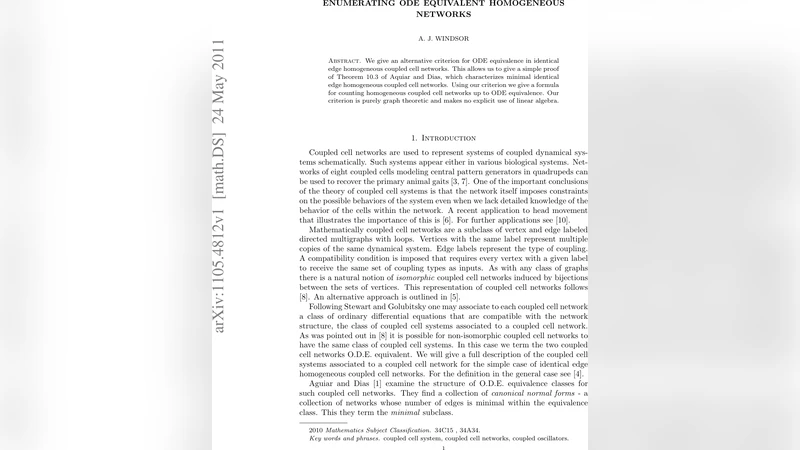
We give an simple criterion for ODE equivalence in identical edge homogeneous coupled cell networks. This allows us to give a simple proof of Theorem 10.3 of Aquiar and Dias “Minimal Coupled Cell Networks”, which characterizes minimal identical edge homogeneous coupled cell networks. Using our criterion we give a formula for counting homogeneous coupled cell networks up to ODE equivalence. Our criterion is purely graph theoretic and makes no explicit use of linear algebra.
💡 Research Summary
The paper addresses the problem of classifying identical‑edge homogeneous coupled cell networks up to ODE equivalence, i.e., when two networks generate exactly the same family of admissible ordinary differential equations for any choice of phase space and coupling function. The authors restrict attention to the simplest setting: directed multigraphs (loops allowed) in which every vertex has the same indegree r, called degree‑r networks.
First, they formalize ODE equivalence: two networks G₁ and G₂ are ODE‑equivalent if, for every phase space P and every symmetric coupling function F :P×P^r→P, the sets of admissible vector fields X_P(G₁) and X_P(G₂) coincide (up to relabeling). They note that linear equivalence (when P=ℝ and F is linear) coincides with ODE equivalence, a fact proved in earlier work.
The core contribution is a purely graph‑theoretic criterion for ODE equivalence. Two elementary operations are introduced and proved to preserve ODE equivalence (Lemma 1):
- Loop addition – add a self‑loop to every vertex, raising the indegree from r to r+1.
- k‑splitting – replace each edge by k identical parallel copies, raising the indegree from r to k·r.
The proof works by restricting to linear coupling functions of the form F(x; y₁,…,y_r)=a x+b∑y_i. By adjusting the coefficients (a,b) appropriately, the authors show that the linear admissible vector fields of the original and transformed networks are identical, establishing ODE equivalence.
Using these operations, Lemma 2 constructs for any network G a reduced network G_M with two properties: (i) at least one vertex has no loops, and (ii) the greatest common divisor of all edge multiplicities equals 1. The construction removes a common number of loops from every vertex and then divides all edge multiplicities by their GCD. Lemma 3 proves that reduced networks are unique up to graph isomorphism: if two reduced networks are ODE‑equivalent, their adjacency matrices satisfy a₁I+b₁A = a₂I+b₂B for some scalars, which forces A = B. Hence each ODE‑equivalence class contains a unique minimal representative.
Having identified a canonical minimal network for each class, the authors turn to enumeration. They adopt the Burnside‑Lemma framework used by Aldosray and Stewart for counting homogeneous networks up to isomorphism. Let Ω_{n,r} be the set of all directed multigraphs on n labeled vertices with constant indegree r. The symmetric group S_n acts on Ω_{n,r} by relabeling vertices; the number of isomorphism classes is |Orb_{Ω_{n,r}}(S_n)| = (1/|S_n|)∑{g∈S_n}|Fix{Ω_{n,r}}(g)|. Since the fixed‑point count depends only on the cycle type of g, the sum can be taken over integer partitions of n. For a partition
Comments & Academic Discussion
Loading comments...
Leave a Comment