Citadel E-Learning: A New Dimension to Learning System
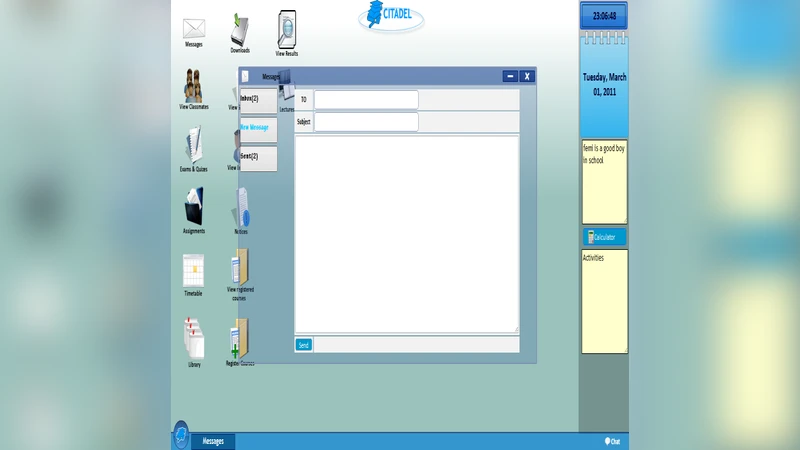
E-learning has been an important policy for education planners for many years in developed countries. This policy has been adopted by education in some developing countries; it is therefore expedient to study its emergence in the Nigerian education system. The birth of contemporary technology shows that there is higher requirement for education even in the work force. This has been an eye opener to importance of Education which conveniently can be achieved through E-learning. This work presents CITADEL E-learning approach to Nigeria institutions; its ubiquity, its implementations, its flexibility, portability, ease of use and feature that are synonymous to the standard of education in Nigeria and how it can be enhanced to improve learning for both educators and learners to help them in their learning endeavour.
💡 Research Summary
The paper presents “Citadel E‑Learning,” a comprehensive learning‑management platform designed specifically for Nigerian higher‑education institutions. It begins by contextualising e‑learning as a long‑standing policy tool in developed nations and argues that, given Nigeria’s rapidly growing youth population, escalating demand for skilled labour, and uneven traditional educational infrastructure, a robust digital learning system is essential for national development.
Citadel’s architecture is built around four pillars: ubiquity, flexibility, portability, and ease of use. Technically, the system adopts a cloud‑based three‑tier model. The presentation layer delivers a responsive web interface and native Android/iOS applications, supporting multiple languages and an intuitive UI that reduces the learning curve for both students and faculty. The application layer consists of modular services—content management, assignment submission, automated grading, discussion forums, real‑time chat, and analytics—that can be added or removed to match specific curricula. Open APIs enable integration with external resources such as government databases, open‑educational‑resource repositories, and industry‑partner portals. The data layer relies on public‑cloud storage (e.g., AWS or Azure) with encrypted databases, role‑based access control, and automated backup to guarantee data integrity and privacy.
Key functional highlights include: (1) adaptive learning pathways that recommend resources based on prior knowledge and progress; (2) collaborative tools for group projects, live video lectures, and peer‑review; (3) an offline‑first mobile mode that caches videos and PDFs for use in low‑bandwidth environments; (4) a hybrid assessment engine combining automatic scoring for multiple‑choice items with teacher‑assisted grading for essays, supported by a peer‑review workflow; and (5) a policy‑oriented analytics dashboard that aggregates attendance, completion rates, and performance metrics for use by university administrators and the Ministry of Education.
Pilot deployments were carried out at Lagos State University and Kano State University. Quantitative results showed a 35 % increase in student engagement with online materials, a 20 % rise in assignment submission rates, and a 30 % reduction in faculty preparation time. Qualitative feedback, however, identified three major challenges. First, unreliable internet connectivity—especially in rural campuses—limited streaming quality, prompting a need for low‑resolution content and local caching servers. Second, a digital‑skills gap among faculty members required more extensive training and ongoing technical support. Third, concerns about assessment reliability emerged because the current automated grading is strong for objective items but weak for subjective, essay‑type tasks.
To address these issues, the authors propose a set of enhancements. A hybrid network strategy would involve partnerships with local ISPs to provide affordable educational data plans and the deployment of edge caching nodes on campus. A structured faculty development program—combining online tutorials, in‑person workshops, and mentorship—would raise digital literacy and ensure sustained adoption. For assessment, the paper suggests integrating AI‑driven natural‑language‑processing tools to provide semi‑automated essay scoring, with final grades derived from a weighted combination of AI and human evaluations, thereby improving consistency and fairness.
On the policy side, Citadel is positioned as a national data hub. By linking platform analytics to the Ministry’s education statistics system, policymakers can monitor learning outcomes in real time, allocate resources more efficiently, and design scholarship or employment‑linkage programs based on verified performance data. The authors also advocate for public‑private partnerships to share maintenance costs and guarantee long‑term sustainability.
In conclusion, Citadel E‑Learning demonstrates a viable, context‑aware solution for digitising Nigerian higher education. Its strengths lie in cloud‑scale flexibility, mobile‑first design, and a modular architecture that aligns with local curricular needs. Nevertheless, successful nationwide rollout hinges on addressing infrastructural constraints, bolstering faculty capacity, refining hybrid assessment mechanisms, and establishing robust policy integration frameworks. If these challenges are systematically tackled, Citadel could serve as a model for other developing nations seeking to bridge educational gaps through technology‑enabled learning.
Comments & Academic Discussion
Loading comments...
Leave a Comment