Chain Homotopies for Object Topological Representations
This paper presents a set of tools to compute topological information of simplicial complexes, tools that are applicable to extract topological information from digital pictures. A simplicial complex is encoded in a (non-unique) algebraic-topological format called AM-model. An AM-model for a given object K is determined by a concrete chain homotopy and it provides, in particular, integer (co)homology generators of K and representative (co)cycles of these generators. An algorithm for computing an AM-model and the cohomological invariant HB1 (derived from the rank of the cohomology ring) with integer coefficients for a finite simplicial complex in any dimension is designed here. A concept of generators which are “nicely” representative cycles is also presented. Moreover, we extend the definition of AM-models to 3D binary digital images and we design algorithms to update the AM-model information after voxel set operations (union, intersection, difference and inverse).
💡 Research Summary
The paper introduces a comprehensive framework for computing topological invariants of finite simplicial complexes and 3‑D binary digital images using integer coefficients. The authors build upon the previously defined AM‑model (Algebraic‑Topological model), which originally relied on chain contractions defined over a field, and extend it to the integer domain (ℤ). An AM‑model is defined as a pair (C, φ) where C is the chain complex of the simplicial complex K (with a chosen basis for each chain group) and φ is a collection of chain homotopy maps φ_q : C_q → C_{q+1} satisfying φ_{q+1} ∘ φ_q = 0 and φ_q ∂{q+1} φ_q = φ_q. From φ the authors construct a projection π_q = id − φ{q−1}∂q − ∂{q+1}φ_q and define a reduced chain complex M whose q‑th group is M_q = Im π_q and whose differential d_q is the restriction of the original boundary operator ∂_q to M_q. Crucially, the Smith Normal Form (SNF) of each d_q contains only non‑unit entries (greater than 1), which makes the torsion coefficients of the homology groups explicit while separating the free part.
Theoretical results (Theorem 2.1 and 2.2) prove that from the homotopy φ alone one can recover the full chain contraction (f, g, φ) and thus the homology of K. The authors then present Algorithm 2.2, which computes an AM‑model for any finite simplicial complex. The algorithm proceeds dimension by dimension: it reduces the boundary matrix ∂q to SNF, extracts the parameters t_q, ℓ_q, s{q−1} that describe the rank of the free part and the torsion part, and defines φ_{q−1} and φ_q accordingly (mapping basis elements that correspond to non‑zero SNF entries to their pre‑images, and sending the rest to zero). This process yields a chain homotopy φ that automatically satisfies the required identities, and the resulting M provides integer homology generators together with representative cycles.
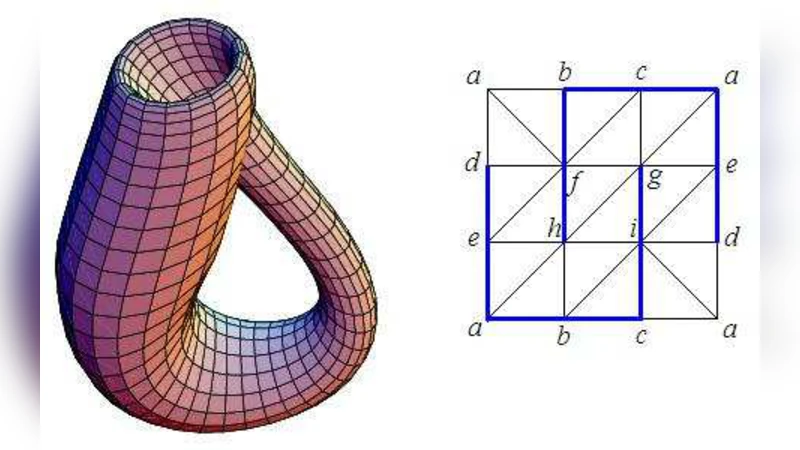
An illustrative example on a triangulated Klein bottle demonstrates the method: the algorithm recovers H₀ ≅ ℤ, H₁ ≅ ℤ ⊕ ℤ/2, and H₂ = 0, and supplies explicit cycles for the free generator, the torsion generator, and the 0‑dimensional component.
The paper then extends the framework to integer cohomology. By taking the dual cochain complex C^* (with coboundary δ induced by the transpose of the boundary matrices), the same AM‑model yields integer cohomology groups H^q(C) = Z^q/B^q. Because torsion may appear, cohomology is not automatically isomorphic to homology, and the cup product structure becomes accessible. The authors show how to compute the cup product and the invariant HB₁, which is derived from the rank of the cohomology ring, directly from the AM‑model without recomputing matrices.
Finally, the authors apply the theory to 3‑D binary digital images. A voxel set is interpreted as a simplicial complex (by considering voxels as 3‑cells, faces as 2‑cells, etc.). An AM‑model is built for the initial image, and then efficient update procedures are described for the four basic set operations: union, intersection, difference, and complement. When voxels are added or removed, only the portions of φ and the projection π that involve the affected cells need to be recomputed, avoiding a full recomputation of the SNF for the whole image. This makes the approach suitable for large‑scale medical imaging or computer‑vision tasks where topological descriptors must be maintained dynamically.
In summary, the paper delivers a mathematically rigorous yet computationally practical method for integer homology and cohomology computation, provides explicit generators and representative cycles, enables the extraction of richer invariants such as cup products and HB₁, and demonstrates a dynamic update scheme for digital images. The work bridges a gap between abstract algebraic topology and concrete applications in digital image analysis, offering tools that are both theoretically sound and implementable with existing matrix‑reduction libraries.
Comments & Academic Discussion
Loading comments...
Leave a Comment