Logical Modelling of Physarum Polycephalum
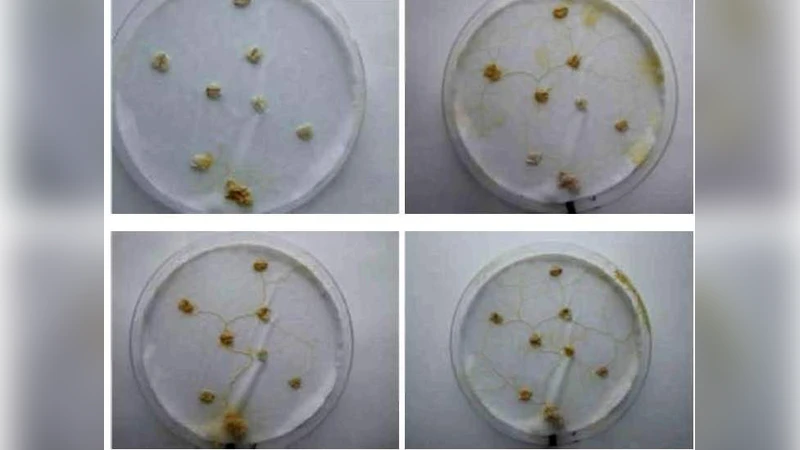
We propose a novel model of unconventional computing where a structural part of computation is presented by dynamics of plasmodium of Physarum polycephalum, a large single cell. We sketch a new logical approach combining conventional logic with process calculus to demonstrate how to employ formal methods in design of unconventional computing media presented by Physarum polycephalum.
💡 Research Summary
The paper proposes a novel formal framework for unconventional computing based on the slime mold Physarum polycephalum. The authors argue that unlike traditional electronic computers, where the hardware (circuitry) is fixed and only the data vary, reaction‑diffusion media such as the Physarum plasmodium exhibit both structural and data variability in space and time. Consequently, they aim to capture the organism’s dynamic behavior—growth, fusion, and competition—using logical and process‑algebraic tools.
First, the plasmodium is modeled as a labeled transition system. The set of states L = {p_ij} represents active zones (pseudopodia) indexed by species i and spatial cell j. A transition relation p —σ→ p′ denotes that state p can evolve to p′ via action σ. Finite or infinite sequences of states are called traces; each trace can be visualized as a graph whose nodes are states and edges are transitions.
Two families of logical connectives are introduced. The co‑algebraic (co‑inductive) connectives treat an infinite trace as a stream. For any trace % (p) the initial value %p(0) and the derivative %₀p (the tail of the stream) are defined. Logical operators ¬, ∨, ∧, ⊃ are given differential‑equation‑like definitions, e.g. (¬ϕ)₀ = ¬(ϕ₀) and (¬ϕ)(0) = ¬ϕ(0). This yields a co‑induction principle: if two traces belong to a bisimulation relation, they are equal. Thus, global logical properties of the whole computation can be proved by constructing the greatest bisimulation.
The second family consists of state‑transition‑based “non‑classical” connectives that directly reflect Physarum’s physical actions:
- Nil (inaction) – a pseudopodium stops moving;
- & (fusion) – two pseudopodia meet and merge;
- + (choice) – competing pseudopodia vie for resources.
These operators do not obey Boolean algebra laws; instead they are interpreted as special transitions over states.
Combining both families, the authors develop a Physarum Process Calculus. The computational domain Ω is partitioned into K disjoint cells c₁,…,c_K. In each cell there may be N active species, with state p_ij. Additional entities are defined: attractants A (nutrient sources), repellents R (light‑intense zones), and protoplasmic tubes C (the network of veins).
The syntax of processes is:
P ::= Nil | α?P | A(α)?P | R(α)?P | C(α) |
      (P | Q) | P \ Q | P & Q | P + Q
where α ranges over action labels, and each label has a complementary action α̅. The operational semantics are given by transition rules:
- Prefix – α?P performs α then behaves as P; similarly for A(α)?P and R(α)?P.
- Diffusion – C(α) spawns a new process representing the spread of a pseudopodium.
- Constant – actions from the set L_τ (including internal τ) can be consumed.
- Choice – P + Q can perform any transition offered by either operand.
- Co‑operation – P | Q interleaves transitions; complementary actions synchronize into an internal τ.
- Hiding – P \ Q restricts the visible actions to those not in Q.
- Fusion – complementary actions in P & Q annihilate each other, yielding Nil.
These rules capture concurrency, synchronization, restriction, and the unique biological operations of inaction, fusion, and competition.
The key insight is that the Physarum’s spatio‑temporal dynamics can be expressed simultaneously by a global co‑inductive logical layer (describing properties of whole traces) and a local transition‑based layer (describing instantaneous physical events). This dual representation bridges the gap between high‑level logical specifications and low‑level biological implementation, enabling formal verification, simulation, and systematic design of slime‑mold‑based computers.
The authors also discuss the broader relevance of their model. Reaction‑diffusion computers, chemical abstract machines, and other biologically inspired substrates can be mapped onto the same framework by interpreting their elementary processes as actions and defining appropriate fusion/choice operators. Future work is suggested to calibrate the abstract model against quantitative experimental data (e.g., speed of pseudopod propagation, nutrient uptake rates, phototactic thresholds) and to explore automated synthesis of logical circuits using Physarum’s natural network formation.
In summary, the paper provides a rigorous logical and process‑algebraic foundation for Physarum‑based unconventional computing, introducing co‑algebraic truth over infinite traces, non‑classical state‑based connectives, and a complete operational semantics that together enable formal reasoning about biological computation.
Comments & Academic Discussion
Loading comments...
Leave a Comment