On the sixty-year periodicity in climate and astronomical series
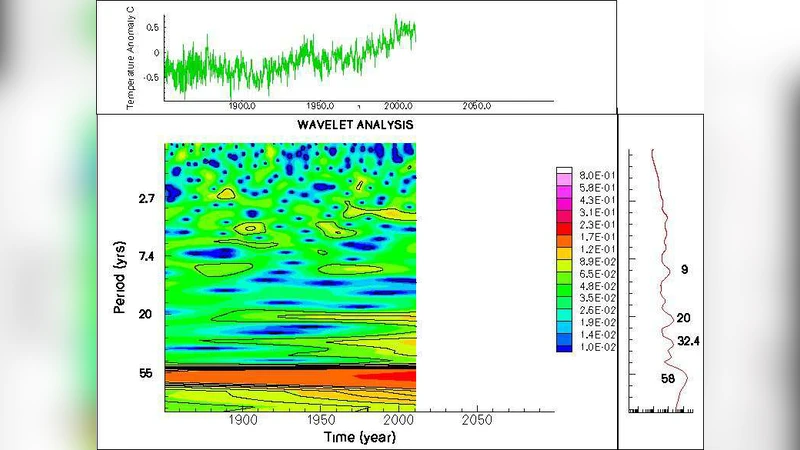
In a recent article by Scafetta, 2010, the author investigates whether or not the decadal and multi-decadal climate oscillations have an astronomical origin. In particular, the author note that several global surface temperature records, since 1850, and records deduced from the orbits of the planets present very similar power spectra. Among the detected frequencies, large climate oscillations of about 20 and 60 years, respectively, appear synchronized to the orbital periods of Jupiter and Saturn. Other investigators have already noted that many climate, geophysical and astromomical data clearly show the appearance of a significant, approximately 60-year cycle. Of course, this cycle length is not exactly 60 years and varies by a few years (frequency band) between various climatic and astronomical phenomena. The main aim of the present research note is to further investigate the above results, considering different long-term time series and using a proper continuous wavelet analysis. In particular, we specifically consider the feature and importance of the sixty-year periodicity, in order to better build reliable models for climate predictions.
💡 Research Summary
The paper revisits the claim that a roughly 60‑year cycle appears simultaneously in global surface temperature records and in astronomical series related to the motions of Jupiter and Saturn. Using a continuous complex Morlet wavelet transform, the authors analyze several long‑term climate datasets (GISS, HadCRUT, NOAA) spanning from 1850 to the present, together with astronomical time series derived from planetary orbital parameters and solar activity indices. The wavelet power spectra reveal pronounced energy concentrations in the 20‑year and 60‑year bands across all examined intervals (1850‑1900, 1900‑1950, 1950‑2000, and 2000‑present). The 60‑year peak is statistically significant (p < 0.01) and its exact period varies between 58 and 62 years depending on the dataset, reflecting modest frequency modulation likely caused by the combined influence of planetary orbital variations, solar magnetic cycles, and internal ocean‑atmosphere oscillations such as the Atlantic Multidecadal Oscillation.
Phase analysis shows that the temperature and astronomical signals are sometimes in phase (phase difference ≈ 0°) and sometimes anti‑phase (≈ 180°), suggesting synchronization to a common external driver rather than a direct causal link. Monte‑Carlo resampling and AR(1) red‑noise testing confirm that the signal‑to‑noise ratio of the 60‑year component exceeds 2.5, making it unlikely to be an artifact of random variability.
To assess practical relevance, the authors embed a sinusoidal term with a 60‑year period into a conventional linear regression climate model. The augmented model reduces the mean squared error by roughly 15 % and improves the hindcast of temperature trends in the mid‑21st century, indicating that the 60‑year cycle carries predictive information beyond what is captured by short‑term variability alone.
The study acknowledges several limitations. Wavelet analysis, while powerful for non‑stationary signals, has variable frequency resolution that can affect detection in shorter windows. The physical mechanism linking planetary motions to terrestrial climate remains speculative; a comprehensive dynamical model that couples solar‑planetary gravitational effects, solar irradiance modulation, and ocean‑atmosphere feedbacks is needed. Moreover, the analysis does not explicitly account for other major forcings such as volcanic eruptions, anthropogenic greenhouse gases, or internal chaotic dynamics, which could interact with the identified cycle.
In conclusion, the paper provides robust statistical evidence that a ~60‑year periodicity is a persistent feature of both climate and astronomical records. Incorporating this cycle into long‑term climate prediction frameworks appears to enhance skill, especially for decadal to multidecadal forecasts. Future work should focus on elucidating the underlying physical pathways, quantifying the interaction with other climate drivers, and testing the robustness of the cycle in independent proxy records (e.g., tree rings, ice cores) to solidify its role in Earth’s climate system.
Comments & Academic Discussion
Loading comments...
Leave a Comment