Study of Astronomical and Geodetic Series using the Allan Variance
Allan variance (AVAR) was first introduced more than 40 years ago as a estimator of the stability of frequency standards, and now it is actively used for investigations of time series in astronomy, geodesy and geodynamics. This method allows one to effectively explore the noise characteristics for various data, such as variations of station and source coordinates, etc. Moreover, this technique can be used to investigate the spectral and fractal structure of the noise in measured data. To process unevenly weighted and multidimensional data, which are usual for many astronomy and geodesy applications, AVAR modifications are proposed by the author. In this paper, a brief overview is given of using of classical and modified AVAR method in astronomy and geodynamics.
💡 Research Summary
The paper revisits the Allan variance (AVAR), originally introduced in the 1960s for assessing the stability of frequency standards, and demonstrates its relevance for modern astronomical and geodetic time‑series analysis. Classical AVAR, defined as the mean of squared successive differences of equally weighted observations, assumes uniform measurement accuracy and one‑dimensional data. These assumptions are violated in most astronomical and geodetic applications where observations have heterogeneous uncertainties and often form multidimensional vectors (e.g., station XYZ coordinates, celestial pole X/Y, right ascension/declination).
To overcome these limitations the author proposes two extensions. First, a weighted AVAR (WADEV) incorporates individual standard deviations (s_i) by assigning a weight (p_i) to each observation. The weighted variance is computed from the weighted differences, which reduces the influence of outliers with large uncertainties—a common situation in VLBI, GPS, SLR, and DORIS data. Second, a multidimensional weighted AVAR (WMAVAR) treats each measurement as a k‑dimensional vector. The Euclidean distance between consecutive vectors, (d_i), is used together with the propagated uncertainties to define a weight. An empirical expression for the weight avoids singularities when consecutive measurements are nearly identical. WMAVAR and its square root, WMADEV, thus capture the true stochastic behavior of vector‑valued series while remaining robust to trends, jumps, and long‑term drifts.
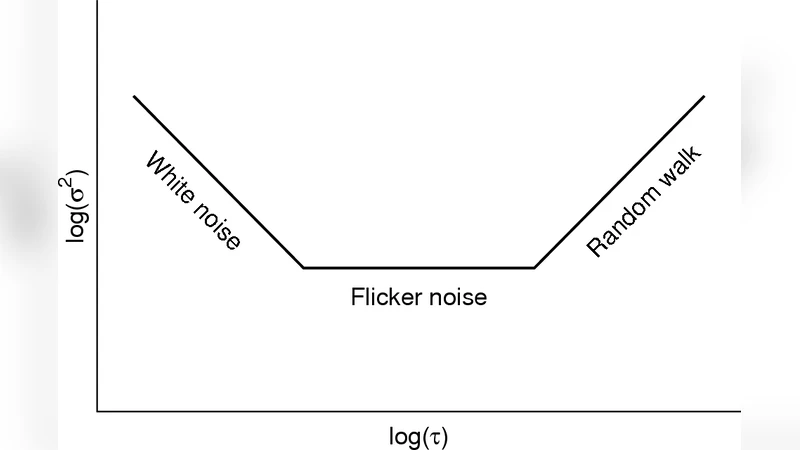
The paper then links AVAR to spectral analysis. Assuming a power‑law noise spectrum (S(f)=S_0 (f/f_0)^k), a log‑log plot of AVAR versus averaging time (\tau) yields a slope (\mu). The value of (\mu) distinguishes three basic noise types: white noise ((\mu=-0.5)), flicker noise ((\mu=0)), and random walk ((\mu=0.5)). The author also mentions the Hurst exponent as a fractal measure that can be derived from AVAR, providing insight into long‑range dependence.
Practical applications are illustrated with several case studies. In the International Earth Rotation Service (IERS) the weighted AVAR was used to assess and combine Earth rotation parameters (ERP) until 2005, when a new algorithm replaced it. For VLBI‑derived celestial pole coordinates, a two‑dimensional WADEV was computed for two radio‑source catalogs (ICRF‑Ext.2 and RSC(PUL)07C02); the latter showed slightly lower WADEV values, indicating higher internal consistency. Station coordinate time series from the European GPS network (EUREF) and from VLBI, SLR, and DORIS were examined; AVAR proved more sensitive to the random component than the traditional RMS, especially when systematic trends or occasional jumps were present.
The most extensive example concerns the International Celestial Reference Frame (ICRF2) construction. Fifteen analysis centers provided series of radio‑source positions processed with different software and strategies. For each source the RMS, linear trend, and ADEV were computed, and median values across all sources were used as a global noise indicator. Comparison of RMS and ADEV showed that ADEV is less affected by systematic motions and therefore offers a more reliable measure of stochastic noise. Detailed comparison of two USNO series for source 0528+134 (usn000d vs. usn001a) highlighted how ADEV captures differences that RMS masks.
Overall, the study demonstrates that weighted and multidimensional AVAR extensions enable robust characterization of stochastic noise in unevenly weighted, vector‑valued time series. Unlike RMS, AVAR is largely immune to long‑term trends and isolated outliers, while still providing a direct link to the underlying noise spectrum. The author recommends pre‑removing known periodic components (e.g., seasonal signals) before AVAR analysis and stresses that reliable spectral classification requires series with at least several hundred data points. The paper positions WMAVAR as a powerful, theoretically sound tool for quality assessment, model selection, and uncertainty prediction in modern astrometry and geodesy.
Comments & Academic Discussion
Loading comments...
Leave a Comment