Tecnologia Movel: Uma Tend^encia, Uma Realidade
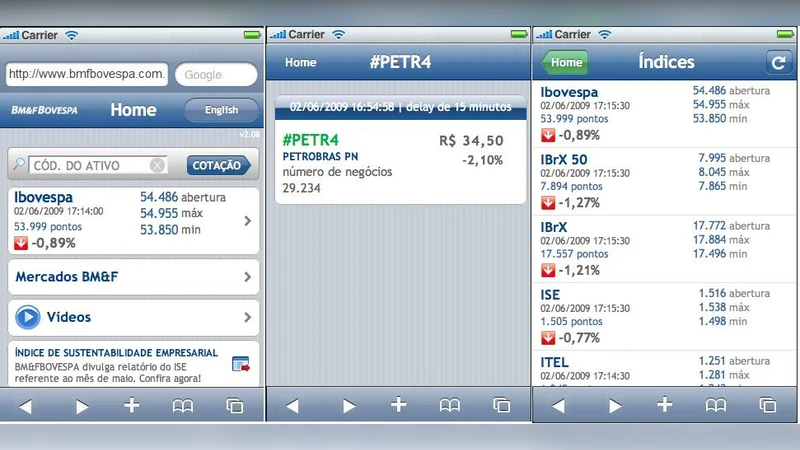
Currently, mobility presents itself as a major innovation in historic technological revolution. From the first decade of this century, nothing compares to what happened in the field of Information Technology (IT), which is adding to market a range of news relating to infrastructure such as mobile computing hardware, software, computer networks, etc.. From a handheld as a wireless device, iPad, Smartphone, you can connect to the digital world, people, customers, business partners, etc.. Given the infinite range of information, services and resources available in the electronic world, it is considered that few are those, markets and people who want to be left behind. The interest in this channel of communication becomes not only a new strategy of marketing and communications. Mobile devices are becoming more sophisticated and allows access to the web. Thinking in this context is that manufacturers of electronic components face each other in a war over the disputed technology to a competitive environment that is open to those who put on the market the product more attractive, interactive and versatile.
💡 Research Summary
The paper “Mobile Technology: A Trend, A Reality” attempts to provide a broad overview of the rapid expansion of mobile computing from the early 2000s to the present, focusing especially on the Brazilian market but also referencing global developments. It begins by defining mobile technology as the ability to access the Internet and other computational resources through handheld devices such as smartphones, tablets, iPods, and notebooks. The authors argue that mobility has become one of the most significant historical innovations of the current technological revolution, reshaping how individuals, businesses, and governments interact with digital information.
The manuscript is organized into several thematic chapters. The first comparative section contrasts conventional (desktop‑based) Internet usage with mobile Internet, emphasizing the convenience of “any‑time, any‑where” access, the elimination of physical keyboards and mice, and the emergence of mobile‑first design principles. The authors cite early marketing experiments, such as full‑page newspaper ads that invited readers to send a free SMS to receive a discount coupon, which then linked to a click‑to‑call number and a web‑based landing page. This illustrates the early integration of offline media with mobile channels, a practice that has evolved into sophisticated omnichannel marketing strategies.
Chapter three discusses the explosive growth of mobile hardware and services. The paper highlights Brazil’s milestone of 147 million active cellular lines, underscoring the country’s massive user base. It describes location‑based services (LBS) powered by GPS, ranging from simple navigation to real‑time personal tracking, and notes the privacy and security implications of such pervasive geolocation. The authors quote Lemos (2004) to portray the smartphone as a “tele‑everything” device that consolidates telephone, camera, television, news, email, social networking, music playback, electronic wallet, and more, effectively supplanting laptops for many everyday tasks.
The subsequent sections present concrete mobile commerce (m‑commerce) examples. Amazon.com’s mobile‑optimized site allows U.S. customers to shop via smartphones, demonstrating the commercial viability of mobile transactions. Coca‑Cola’s partnership with M‑Pay, Visa, and a local bottler enables consumers to purchase beverages from vending machines using a smartphone, illustrating the integration of mobile payment into physical retail. The paper also details the TIM‑Gol collaboration, which lets Brazilian users buy airline tickets, receive a confirmation code, and even perform check‑in through a mobile portal, thereby reducing the need for physical tickets and airport counters. These case studies collectively show how mobile platforms are reshaping retail, hospitality, and travel industries.
Security concerns receive a dedicated discussion. The authors acknowledge that mobile devices are vulnerable to viruses, malware, and theft, citing a Tower Group study that identified over 200 mobile‑specific viruses, a number that doubles roughly every six months. They recommend multi‑factor authentication, device‑bound credentials, and strict login procedures to mitigate risks, especially for financial transactions. Nonetheless, the paper’s treatment of security is superficial, lacking technical depth or empirical evaluation.
In its concluding remarks, the manuscript admits several methodological shortcomings: the absence of a clear research design, limited citation of peer‑reviewed literature, and numerous typographical and grammatical errors. While the narrative is rich in anecdotal examples, it falls short of providing quantitative analysis, theoretical framing, or rigorous evaluation of the claimed trends. The authors suggest that future work should incorporate statistical data, user behavior modeling, and policy analysis to better understand the societal impact of mobile technology.
Overall, the paper serves as a descriptive, case‑driven overview of mobile technology’s diffusion and its implications for marketing, commerce, and security, particularly within the Brazilian context. Its primary contribution lies in aggregating a variety of real‑world examples that illustrate the shift toward a mobile‑centric digital ecosystem. However, for an academic audience, the work would benefit from a more structured methodology, deeper technical analysis, and stronger engagement with existing scholarly discourse on mobile computing, diffusion of innovations, and information security.
Comments & Academic Discussion
Loading comments...
Leave a Comment