A continuous-time quantum walk is investigated on complex networks with the characteristic property of community structure, which is shared by most real-world networks. Motivated by the prospect of viable quantum networks, I focus on the effects of network instabilities in the form of broken links, and examine the response of the quantum walk to such failures. It is shown that the reconfiguration of the quantum walk is determined by the community structure of the network. In this context, quantum walks based on the adjacency and Laplacian matrices of the network are compared, and their responses to link failures is analyzed.
Deep Dive into Quantum walks on complex networks with connection instabilities and community structure.
A continuous-time quantum walk is investigated on complex networks with the characteristic property of community structure, which is shared by most real-world networks. Motivated by the prospect of viable quantum networks, I focus on the effects of network instabilities in the form of broken links, and examine the response of the quantum walk to such failures. It is shown that the reconfiguration of the quantum walk is determined by the community structure of the network. In this context, quantum walks based on the adjacency and Laplacian matrices of the network are compared, and their responses to link failures is analyzed.
arXiv:1012.2405v2 [quant-ph] 19 May 2011
Quantum walks on complex networks with connection instabilities and community structure
Dimitris I. Tsomokos
Department of Mathematics, Royal Holloway, University of London, Egham, TW20 0EX, United Kingdom
(Dated: October 22, 2018)
A continuous-time quantum walk is investigated on complex networks with the characteristic property of
community structure, which is shared by most real-world networks. Motivated by the prospect of viable quantum
networks, I focus on the effects of network instabilities in the form of broken links, and examine the response
of the quantum walk to such failures. It is shown that the reconfiguration of the quantum walk is determined by
the community structure of the network. In this context, quantum walks based on the adjacency and Laplacian
matrices of the network are compared, and their responses to link failures is analyzed.
PACS numbers: 03.67.Ac, 75.10.Jm, 89.75.Kd
I.
INTRODUCTION
Networks are ubiquitous in both nature and society. They
are routinely used to simulate a wealth of phenomena in the
physical and biological sciences, as well as in sociology, fi-
nance, information and communication technologies [1, 2].
In the vast majority of such applications the employed net-
works are inherently complex, by which we mean that there
are strong fluctuations in their structural characteristics. This
structural disorder is, in fact, a new type of disorder that can
lead to cooperative behavior which goes beyond the one en-
countered in traditional condensed matter physics [3].
Quantum networks have become a viable prospect in the
area of quantum information processing, with potential ap-
plications ranging from teleportation to cryptography [4]. In
view of their potential use in the foreseeable future, it is
clearly beneficial to determine the role of structural complex-
ity in the dynamics of quantum networks.
A small step in this direction is taken in the present work
by focusing on a characteristic property of complex networks,
which is typically referred to as community structure [5]. Intu-
itively, a community is a cluster of nodes (vertices) in a com-
plex network (graph), which is connected more densely on the
inside than it is connected with the outside. In other words,
there are more intracommunity links (edges) within the com-
munity than there are intercommunity links between that par-
ticular community and other communities in the network.
As a straightforward illustration we shall examine a social
network known as Zachary’s karate club (KC) [6, 7], depicted
in Fig. 1. The specific network has been studied extensively in
the field of community detection [8]. The main results are pre-
sented here in relation to the KC network, but they are valid in
general and apply equally well to other networks of increasing
size and complexity. In particular, the results have been cor-
roborated by calculations on the bottlenose dolphins network
with N = 62 nodes [9] and benchmark artificial networks of
various sizes N ∈[40, 500] with heterogeneous community
structure [10], studied for the altogether different purposes of
community detection [8].
In this setting, I examine a continuous-time quantum walk
(CTQW) and its dynamical response to structural instabilities
of complex networks. CTQWs have been studied well in dif-
ferent contexts [11, 12], including quantum search algorithms
and quantum communication with spin system dynamics [13].
CTQWs on statistical models, such as small-world networks,
have also been studied [12]. In the context of spin lattice
dynamics [14] and modified quantum walks, it was recently
shown that quantum walks can detect structural faults in reg-
ular graphs [15, 16]. The aim of the present work is differ-
ent, however, namely to examine the behavior of CTQWs on
real-world networks and assess their behavior following a link
failure (fault with the connections of the network).
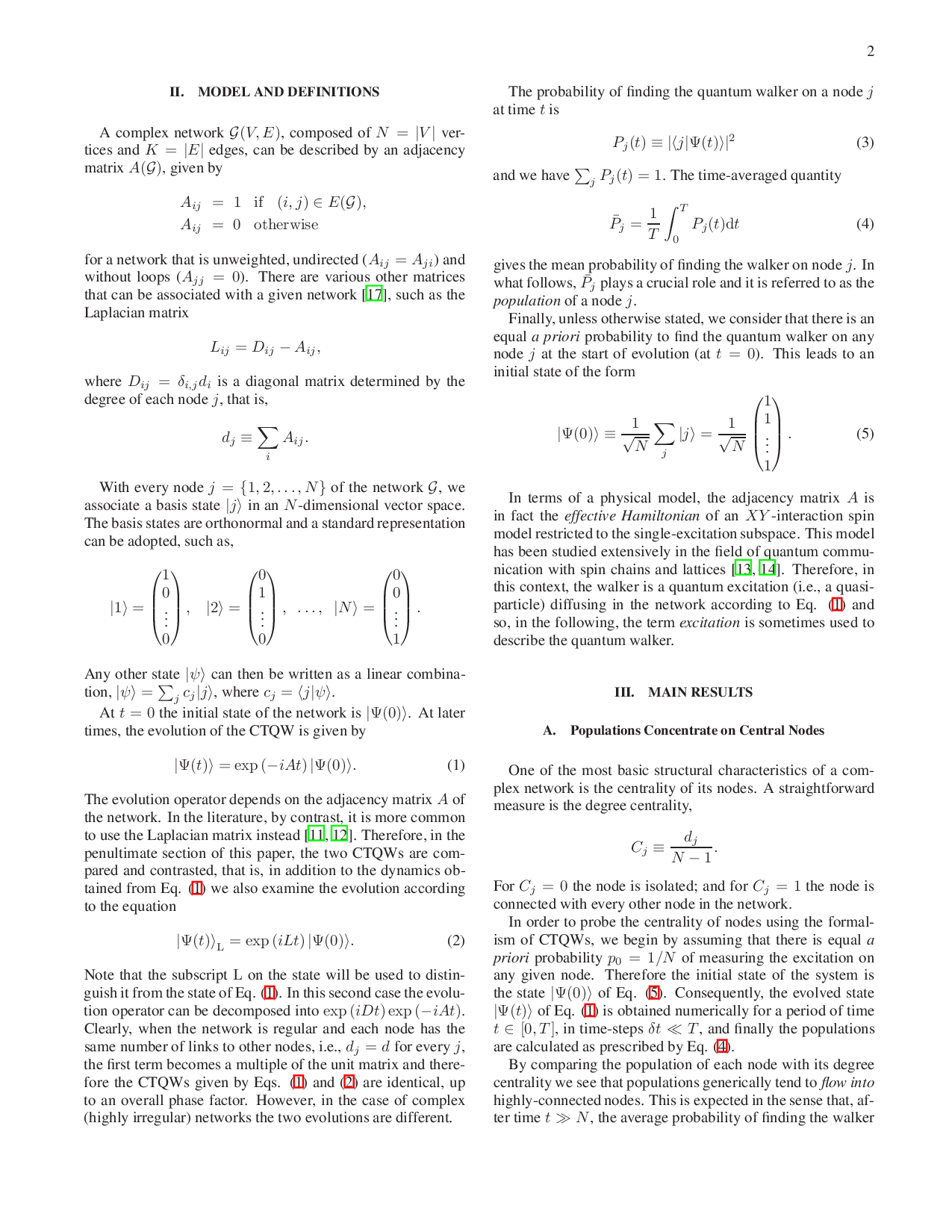
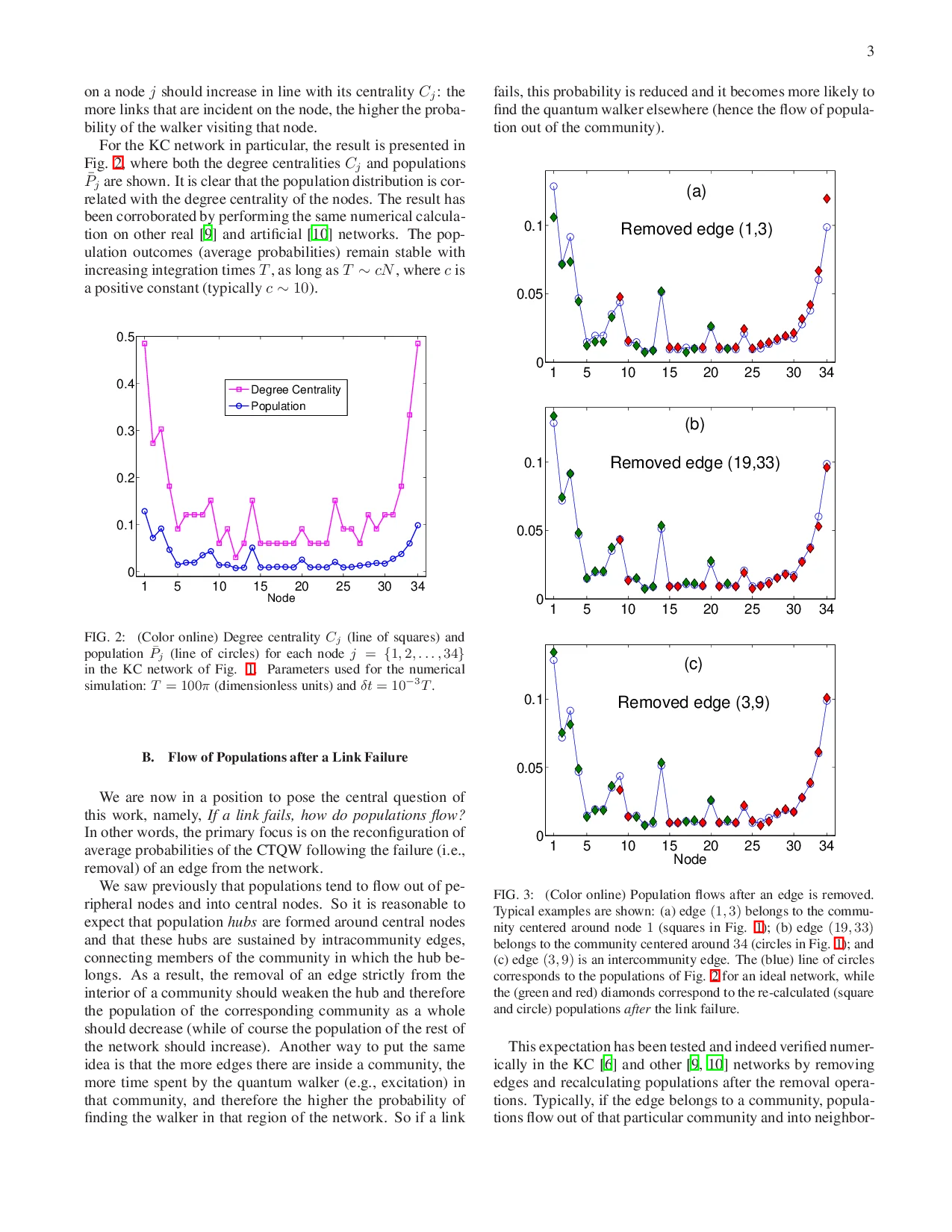
FIG. 1: (Color online) Community structure in the karate club (KC)
network [6] with N = 34 nodes. The two main communities, cen-
tered around nodes 1 and 34, are indicated by squares and circles,
respectively. Colors correspond to the various possible communities
in the network, including sub-communities. Reprinted from Ref. [7]
( c⃝2004, IOP Publishing and SISSA).
The rest of the paper is organized as follows. Sec. II in-
troduces the model and defines the essential quantities to be
used later on. Sec. III solves the model on the KC network
and on larger systems, and establishes the main result, which
can be quantified using the node affinity function, introduced
here precisely for this purpose. Sec. IV extends the anal-
ysis by comparing the behavior of the system with a differ-
ent type of quantum walk, in order to assess the robustness
in each case (in particular, CTQWs based on the adjacency
and Laplacian matrices of a given network are compared and
contrasted). Sec. V concludes with a summary of results,
comments on experimental implementation, and pot
…(Full text truncated)…
This content is AI-processed based on ArXiv data.